Ch. 7 - Transcendental Functions
Hass - Thomas' Calculus 15th Edition
Hass15th EditionThomas' CalculusISBN: 9780137616077당신이 사용하는 게 아니라요?교과서 변경
7장, 문제 7.6.7c

Use reference triangles in an appropriate quadrant to find the angles in Exercises 1–8.
7. c. arcsec(-2)

검증된 단계별 안내
1
Recall that the function \( \arcsec(x) \) is the inverse of the secant function, so \( \arcsec(-2) \) is the angle \( \theta \) such that \( \sec(\theta) = -2 \).
Since \( \sec(\theta) = \frac{1}{\cos(\theta)} \), rewrite the equation as \( \frac{1}{\cos(\theta)} = -2 \), which implies \( \cos(\theta) = -\frac{1}{2} \).
Identify the quadrants where \( \cos(\theta) \) is negative. Cosine is negative in Quadrants II and III, so the angle \( \theta \) must lie in one of these quadrants.
Use a reference triangle to find the reference angle \( \alpha \) where \( \cos(\alpha) = \frac{1}{2} \). The reference angle \( \alpha \) corresponds to \( \frac{\pi}{3} \) (or 60 degrees).
Determine the actual angle \( \theta \) in the appropriate quadrant(s) by adjusting the reference angle: in Quadrant II, \( \theta = \pi - \alpha \); in Quadrant III, \( \theta = \pi + \alpha \). Since the principal value of \( \arcsec(x) \) is usually taken in \([0, \pi]\) excluding \( \frac{\pi}{2} \), select the angle in Quadrant II.

비슷한 문제에 대한 검증된 영상 답변:

이 영상 해법은 위 문제에 도움이 된다고 튜터들이 추천한 것입니다.
영상 길이:
1m
도움이 되었나요?

주요 개념

질문에 올바르게 답하기 위해 반드시 이해해야 하는 핵심 개념들은 다음과 같습니다.

Inverse Trigonometric Functions

Inverse trigonometric functions, like arcsec, return the angle whose trigonometric value matches the given input. For arcsec(x), it gives the angle whose secant is x. Understanding their domains and ranges is essential to find correct angle values.
추천 영상:
06:35
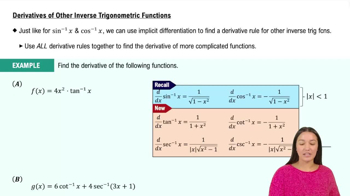
Derivatives of Other Inverse Trigonometric Functions

Reference Triangles and Quadrants

Reference triangles help relate trigonometric values to angles in different quadrants. Knowing the sign of the trigonometric function in each quadrant allows you to determine the correct angle corresponding to a given value, especially when the input is negative.
추천 영상:
5:30
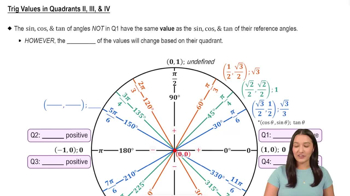
Trig Values in Quadrants II, III, & IV

Secant Function and Its Properties

The secant function is the reciprocal of cosine, sec(θ) = 1/cos(θ). Recognizing this relationship helps in constructing reference triangles and understanding the behavior of arcsec, including its domain (|x| ≥ 1) and how to find angles from secant values.
추천 영상:
가이드 코스
06:21
Properties of Functions