Ch. 7 - Transcendental Functions
Hass - Thomas' Calculus 15th Edition
Hass15th EditionThomas' CalculusISBN: 9780137616077당신이 사용하는 게 아니라요?교과서 변경
7장, 문제 7.3.95

Evaluate the integrals in Exercises 87–96.
95. ∫₂⁴ x^(2x) (1 + ln x) dx

검증된 단계별 안내
1
Recognize that the integrand is of the form \(x^{2x} (1 + \ln x)\), which suggests a function multiplied by its derivative or a derivative of a product involving \(x^{2x}\).
Rewrite the integrand by expressing \(x^{2x}\) in terms of the exponential function: \(x^{2x} = e^{2x \ln x}\).
Differentiate \(x^{2x}\) with respect to \(x\) using the chain rule: \(\frac{d}{dx} x^{2x} = \frac{d}{dx} e^{2x \ln x} = e^{2x \ln x} \cdot \frac{d}{dx} (2x \ln x)\).
Calculate \(\frac{d}{dx} (2x \ln x)\) using the product rule: \(\frac{d}{dx} (2x \ln x) = 2 \ln x + 2\).
Notice that the integrand \(x^{2x} (1 + \ln x)\) matches \(\frac{1}{2} \frac{d}{dx} x^{2x}\), so rewrite the integral accordingly and integrate by reversing the differentiation.

비슷한 문제에 대한 검증된 영상 답변:

이 영상 해법은 위 문제에 도움이 된다고 튜터들이 추천한 것입니다.
영상 길이:
5m
도움이 되었나요?

주요 개념

질문에 올바르게 답하기 위해 반드시 이해해야 하는 핵심 개념들은 다음과 같습니다.

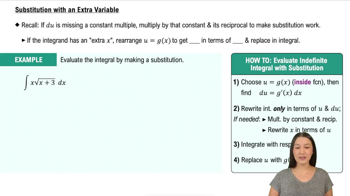
Integration by Substitution

Integration by substitution is a technique used to simplify integrals by changing variables. It involves identifying a part of the integrand as a new variable, which transforms the integral into a simpler form. This method is especially useful when the integral contains a function and its derivative.
추천 영상:
04:27
Substitution With an Extra Variable

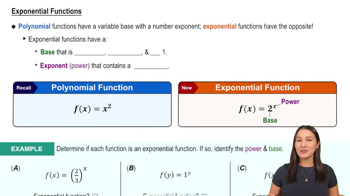
Differentiation of Exponential Functions with Variable Exponents

Functions like x^(2x) involve variable exponents, which require logarithmic differentiation to handle. Understanding how to differentiate and integrate such functions is crucial, as they combine polynomial and exponential behaviors. Recognizing the derivative of the exponent helps in integration.
추천 영상:
6:13
Exponential Functions

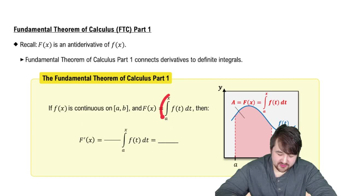
Fundamental Theorem of Calculus

The Fundamental Theorem of Calculus links differentiation and integration, allowing evaluation of definite integrals using antiderivatives. After finding an antiderivative of the integrand, you compute its values at the upper and lower limits and subtract to find the integral's value.
추천 영상:
06:11
Fundamental Theorem of Calculus Part 1