Ch. 7 - Transcendental Functions
Hass - Thomas' Calculus 15th Edition
Hass15th EditionThomas' CalculusISBN: 9780137616077당신이 사용하는 게 아니라요?교과서 변경
7장, 문제 7.3.122

In Exercises 115–126, use logarithmic differentiation or the method in Example 6 to find the derivative of y with respect to the given independent variable.
122. y = (ln x)^(ln x)

검증된 단계별 안내
1
Recognize that the function is of the form \(y = (\ln x)^{\ln x}\), which is a variable base raised to a variable exponent. This is a perfect candidate for logarithmic differentiation.
Take the natural logarithm of both sides to simplify the expression: \(\ln y = \ln \left( (\ln x)^{\ln x} \right)\).
Use the logarithm power rule to bring down the exponent: \(\ln y = (\ln x) \cdot \ln (\ln x)\).
Differentiate both sides with respect to \(x\). Remember to use implicit differentiation on the left side and the product rule on the right side: \(\frac{1}{y} \frac{dy}{dx} = \frac{d}{dx} \left( (\ln x) \cdot \ln (\ln x) \right)\).
Apply the product rule to the right side: \(\frac{d}{dx} (\ln x) \cdot \ln (\ln x) + (\ln x) \cdot \frac{d}{dx} \ln (\ln x)\). Then find each derivative separately using the chain rule, and finally multiply both sides by \(y\) to solve for \(\frac{dy}{dx}\).

비슷한 문제에 대한 검증된 영상 답변:

이 영상 해법은 위 문제에 도움이 된다고 튜터들이 추천한 것입니다.
영상 길이:
5m
도움이 되었나요?

주요 개념

질문에 올바르게 답하기 위해 반드시 이해해야 하는 핵심 개념들은 다음과 같습니다.

Logarithmic Differentiation

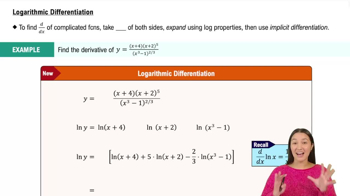
Logarithmic differentiation is a technique used to differentiate functions where both the base and the exponent are variable expressions. By taking the natural logarithm of both sides, the function is transformed into a product or sum, simplifying differentiation using the chain and product rules.
추천 영상:
06:30
Logarithmic Differentiation

Properties of Logarithms

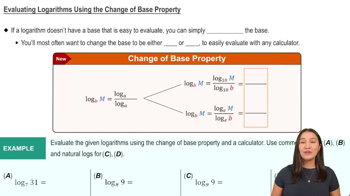
Understanding logarithm properties, such as ln(a^b) = b ln(a), is essential for rewriting complex expressions. These properties allow the exponent to be brought down as a multiplier, making differentiation more straightforward when dealing with functions like (ln x)^(ln x).
추천 영상:
05:36
Change of Base Property

Chain Rule and Product Rule

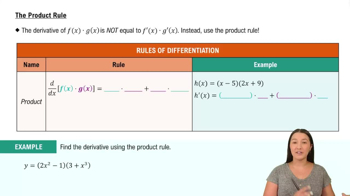
The chain rule is used to differentiate composite functions, while the product rule applies when differentiating products of functions. In logarithmic differentiation, after applying logarithms, these rules are often combined to find the derivative of the transformed expression.
추천 영상:
05:18
The Product Rule
관련 실천
교과서 질문

Since the hyperbolic functions can be expressed in terms of exponential functions, it is possible to express the inverse hyperbolic functions in terms of logarithms, as shown in the following table.

sinh⁻¹x = ln(x + √(x² + 1)), -∞ < x < ∞

cosh⁻¹x = ln(x + √(x² - 1)), x ≥ 1

tanh⁻¹x = (1/2)ln((1+x)/(1-x)), |x| < 1

sech⁻¹x = ln((1+√(1-x²))/x), 0 < x ≤ 1

csch⁻¹x = ln(1/x + √(1+x²)/|x|), x ≠ 1

coth⁻¹x = (1/2)ln((x+1)/(x-1)), |x| > 1

Use these formulas to express the numbers in Exercises 61–66 in terms of natural logarithms.

63. tanh⁻¹(-1/2)

35
views
교과서 질문

130. Where does the periodic function f(x) = 2e^(sin(x/2)) take on its extreme values, and what are these values?

18
views
교과서 질문

25. First-order chemical reactions In some chemical reactions, the rate at which the amount of a substance changes with time is proportional to the amount present. For the change of δ-gluconolactone into gluconic acid, for example,

dy/dt = -0.6y

when t is measured in hours. If there are 100 grams of δ-gluconolactone present when t=0, how many grams will be left after the first hour?

55
views
교과서 질문

In Exercises 25–36, find the derivative of y with respect to the appropriate variable.

31. y = cos⁻¹(x) - x sech⁻¹(x)

25
views
교과서 질문

Evaluate the integrals in Exercises 91–102.

102. ∫(from -1/3 to 1/√3)(cos(arctan 3x))/(1+9x²) dx

32
views
교과서 질문

In Exercises 57–70, use logarithmic differentiation to find the derivative of y with respect to the given independent variable.

66. y = θsin(θ)/√(sec(θ))

40
views