
Ch. 7 - Transcendental Functions
Hass - Thomas' Calculus 15th Edition
Hass15th EditionThomas' CalculusISBN: 9780137616077당신이 사용하는 게 아니라요?교과서 변경
7장, 문제 7.3.57

Solve the initial value problems in Exercises 55–58.


57. d²y/dx² = 2e^(−x),y(0) = 1,y′(0) = 0

검증된 단계별 안내
1
Identify the given differential equation and initial conditions: \( \frac{d^{2}y}{dx^{2}} = 2e^{-x} \), with \( y(0) = 1 \) and \( y'(0) = 0 \).
Integrate the second derivative \( \frac{d^{2}y}{dx^{2}} \) once with respect to \( x \) to find the first derivative \( y'(x) \). This gives \( y'(x) = \int 2e^{-x} \, dx + C_1 \), where \( C_1 \) is a constant of integration.
Perform the integration \( \int 2e^{-x} \, dx \) by recalling that \( \int e^{ax} \, dx = \frac{1}{a} e^{ax} + C \). Substitute the result back to express \( y'(x) \) including the constant \( C_1 \).
Integrate \( y'(x) \) with respect to \( x \) to find \( y(x) \). This will introduce another constant of integration \( C_2 \). So, \( y(x) = \int y'(x) \, dx = \int (\text{expression from previous step}) \, dx + C_2 \).
Use the initial conditions \( y(0) = 1 \) and \( y'(0) = 0 \) to set up equations and solve for the constants \( C_1 \) and \( C_2 \). Substitute these constants back into the expression for \( y(x) \) to get the particular solution.

비슷한 문제에 대한 검증된 영상 답변:

이 영상 해법은 위 문제에 도움이 된다고 튜터들이 추천한 것입니다.
영상 길이:
6m
도움이 되었나요?

주요 개념

질문에 올바르게 답하기 위해 반드시 이해해야 하는 핵심 개념들은 다음과 같습니다.

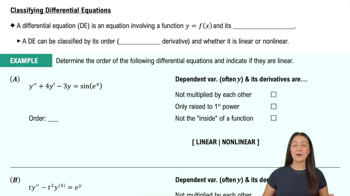
Second-Order Differential Equations

A second-order differential equation involves the second derivative of an unknown function. Solving it requires finding a function y(x) whose second derivative matches the given expression. The general solution often includes two arbitrary constants, reflecting the equation's order.
추천 영상:
07:39
Classifying Differential Equations

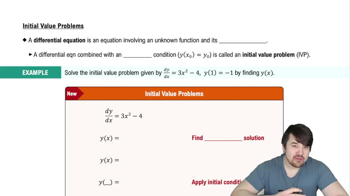
Initial Conditions and Initial Value Problems

Initial conditions specify the values of a function and its derivatives at a particular point, allowing determination of the arbitrary constants in the general solution. An initial value problem combines a differential equation with these conditions to find a unique solution.
추천 영상:
가이드 코스
05:03
Initial Value Problems

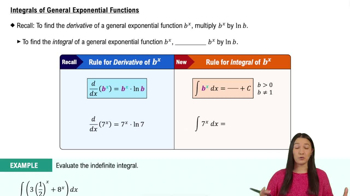
Integration of Exponential Functions

Solving the differential equation involves integrating the right-hand side function, here an exponential function e^(−x). Understanding how to integrate exponentials and apply constants of integration is essential to find the general solution before applying initial conditions.
추천 영상:
05:11
Integrals of General Exponential Functions
관련 실천
교과서 질문

Since the hyperbolic functions can be expressed in terms of exponential functions, it is possible to express the inverse hyperbolic functions in terms of logarithms, as shown in the following table.

sinh⁻¹x = ln(x + √(x² + 1)), -∞ < x < ∞

cosh⁻¹x = ln(x + √(x² - 1)), x ≥ 1

tanh⁻¹x = (1/2)ln((1+x)/(1-x)), |x| < 1

sech⁻¹x = ln((1+√(1-x²))/x), 0 < x ≤ 1

csch⁻¹x = ln(1/x + √(1+x²)/|x|), x ≠ 1

coth⁻¹x = (1/2)ln((x+1)/(x-1)), |x| > 1

Use these formulas to express the numbers in Exercises 61–66 in terms of natural logarithms.

63. tanh⁻¹(-1/2)

35
views
교과서 질문

25. First-order chemical reactions In some chemical reactions, the rate at which the amount of a substance changes with time is proportional to the amount present. For the change of δ-gluconolactone into gluconic acid, for example,

dy/dt = -0.6y

when t is measured in hours. If there are 100 grams of δ-gluconolactone present when t=0, how many grams will be left after the first hour?

55
views
교과서 질문

130. Use the identity arccot(u)=π/2 - arctan(u) to derive the formula for the derivative of arccot(u) in Table 7.4 from the formula for the derivative of arctan(u).

32
views
교과서 질문

Evaluate the integrals in Exercises 91–102.

102. ∫(from -1/3 to 1/√3)(cos(arctan 3x))/(1+9x²) dx

32
views
교과서 질문

In Exercises 115–126, use logarithmic differentiation or the method in Example 6 to find the derivative of y with respect to the given independent variable.

122. y = (ln x)^(ln x)

29
views
교과서 질문

In Exercises 57–70, use logarithmic differentiation to find the derivative of y with respect to the given independent variable.

66. y = θsin(θ)/√(sec(θ))

40
views