Ch. 7 - Transcendental Functions
Hass - Thomas' Calculus 15th Edition
Hass15th EditionThomas' CalculusISBN: 9780137616077당신이 사용하는 게 아니라요?교과서 변경
7장, 문제 7.2.16

In Exercises 7–38, find the derivative of y with respect to x, t, or θ, as appropriate.
16. y = (ln x)³

검증된 단계별 안내
1
Identify the function given: \(y = (\ln x)^3\). This is a composite function where the outer function is \(u^3\) and the inner function is \(u = \ln x\).
Apply the chain rule for differentiation, which states that if \(y = f(g(x))\), then \(\frac{dy}{dx} = f'(g(x)) \cdot g'(x)\).
Differentiate the outer function \(u^3\) with respect to \(u\): \(\frac{d}{du}(u^3) = 3u^2\).
Differentiate the inner function \(u = \ln x\) with respect to \(x\): \(\frac{d}{dx}(\ln x) = \frac{1}{x}\).
Combine the results using the chain rule: \(\frac{dy}{dx} = 3(\ln x)^2 \cdot \frac{1}{x}\).

비슷한 문제에 대한 검증된 영상 답변:

이 영상 해법은 위 문제에 도움이 된다고 튜터들이 추천한 것입니다.
영상 길이:
2m

주요 개념

질문에 올바르게 답하기 위해 반드시 이해해야 하는 핵심 개념들은 다음과 같습니다.

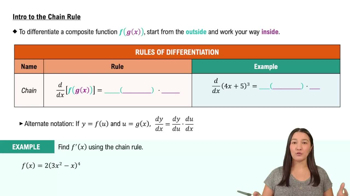
Chain Rule

The chain rule is used to differentiate composite functions. It states that the derivative of a function composed of another function is the derivative of the outer function evaluated at the inner function times the derivative of the inner function. For example, if y = (ln x)³, treat (ln x) as the inner function and cube as the outer function.
추천 영상:
05:02
Intro to the Chain Rule

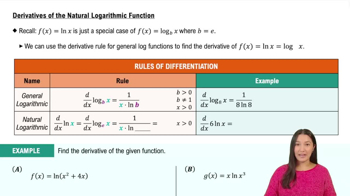
Derivative of the Natural Logarithm Function

The derivative of ln x with respect to x is 1/x. This is fundamental when differentiating expressions involving logarithms. Knowing this allows you to find the derivative of functions like (ln x)³ by applying the chain rule.
추천 영상:
05:18
Derivative of the Natural Logarithmic Function

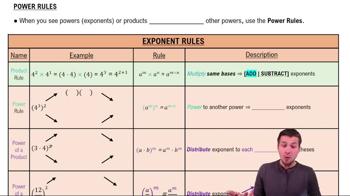
Power Rule

The power rule states that the derivative of xⁿ is n*xⁿ⁻¹. When differentiating (ln x)³, the power rule applies to the outer function (raising to the third power), which helps simplify the differentiation process when combined with the chain rule.
추천 영상:
5:50
Power Rules