Ch. 7 - Transcendental Functions
Hass - Thomas' Calculus 15th Edition
Hass15th EditionThomas' CalculusISBN: 9780137616077당신이 사용하는 게 아니라요?교과서 변경
7장, 문제 7.5.30

Use l’Hôpital’s rule to find the limits in Exercises 7–52.
30. lim (θ → 0) ((1/2)^θ - 1) / θ

검증된 단계별 안내
1
Identify the limit expression: \(\lim_{\theta \to 0} \frac{(\frac{1}{2})^{\theta} - 1}{\theta}\).
Check the form of the limit by substituting \(\theta = 0\): the numerator becomes \((\frac{1}{2})^0 - 1 = 1 - 1 = 0\) and the denominator is \(0\), so the limit is of the indeterminate form \(\frac{0}{0}\).
Since the limit is of the form \(\frac{0}{0}\), apply l'Hôpital's Rule, which states that \(\lim_{x \to a} \frac{f(x)}{g(x)} = \lim_{x \to a} \frac{f'(x)}{g'(x)}\) if the original limit is indeterminate.
Differentiate the numerator and denominator separately with respect to \(\theta\): the derivative of the numerator \(f(\theta) = (\frac{1}{2})^{\theta} - 1\) is \(f'(\theta) = (\frac{1}{2})^{\theta} \ln(\frac{1}{2})\), and the derivative of the denominator \(g(\theta) = \theta\) is \(g'(\theta) = 1\).
Rewrite the limit using these derivatives: \(\lim_{\theta \to 0} \frac{(\frac{1}{2})^{\theta} \ln(\frac{1}{2})}{1}\), then evaluate this limit by substituting \(\theta = 0\).

비슷한 문제에 대한 검증된 영상 답변:

이 영상 해법은 위 문제에 도움이 된다고 튜터들이 추천한 것입니다.
영상 길이:
2m
도움이 되었나요?

주요 개념

질문에 올바르게 답하기 위해 반드시 이해해야 하는 핵심 개념들은 다음과 같습니다.

Limits and Indeterminate Forms

Limits describe the behavior of a function as the input approaches a certain value. When direct substitution results in forms like 0/0 or ∞/∞, these are called indeterminate forms, requiring special techniques such as l’Hôpital’s rule to evaluate the limit.
추천 영상:
05:50
One-Sided Limits

l’Hôpital’s Rule

l’Hôpital’s rule is a method for evaluating limits that yield indeterminate forms 0/0 or ∞/∞ by differentiating the numerator and denominator separately and then taking the limit of their quotient. It simplifies complex limits involving functions that are difficult to evaluate directly.
추천 영상:
5:50
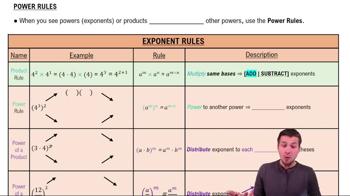
Power Rules

Exponential and Logarithmic Functions

Understanding the behavior and derivatives of exponential functions, such as (1/2)^θ, is essential. These functions can be rewritten using logarithms to facilitate differentiation, which is crucial when applying l’Hôpital’s rule to limits involving exponential expressions.
추천 영상:
06:32
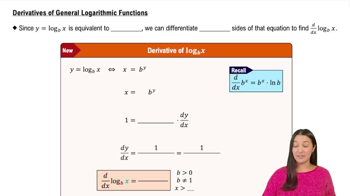
Derivatives of General Logarithmic Functions