Ch. 7 - Transcendental Functions
Hass - Thomas' Calculus 15th Edition
Hass15th EditionThomas' CalculusISBN: 9780137616077당신이 사용하는 게 아니라요?교과서 변경
7장, 문제 7.2.29

In Exercises 7–38, find the derivative of y with respect to x, t, or θ, as appropriate.
29. y = ln(1/(x√(x+1)))

검증된 단계별 안내
1
Rewrite the function to simplify differentiation. Given \( y = \ln\left( \frac{1}{x\sqrt{x+1}} \right) \), express it as \( y = \ln(1) - \ln\left(x\sqrt{x+1}\right) \). Since \( \ln(1) = 0 \), this simplifies to \( y = -\ln\left(x\sqrt{x+1}\right) \).
Use the property of logarithms to separate the terms inside the logarithm: \( \ln\left(x\sqrt{x+1}\right) = \ln(x) + \ln\left( (x+1)^{1/2} \right) = \ln(x) + \frac{1}{2} \ln(x+1) \). So, \( y = -\left( \ln(x) + \frac{1}{2} \ln(x+1) \right) \).
Differentiate \( y \) with respect to \( x \) by applying the derivative of logarithmic functions: \( \frac{d}{dx} \ln(x) = \frac{1}{x} \) and \( \frac{d}{dx} \ln(x+1) = \frac{1}{x+1} \).
Apply the chain rule and linearity of differentiation: \( \frac{dy}{dx} = -\left( \frac{1}{x} + \frac{1}{2} \cdot \frac{1}{x+1} \right) \).
Combine the terms to write the derivative as a single expression, if desired, by finding a common denominator or leaving it as a sum of fractions.

비슷한 문제에 대한 검증된 영상 답변:

이 영상 해법은 위 문제에 도움이 된다고 튜터들이 추천한 것입니다.
영상 길이:
4m

주요 개념

질문에 올바르게 답하기 위해 반드시 이해해야 하는 핵심 개념들은 다음과 같습니다.

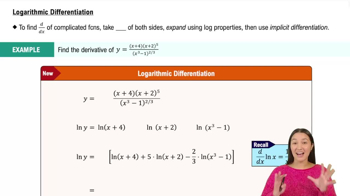
Logarithmic Differentiation

Logarithmic differentiation involves applying the properties of logarithms to simplify the differentiation of complex functions, especially those involving products, quotients, or powers. It allows rewriting the function as a sum or difference of simpler logarithmic terms, making the derivative easier to find.
추천 영상:
06:30
Logarithmic Differentiation

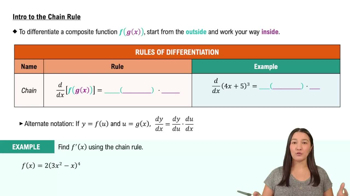
Chain Rule

The chain rule is a fundamental differentiation technique used when dealing with composite functions. It states that the derivative of a composite function is the derivative of the outer function evaluated at the inner function times the derivative of the inner function.
추천 영상:
05:02
Intro to the Chain Rule

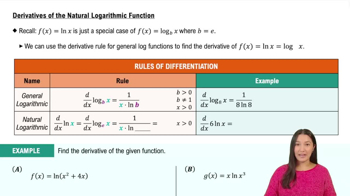
Derivative of Logarithmic Functions

The derivative of the natural logarithm function ln(u) with respect to x is (1/u) times the derivative of u. This rule is essential when differentiating functions expressed as logarithms, especially after simplifying the original function using logarithmic properties.
추천 영상:
05:18
Derivative of the Natural Logarithmic Function