Ch. 7 - Transcendental Functions
Hass - Thomas' Calculus 15th Edition
Hass15th EditionThomas' CalculusISBN: 9780137616077당신이 사용하는 게 아니라요?교과서 변경
7장, 문제 7.4.15

Solve the differential equation in Exercises 9–22.
15. √x (dy/dx) = e^(y+√x), x > 0

검증된 단계별 안내
1
Rewrite the given differential equation to isolate \( \frac{dy}{dx} \): \[ \sqrt{x} \frac{dy}{dx} = e^{y + \sqrt{x}} \implies \frac{dy}{dx} = \frac{e^{y + \sqrt{x}}}{\sqrt{x}} \].
Express the right-hand side as a product of exponentials to separate variables more easily: \[ \frac{dy}{dx} = \frac{e^y \cdot e^{\sqrt{x}}}{\sqrt{x}}. \]
Rewrite the equation in differential form to separate variables \( y \) and \( x \): \[ \frac{dy}{e^y} = \frac{e^{\sqrt{x}}}{\sqrt{x}} dx. \]
Integrate both sides: \[ \int \frac{1}{e^y} dy = \int \frac{e^{\sqrt{x}}}{\sqrt{x}} dx. \] The left integral simplifies to \( \int e^{-y} dy \).
For the right integral, use substitution: let \( t = \sqrt{x} \), so \( x = t^2 \) and \( dx = 2t dt \). Substitute and simplify the integral accordingly before integrating.

비슷한 문제에 대한 검증된 영상 답변:

이 영상 해법은 위 문제에 도움이 된다고 튜터들이 추천한 것입니다.
영상 길이:
6m
도움이 되었나요?

주요 개념

질문에 올바르게 답하기 위해 반드시 이해해야 하는 핵심 개념들은 다음과 같습니다.

Separable Differential Equations

A separable differential equation can be written so that all terms involving y are on one side and all terms involving x are on the other. This allows integration of each side independently. Recognizing separability is key to solving equations like √x (dy/dx) = e^(y+√x).
추천 영상:
06:06
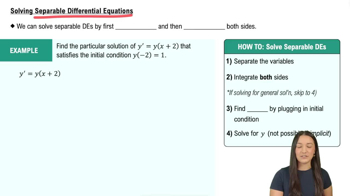
Solving Separable Differential Equations

Integration Techniques

Solving separable equations requires integrating functions of x and y separately. Familiarity with integrating exponential functions and substitutions, such as u = √x, helps simplify the integrals and find the general solution.
추천 영상:
06:18
Integration by Parts for Definite Integrals

Implicit and Explicit Solutions

After integration, solutions may be implicit or explicit. Understanding how to manipulate and interpret these forms is important, especially when the solution involves expressions like e^(y+√x), which may require logarithmic manipulation to isolate y.
추천 영상:
05:14
Finding The Implicit Derivative