
Ch. 7 - Transcendental Functions
Hass - Thomas' Calculus 15th Edition
Hass15th EditionThomas' CalculusISBN: 9780137616077당신이 사용하는 게 아니라요?교과서 변경
7장, 문제 7.6.1c

Use reference triangles in an appropriate quadrant to find the angles in Exercises 1–8.
1. c. tan^(-1)(1/√3)

검증된 단계별 안내
1
Identify the value inside the inverse tangent function: here it is \(\frac{1}{\sqrt{3}}\).
Recall that \(\tan \theta = \frac{\text{opposite}}{\text{adjacent}}\) in a right triangle, so we want to find an angle \(\theta\) such that \(\tan \theta = \frac{1}{\sqrt{3}}\).
Recognize the common special angle where \(\tan \theta = \frac{1}{\sqrt{3}}\) is \(\theta = 30^\circ\) or \(\theta = \frac{\pi}{6}\) radians, based on the reference triangle with sides 1 (opposite), \(\sqrt{3}\) (adjacent), and 2 (hypotenuse).
Since the problem asks to use reference triangles in an appropriate quadrant, consider the principal value range of \(\tan^{-1}\), which is \(\left(-\frac{\pi}{2}, \frac{\pi}{2}\right)\), so the angle is in the first quadrant where tangent is positive.
Conclude that the angle corresponding to \(\tan^{-1}\left(\frac{1}{\sqrt{3}}\right)\) is the reference angle \(\frac{\pi}{6}\) radians (or \(30^\circ\)) in the first quadrant.

비슷한 문제에 대한 검증된 영상 답변:

이 영상 해법은 위 문제에 도움이 된다고 튜터들이 추천한 것입니다.
영상 길이:
1m

주요 개념

질문에 올바르게 답하기 위해 반드시 이해해야 하는 핵심 개념들은 다음과 같습니다.

Inverse Tangent Function (arctan)

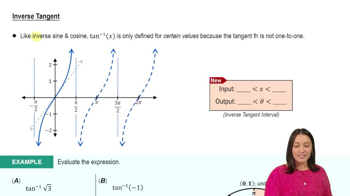
The inverse tangent function, arctan or tan⁻¹, returns the angle whose tangent is a given value. It is used to find an angle when the ratio of the opposite side to the adjacent side in a right triangle is known. The output angle is typically in the range (-π/2, π/2) or (-90°, 90°).
추천 영상:
3:17
Inverse Tangent

Reference Triangles

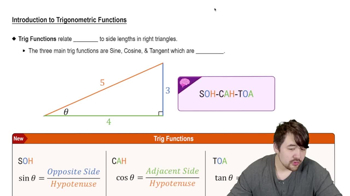
Reference triangles are right triangles drawn in a coordinate plane to help find angles and trigonometric values in different quadrants. By using the acute angle in the triangle and the signs of trigonometric functions in each quadrant, one can determine the actual angle measure.
추천 영상:
가이드 코스
6:04
Introduction to Trigonometric Functions

Quadrants and Sign of Trigonometric Functions

The coordinate plane is divided into four quadrants, each affecting the sign of sine, cosine, and tangent functions. Knowing the quadrant helps determine the correct angle corresponding to a trigonometric value, especially when using inverse functions that have restricted ranges.
추천 영상:
가이드 코스
6:04
Introduction to Trigonometric Functions
관련 실천
교과서 질문

In Exercises 67–72, you will explore some functions and their inverses together with their derivatives and tangent line approximations at specified points. Perform the following steps using your CAS:


c. Find the equation for the tangent line to f at the specified point (x_0, f(x_0)).


70. y= x³/(x²+1), -1 ≤ x ≤ 1, x_0=1/2

16
views
교과서 질문

9. True, or false? As x→∞,

c. x = O(x+5)

29
views
교과서 질문

c. Find the slopes of the tangent lines to the graphs of f and g at (1, 1) and (−1, −1) (four tangent lines in all).

34
views
교과서 질문

In Exercises 67–72, you will explore some functions and their inverses together with their derivatives and tangent line approximations at specified points. Perform the following steps using your CAS:

c. Find the equation for the tangent line to f at the specified point (x_0, f(x_0)).

68. y= (3x+2)/(2x-11), -2 ≤ x ≤ 2, x_0=1/2

24
views
교과서 질문

In Exercises 67–72, you will explore some functions and their inverses together with their derivatives and tangent line approximations at specified points. Perform the following steps using your CAS:


c. Find the equation for the tangent line to f at the specified point (x_0, f(x_0)).


72. y= 2-x-x³, -2 ≤ x ≤ 2, x_0 = 3/2


15
views
교과서 질문

23. Human evolution continues The analysis of tooth shrinkage by C. Loring Brace and colleagues at the University of Michigan’s Museum of Anthropology indicates that human tooth size is continuing to decrease and that the evolutionary process has not yet come to a halt. In northern Europeans, for example, tooth size reduction now has a rate of 1% per 1000 years.

c. What will be our descendants’ tooth size 20,000 years from now (as a percentage of our present tooth size)?

6
views