Ch. 9 - First-Order Differential Equations
Hass - Thomas' Calculus 15th Edition
Hass15th EditionThomas' CalculusISBN: 9780137616077당신이 사용하는 게 아니라요?교과서 변경
9장, 문제 9.2.11

First-Order Linear Equations
Solve the differential equations in Exercises 1–14.


(t-1)³ ds/dt + 4(t-1)²s = t+1, t >1

검증된 단계별 안내
1
Rewrite the given differential equation in the standard linear form. Start by dividing both sides of the equation by \( (t-1)^3 \) to isolate \( \frac{ds}{dt} \). This gives: \( \frac{ds}{dt} + \frac{4}{t-1} s = \frac{t+1}{(t-1)^3} \)
Identify the integrating factor \( \mu(t) \) for the linear differential equation. Recall that the integrating factor is given by: \( \mu(t) = e^{\int P(t) dt} \) where \( P(t) \) is the coefficient of \( s \) in the standard form. Here, \( P(t) = \frac{4}{t-1} \).
Calculate the integrating factor: \( \mu(t) = e^{\int \frac{4}{t-1} dt} = e^{4 \ln|t-1|} = |t-1|^4 \). Since \( t > 1 \), we can write \( \mu(t) = (t-1)^4 \).
Multiply the entire differential equation by the integrating factor \( (t-1)^4 \) to make the left side an exact derivative: \( (t-1)^4 \frac{ds}{dt} + 4 (t-1)^3 s = (t-1)^4 \cdot \frac{t+1}{(t-1)^3} \) which simplifies to: \( \frac{d}{dt} \left[ (t-1)^4 s \right] = (t-1)(t+1) \)
Integrate both sides with respect to \( t \): \( \int \frac{d}{dt} \left[ (t-1)^4 s \right] dt = \int (t-1)(t+1) dt \) This will give you an expression for \( (t-1)^4 s \) plus a constant of integration. Finally, solve for \( s(t) \) by dividing both sides by \( (t-1)^4 \).

비슷한 문제에 대한 검증된 영상 답변:

이 영상 해법은 위 문제에 도움이 된다고 튜터들이 추천한 것입니다.
영상 길이:
6m
도움이 되었나요?

주요 개념

질문에 올바르게 답하기 위해 반드시 이해해야 하는 핵심 개념들은 다음과 같습니다.

First-Order Linear Differential Equations

These are differential equations of the form dy/dt + P(t)y = Q(t), where the highest derivative is first order and the equation is linear in the unknown function y. Understanding this form allows the use of integrating factors to find explicit solutions.
추천 영상:
07:39
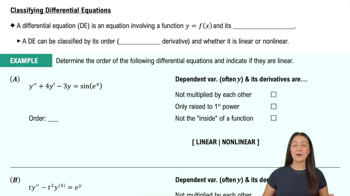
Classifying Differential Equations

Integrating Factor Method

This technique involves multiplying the entire differential equation by an integrating factor, usually e^(∫P(t)dt), to rewrite the left side as the derivative of a product. This simplifies solving the equation by enabling direct integration.
추천 영상:
07:33
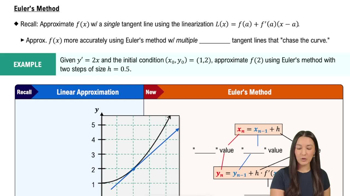
Euler's Method

Domain and Continuity Conditions

The problem specifies t > 1, which ensures the functions involved, like (t-1)³, are well-defined and nonzero. Recognizing the domain is crucial for applying the integrating factor method and ensuring the solution's validity.
추천 영상:
00:57
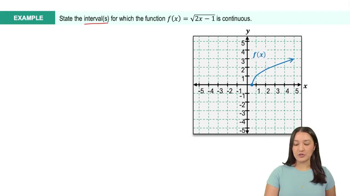
Intro to Continuity Example 2