Ch. 9 - First-Order Differential Equations
Hass - Thomas' Calculus 15th Edition
Hass15th EditionThomas' CalculusISBN: 9780137616077당신이 사용하는 게 아니라요?교과서 변경
9장, 문제 9.1.15

Using Euler’s Method
In Exercises 15–20, use Euler’s method to calculate the first three approximations to the given initial value problem for the specified increment size. Calculate the exact solution and investigate the accuracy of your approximations. Round your results to four decimal places.


y' = 2y/x, y(1) = -1, dx = 0.5

검증된 단계별 안내
1
Identify the differential equation and initial condition: \(y' = \frac{2y}{x}\) with \(y(1) = -1\). The step size is \(\Delta x = 0.5\).
Recall Euler's method formula: \(y_{n+1} = y_n + f(x_n, y_n) \Delta x\), where \(f(x, y) = \frac{2y}{x}\) is the derivative function.
Calculate the first approximation: starting at \(x_0 = 1\), \(y_0 = -1\), compute \(y_1 = y_0 + f(x_0, y_0) \Delta x = y_0 + \frac{2 y_0}{x_0} \times 0.5\).
Calculate the second approximation: update \(x_1 = x_0 + \Delta x\), then compute \(y_2 = y_1 + f(x_1, y_1) \Delta x = y_1 + \frac{2 y_1}{x_1} \times 0.5\).
Calculate the third approximation similarly: update \(x_2 = x_1 + \Delta x\), then compute \(y_3 = y_2 + f(x_2, y_2) \Delta x = y_2 + \frac{2 y_2}{x_2} \times 0.5\). After these, find the exact solution by solving the differential equation and compare the values to assess accuracy.

비슷한 문제에 대한 검증된 영상 답변:

이 영상 해법은 위 문제에 도움이 된다고 튜터들이 추천한 것입니다.
영상 길이:
7m
도움이 되었나요?

주요 개념

질문에 올바르게 답하기 위해 반드시 이해해야 하는 핵심 개념들은 다음과 같습니다.

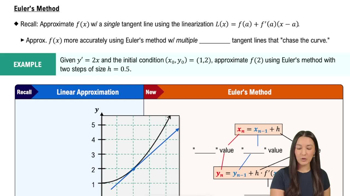
Euler's Method

Euler's Method is a numerical technique to approximate solutions of first-order differential equations. Starting from an initial point, it uses the slope given by the differential equation to estimate the next value by moving a small step size along the tangent. This iterative process provides approximate values of the solution at discrete points.
추천 영상:
07:33
Euler's Method

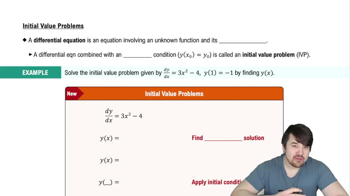
Initial Value Problem (IVP)

An Initial Value Problem specifies a differential equation along with a starting condition, or initial value, for the unknown function. The solution must satisfy both the differential equation and the initial condition, which anchors the solution curve at a specific point, enabling numerical or analytical methods to find the function.
추천 영상:
05:03
Initial Value Problems

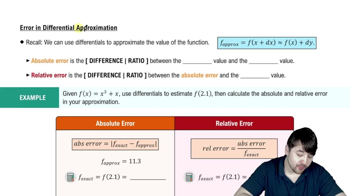
Exact Solution and Error Analysis

The exact solution is the precise function satisfying the differential equation and initial condition, often found analytically. Comparing Euler’s approximations to the exact solution helps assess the accuracy of the numerical method. Error analysis involves measuring the difference between approximate and exact values to understand the method’s reliability.
추천 영상:
04:57
Determining Error and Relative Error