

Ch. 9 - First-Order Differential Equations
Hass - Thomas' Calculus 15th Edition
Hass15th EditionThomas' CalculusISBN: 9780137616077당신이 사용하는 게 아니라요?교과서 변경
9장, 문제 9.2.8

First-Order Linear Equations
Solve the differential equations in Exercises 1–14.


e²ˣy' + 2e²ˣ y = 2x

검증된 단계별 안내
1
Rewrite the given differential equation in the standard linear form \(y' + P(x)y = Q(x)\). Start by dividing the entire equation by \(e^{2x}\) to isolate \(y'\):
\[y' + 2y = 2xe^{-2x}\]
Identify the integrating factor \(\mu(x)\), which is given by \(\mu(x) = e^{\int P(x) \, dx}\). Here, \(P(x) = 2\), so calculate:
\[\mu(x) = e^{\int 2 \, dx} = e^{2x}\]
Multiply both sides of the differential equation by the integrating factor \(e^{2x}\) to make the left side a product derivative:
\[e^{2x} y' + 2 e^{2x} y = 2x\]
Recognize that the left side is the derivative of \(e^{2x} y\), so write:
\[\frac{d}{dx} \left( e^{2x} y \right) = 2x\]
Integrate both sides with respect to \(x\) to find \(e^{2x} y\):
\[e^{2x} y = \int 2x \, dx + C\]

비슷한 문제에 대한 검증된 영상 답변:

이 영상 해법은 위 문제에 도움이 된다고 튜터들이 추천한 것입니다.
영상 길이:
2m
도움이 되었나요?

주요 개념

질문에 올바르게 답하기 위해 반드시 이해해야 하는 핵심 개념들은 다음과 같습니다.

First-Order Linear Differential Equations

These are differential equations of the form y' + P(x)y = Q(x), where y' is the first derivative of y. They can be solved using an integrating factor, which simplifies the equation into an exact derivative, allowing integration to find the solution.
추천 영상:
07:39
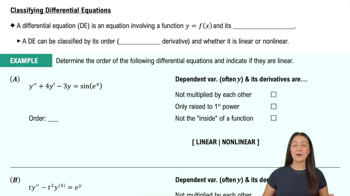
Classifying Differential Equations

Integrating Factor Method

The integrating factor is a function, usually denoted μ(x), defined as e^(∫P(x)dx). Multiplying the entire differential equation by μ(x) transforms it into a form where the left side is the derivative of μ(x)y, enabling straightforward integration to solve for y.
추천 영상:
07:33
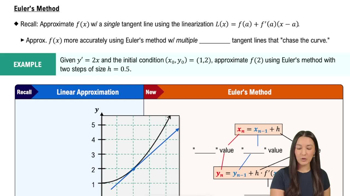
Euler's Method

Exponential Functions and Their Properties

Exponential functions like e^(2x) appear in the equation and integrating factor. Understanding their differentiation and integration properties is essential, as they often simplify the process of finding the integrating factor and solving the differential equation.
추천 영상:
가이드 코스
06:21
Properties of Functions
관련 실천
교과서 질문

Using Euler’s Method

In Exercises 15–20, use Euler’s method to calculate the first three approximations to the given initial value problem for the specified increment size. Calculate the exact solution and investigate the accuracy of your approximations. Round your results to four decimal places.


y' = 2y/x, y(1) = -1, dx = 0.5

25
views
교과서 질문

Sailing A sailboat is running along a straight course with the wind providing a constant forward force of 50 lb. The only other force acting on the boat is resistance as the boat moves through the water. The resisting force is numerically equal to five times the boat’s speed, and the initial velocity is 1 ft/sec. What is the maximum velocity in feet per second of the boat under this wind?

교과서 질문

Solving Initial Value Problems

Solve the initial value problems in Exercises 15–20.


dy/dx + xy = x, y(0) = -6

5
views
교과서 질문

Using Euler’s Method

In Exercises 15–20, use Euler’s method to calculate the first three approximations to the given initial value problem for the specified increment size. Calculate the exact solution and investigate the accuracy of your approximations. Round your results to four decimal places.


y' = y²(1+2x), (y-1) = 1, dx = 0.5

31
views
교과서 질문

Is either of the following equations correct? Give reasons for your answers.


a. (1/cosx) ∫ cos x dx = tan x + C

b. (1/cosx) ∫ cos x dx = tan x + C / cos x

25
views
교과서 질문

In Exercises 39–42, use Euler’s method with the specified step size to estimate the value of the solution at the given point x*. Find the value of the exact solution at x*.


y' = 1 + y², y(0) = 0, dx = 0.1, x* = 1

19
views