Skip to main content
Cell Biology
나의 코스
배우기
시험 준비
AI 튜터
학습 가이드
플래시카드
탐험해 보세요
앱을 사용해 보세요
나의 코스
배우기
시험 준비
AI 튜터
학습 가이드
플래시카드
탐험해 보세요
앱을 사용해 보세요
뒤로
Antibody Structure and Diversity quiz
카드를 뒤집기 위해 탭할 수 있습니다.
What is the basic structure of an antibody?
카드를 뒤집기 위해 탭할 수 있습니다.
👆
What is the basic structure of an antibody?
An antibody is Y-shaped and composed of two heavy chains and two light chains.
진행 상황 추적
컨트롤 버튼이 '내비게이션' 모드로 변경되었습니다.
1/15
관련 플래시카드
관련 실천
추천 영상
Antibody Structure and Diversity definitions
Antibody Structure and Diversity
16 용어
Antibody Structure and Diversity
21. The Immune System
7 문제점
주제
T Cells
21. The Immune System
7 문제점
주제
21. The Immune System - Part 1 of 2
4 주제
11 문제점
장
21. The Immune System - Part 2 of 2
4 주제
10 문제점
장
VideoThumbView.guidedCourse
06:12
Antibody Variation
208
views
6
rank
VideoThumbView.guidedCourse
06:11
Antibody Structure
284
views
5
rank
이 집합의 용어 (15)
하이드의 정의
What is the basic structure of an antibody?
An antibody is Y-shaped and composed of two heavy chains and two light chains.
Where are the antigen-binding sites located on an antibody?
The antigen-binding sites are located at the tips of the Y structure, involving both the heavy and light chains.
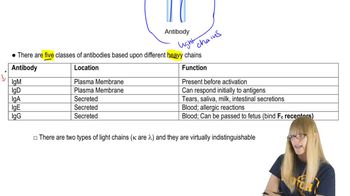
What are the five classes of antibodies based on?
The five classes are based on the type of heavy chain present: IgM, IgD, IgA, IgE, and IgG.
Which antibody classes are membrane-bound and not secreted?
IgM and IgD are membrane-bound and not secreted.
What is the main function of antibodies?
Antibodies mark pathogens for destruction by binding to specific antigens.
How do antibodies achieve high specificity for antigens?
They have variable regions in their light and heavy chains that are unique to each antibody, allowing specific antigen recognition.
What is VDJ recombination?
VDJ recombination is a process that shuffles variable (V), diversity (D), and joining (J) gene segments to create diverse antigen-binding sites.
Why can't the genome encode every possible antibody directly?
There isn't enough space in the genome to encode every possible antibody, so diversity is generated through recombination and mutation.
What is somatic hypermutation?
Somatic hypermutation is a process where mutations occur at a high rate in the variable regions of antibody genes in B cells, increasing diversity.
What is class switching in B cells?
Class switching is when a B cell changes the type of antibody it produces (e.g., from IgM to IgE) to adapt to different immune responses.
What regions are found on both the heavy and light chains of antibodies?
Both chains have constant regions (same within a class) and variable regions (unique to each antibody).
What are hypervariable regions in antibodies?
Hypervariable regions are small segments within the variable regions where the antigen makes most of its contacts, providing high specificity.
How many types of light chains exist, and are they functionally different?
There are two types of light chains, but they are virtually indistinguishable and functionally similar.
What type of bonds do antibodies use to bind antigens?
Antibodies bind antigens using non-covalent bonds.
What is the primary antibody repertoire, and which classes does it include?
The primary antibody repertoire consists of IgM and IgD, which are the first antibodies produced by B cells and are membrane-bound.
 뒤로뒤로
뒤로뒤로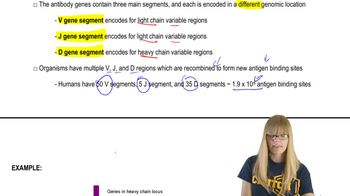
 06:12
06:12