Skip to main content
Cell Biology
나의 코스
배우기
시험 준비
AI 튜터
학습 가이드
플래시카드
탐험해 보세요
앱을 사용해 보세요
나의 코스
배우기
시험 준비
AI 튜터
학습 가이드
플래시카드
탐험해 보세요
앱을 사용해 보세요
뒤로
Cancer Treatment quiz
카드를 뒤집기 위해 탭할 수 있습니다.
What are the three main types of traditional cancer therapies?
카드를 뒤집기 위해 탭할 수 있습니다.
👆
What are the three main types of traditional cancer therapies?
The three main types are surgery, radiation, and chemotherapy.
진행 상황 추적
컨트롤 버튼이 '내비게이션' 모드로 변경되었습니다.
1/15
관련 플래시카드
관련 실천
추천 영상
Cancer Treatment definitions
Cancer Treatment
13 용어
Cancer Treatment
20. Cancer
7 문제점
주제
Metastasis and Cancer Spread
20. Cancer
7 문제점
주제
20. Cancer - Part 1 of 2
3 주제
9 문제점
장
20. Cancer - Part 2 of 2
3 주제
9 문제점
장
VideoThumbView.guidedCourse
04:05
Cancer Treatment
300
views
2
rank
이 집합의 용어 (15)
하이드의 정의
What are the three main types of traditional cancer therapies?
The three main types are surgery, radiation, and chemotherapy.
How does surgery treat cancer?
Surgery treats cancer by physically removing the tumor from the body.
What is the primary mechanism by which radiation and chemotherapy kill cancer cells?
Radiation and chemotherapy kill cancer cells by damaging their DNA, leading to cell death.
What is passive immunotherapy in cancer treatment?
Passive immunotherapy involves introducing antibodies that specifically target and kill tumor cells.
How does active immunotherapy differ from passive immunotherapy?
Active immunotherapy stimulates the patient's own immune system to attack the cancer, while passive immunotherapy provides antibodies directly.
What is the goal of anti-angiogenic therapies in cancer treatment?
Anti-angiogenic therapies aim to destroy the blood vessels that supply nutrients to tumors, inhibiting their growth.
What does molecular targeting in cancer therapy involve?
Molecular targeting uses drugs that specifically target cancer-causing genes or mutations in tumor cells.
Why is molecular targeting important in personalized medicine?
It allows treatments to be tailored to the specific genetic mutations present in an individual's tumor.
What is multi-drug resistance (MDR) in cancer cells?
Multi-drug resistance is when cancer cells become insensitive to multiple treatments, even those they have not previously encountered.
Which gene is commonly associated with multi-drug resistance in cancer?
The MDR1 gene is commonly associated with multi-drug resistance.
What does the MDR1 gene encode?
The MDR1 gene encodes an ABC transporter protein.
How does the MDR1 gene contribute to drug resistance in cancer cells?
It produces a transporter that exports anticancer drugs out of the cell, preventing them from working.
What happens when the MDR1 gene is overexpressed in cancer cells?
Overexpression leads to increased export of drugs from the cell, making treatments less effective.
Can cancer cells develop resistance to treatments they have never been exposed to? How?
Yes, through mechanisms like multi-drug resistance, cancer cells can become insensitive to various treatments.
Why is overcoming multi-drug resistance important in cancer therapy?
Overcoming multi-drug resistance is crucial because it allows treatments to remain effective against cancer cells.
 뒤로뒤로
뒤로뒤로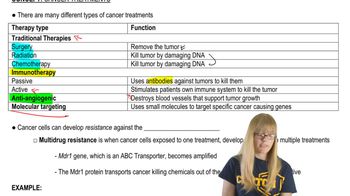
 04:05
04:05