Skip to main content
Cell Biology
나의 코스
배우기
시험 준비
AI 튜터
학습 가이드
플래시카드
탐험해 보세요
앱을 사용해 보세요
나의 코스
배우기
시험 준비
AI 튜터
학습 가이드
플래시카드
탐험해 보세요
앱을 사용해 보세요
뒤로
Glycolysis quiz #1
카드를 뒤집기 위해 탭할 수 있습니다.
What are the net products of glycolysis from one molecule of glucose?
카드를 뒤집기 위해 탭할 수 있습니다.
👆
What are the net products of glycolysis from one molecule of glucose?
The net products of glycolysis from one glucose molecule are 2 ATP, 2 NADH, and 2 pyruvate.
진행 상황 추적
컨트롤 버튼이 '내비게이션' 모드로 변경되었습니다.
1/38
관련 플래시카드
관련 실천
추천 영상
Glycolysis definitions
Glycolysis
14 용어
Glycolysis
10. Anaerobic Respiration
7 문제점
주제
Fermentation
10. Anaerobic Respiration
7 문제점
주제
10. Anerobic Respiration
4 주제
12 문제점
장
VideoThumbView.guidedCourse
11:10
Glycolysis Steps
851
views
8
rank
4
comments
VideoThumbView.guidedCourse
03:51
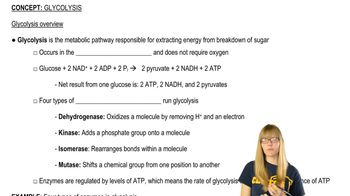
Glycolysis Overview
1187
views
16
rank
1
comments
이 집합의 용어 (38)
하이드의 정의
What are the net products of glycolysis from one molecule of glucose?
The net products of glycolysis from one glucose molecule are 2 ATP, 2 NADH, and 2 pyruvate.
Where in the cell does glycolysis occur, and does it require oxygen?
Glycolysis occurs in the cytosol of the cell and does not require oxygen.
What is the main purpose of phosphorylating glucose in the first step of glycolysis?
Phosphorylating glucose traps it inside the cell, preventing it from leaving and allowing it to be metabolized.
Which enzyme catalyzes the key regulatory step in glycolysis, and what reaction does it perform?
Phosphofructokinase catalyzes the phosphorylation of fructose-6-phosphate to fructose-1,6-bisphosphate, a key regulatory step in glycolysis.
How is glycolysis regulated by ATP levels in the cell?
High ATP levels inhibit glycolysis, while low ATP levels stimulate it, helping the cell balance energy production.
What are the net products of glycolysis from one molecule of glucose?
The net products of glycolysis from one glucose molecule are 2 ATP, 2 NADH, and 2 pyruvate.
Where in the cell does glycolysis occur, and does it require oxygen?
Glycolysis occurs in the cytosol of the cell and does not require oxygen.
What is the main purpose of phosphorylating glucose in the first step of glycolysis?
Phosphorylating glucose traps it inside the cell, preventing it from leaving and allowing it to be metabolized.
Which enzyme catalyzes the key regulatory step in glycolysis, and what reaction does it perform?
Phosphofructokinase catalyzes the phosphorylation of fructose-6-phosphate to fructose-1,6-bisphosphate, a key regulatory step in glycolysis.
How is glycolysis regulated by ATP levels in the cell?
High ATP levels inhibit glycolysis, while low ATP levels stimulate it, helping the cell balance energy production.
Where does glycolysis take place within a cell?
Glycolysis takes place in the cytosol of the cell.
In what part of the cell does glycolysis occur?
Glycolysis occurs in the cytosol of the cell.
Does glycolysis occur in the mitochondria?
No, glycolysis does not occur in the mitochondria; it occurs in the cytosol.
What is the net gain of ATP for a cell after glycolysis of one glucose molecule?
The net gain of ATP after glycolysis of one glucose molecule is 2 ATP.
What are the end products of glycolysis from one glucose molecule?
The end products of glycolysis from one glucose molecule are 2 ATP, 2 NADH, and 2 pyruvate.
Is oxygen required for glycolysis to occur?
No, glycolysis does not require oxygen.
Which key enzymes are involved in glycolysis?
Key enzymes in glycolysis include dehydrogenase, kinase, isomerase, and mutase.
How many steps are there in the glycolysis pathway?
There are 10 steps in the glycolysis pathway.
What is the first step of glycolysis?
The first step of glycolysis is the phosphorylation of glucose by ATP to form glucose-6-phosphate.
What is the role of phosphofructokinase in glycolysis?
Phosphofructokinase catalyzes the phosphorylation of fructose-6-phosphate to fructose-1,6-bisphosphate in glycolysis.
What is the significance of the cleavage step in glycolysis?
The cleavage step splits a 6-carbon sugar into two 3-carbon molecules: G3P and DHAP.
What is the key intermediate produced during the cleavage step of glycolysis?
The key intermediate produced is glyceraldehyde-3-phosphate (G3P).
How is NADH generated during glycolysis?
NADH is generated during the oxidation of G3P in glycolysis.
What type of phosphorylation produces ATP in glycolysis?
ATP is produced by substrate-level phosphorylation in glycolysis.
What is the final product of glycolysis?
The final product of glycolysis is pyruvate.
How many pyruvate molecules are produced from one glucose molecule during glycolysis?
Two pyruvate molecules are produced from one glucose molecule.
How many NADH molecules are produced per glucose during glycolysis?
Two NADH molecules are produced per glucose during glycolysis.
How many ATP molecules are produced and consumed during glycolysis?
Four ATP molecules are produced and two ATP molecules are consumed, resulting in a net gain of two ATP.
What regulates the activity of glycolytic enzymes?
The activity of glycolytic enzymes is regulated by ATP levels in the cell.
Why is glucose phosphorylated in the first step of glycolysis?
Glucose is phosphorylated to trap it inside the cell, preventing it from leaving.
What happens to DHAP during glycolysis?
DHAP is converted into a second molecule of G3P during glycolysis.
Does glycolysis occur in both prokaryotic and eukaryotic cells?
Yes, glycolysis occurs in the cytosol of both prokaryotic and eukaryotic cells.
What is substrate-level phosphorylation?
Substrate-level phosphorylation is the direct transfer of a phosphate group to ADP to form ATP.
What is the role of dehydrogenase in glycolysis?
Dehydrogenase oxidizes molecules by removing a proton and an electron during glycolysis.
What is the role of kinase in glycolysis?
Kinase adds a phosphate group to a molecule during glycolysis.
What is the role of isomerase in glycolysis?
Isomerase rearranges bonds within a molecule during glycolysis.
What is the role of mutase in glycolysis?
Mutase shifts chemical groups from one position to another within a molecule during glycolysis.
What is the overall purpose of glycolysis in cellular metabolism?
The overall purpose of glycolysis is to break down glucose into pyruvate, producing ATP and NADH for cellular energy.
 뒤로뒤로
뒤로뒤로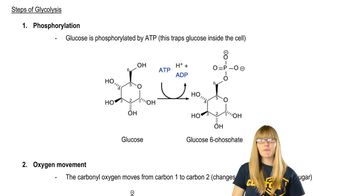
 11:10
11:10