Skip to main content
Cell Biology
나의 코스
배우기
시험 준비
AI 튜터
학습 가이드
플래시카드
탐험해 보세요
앱을 사용해 보세요
나의 코스
배우기
시험 준비
AI 튜터
학습 가이드
플래시카드
탐험해 보세요
앱을 사용해 보세요
뒤로
Properties of Macromolecules definitions
카드를 뒤집기 위해 탭할 수 있습니다.
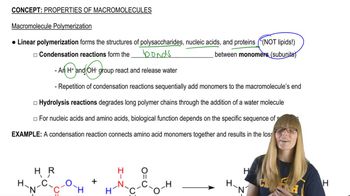
Polymerization
카드를 뒤집기 위해 탭할 수 있습니다.
👆
Polymerization
Sequential assembly of large biological structures from individual subunits, crucial for forming polysaccharides, nucleic acids, and proteins.
진행 상황 추적
컨트롤 버튼이 '내비게이션' 모드로 변경되었습니다.
1/15
관련 플래시카드
관련 실천
추천 영상
Properties of Macromolecules quiz
Properties of Macromolecules
15 용어
Properties of Macromolecules
2. Chemical Components of Cells
7 문제점
주제
Four Classes of Macromolecules
2. Chemical Components of Cells
7 문제점
주제
2. Chemical Components of Cells
5 주제
14 문제점
장
VideoThumbView.guidedCourse
01:58
Stereoisomers
597
views
4
rank
2
comments
VideoThumbView.guidedCourse
03:28
Polymerization
739
views
5
rank
VideoThumbView.guidedCourse
02:00
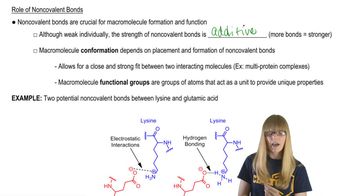
Noncovalent Bonds and Macromolecules
573
views
2
rank
이 집합의 용어 (15)
하이드의 정의
Polymerization
Sequential assembly of large biological structures from individual subunits, crucial for forming polysaccharides, nucleic acids, and proteins.
Condensation Reaction
Chemical process joining monomers by releasing water, enabling the formation of complex macromolecules.
Hydrolysis Reaction
Breakdown of polymers into monomers by adding water, reversing the process of condensation reactions.
Monomer
Small molecular subunit, such as an amino acid or monosaccharide, that serves as a building block for macromolecules.
Amino Acid
Organic molecule with amino, carboxyl, and R groups, serving as the fundamental unit of proteins.
Monosaccharide
Simple sugar unit that forms the basic building block of polysaccharides.
Stereoisomer
Mirror-image molecular forms arising from an asymmetric carbon, with only specific types being biologically active.
Chiral Center
Asymmetric carbon atom bonded to four different groups, giving rise to distinct stereoisomers.
Non-covalent Bond
Weak chemical interaction, such as hydrogen bonding or electrostatic interaction, whose collective effect stabilizes macromolecular structures.
Conformation
Three-dimensional shape of a macromolecule, influenced by the arrangement and interaction of non-covalent bonds.
Polysaccharide
Large carbohydrate polymer formed by repeated condensation of monosaccharide units.
Nucleic Acid
Polymer composed of nucleotide monomers, essential for genetic information storage and transfer.
Protein
Macromolecule formed by linear polymerization of amino acids, with structure and function determined by monomer sequence.
Functional Group
Specific group of atoms within a molecule, such as the R group in amino acids, conferring distinct chemical properties.
Electrostatic Interaction
Type of non-covalent bond resulting from attraction between oppositely charged groups, contributing to macromolecular stability.
 뒤로뒤로
뒤로뒤로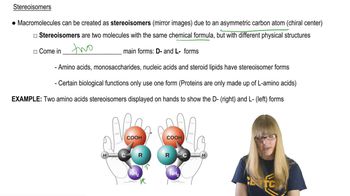
 01:58
01:58