Skip to main content
Cell Biology
나의 코스
배우기
시험 준비
AI 튜터
학습 가이드
플래시카드
탐험해 보세요
앱을 사용해 보세요
나의 코스
배우기
시험 준비
AI 튜터
학습 가이드
플래시카드
탐험해 보세요
앱을 사용해 보세요
뒤로
Properties of Macromolecules quiz
카드를 뒤집기 위해 탭할 수 있습니다.
What is polymerization in the context of macromolecules?
카드를 뒤집기 위해 탭할 수 있습니다.
👆
What is polymerization in the context of macromolecules?
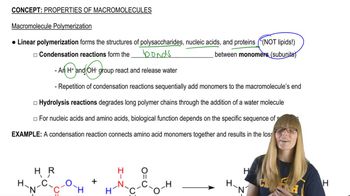
Polymerization is the sequential formation of large structures from individual subunits, such as polysaccharides, nucleic acids, and proteins.
진행 상황 추적
컨트롤 버튼이 '내비게이션' 모드로 변경되었습니다.
1/15
관련 플래시카드
관련 실천
추천 영상
Properties of Macromolecules definitions
Properties of Macromolecules
15 용어
Properties of Macromolecules
2. Chemical Components of Cells
7 문제점
주제
Four Classes of Macromolecules
2. Chemical Components of Cells
7 문제점
주제
2. Chemical Components of Cells
5 주제
14 문제점
장
VideoThumbView.guidedCourse
01:58
Stereoisomers
598
views
4
rank
2
comments
VideoThumbView.guidedCourse
03:28
Polymerization
740
views
5
rank
VideoThumbView.guidedCourse
02:00
Noncovalent Bonds and Macromolecules
574
views
2
rank
이 집합의 용어 (15)
하이드의 정의
What is polymerization in the context of macromolecules?
Polymerization is the sequential formation of large structures from individual subunits, such as polysaccharides, nucleic acids, and proteins.
Which macromolecule is NOT formed by polymerization?
Lipids are not formed by polymerization; they are created through a different process.
What type of reaction forms bonds between monomers during polymerization?
Condensation reactions form bonds between monomers, releasing water in the process.
What is released during a condensation reaction?
A water molecule is released when monomers bond together in a condensation reaction.
How are macromolecules broken down in cells?
Macromolecules are broken down by hydrolysis reactions, which add water to break apart polymer chains.
What is the main difference between condensation and hydrolysis reactions?
Condensation reactions release water to form bonds, while hydrolysis reactions use water to break bonds.
Why is the sequence of monomers important in macromolecules like nucleic acids and proteins?
The sequence determines the genetic code and protein structure, which significantly impacts biological function.
What are stereoisomers in macromolecules?
Stereoisomers are mirror-image forms of macromolecules resulting from an asymmetric carbon atom.
What is a chiral center in the context of stereoisomers?
A chiral center is an asymmetric carbon atom with different groups attached, leading to stereoisomer formation.
Which form of amino acids is used in proteins?
Proteins are made up of L-amino acids; D-amino acids exist but are not used in protein synthesis.
What is the significance of stereoisomers in biological functions?
Certain biological functions can only use one stereoisomer form, making their structure crucial for activity.
What are non-covalent bonds and why are they important in macromolecules?
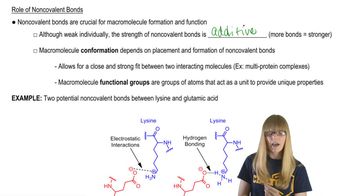
Non-covalent bonds are weak individually but become strong when additive, influencing macromolecule structure and function.
How do non-covalent bonds affect macromolecule conformation?
They allow for strong fits between interacting molecules and affect the structure and formation of macromolecules.
What types of non-covalent bonds can form between amino acids?
Hydrogen bonding and electrostatic interactions are examples of non-covalent bonds between amino acids.
Why are non-covalent bonds described as additive?
Their collective strength increases as more bonds form, allowing for strong interactions despite individual weakness.
 뒤로뒤로
뒤로뒤로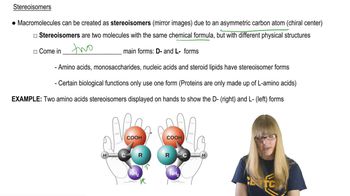
 01:58
01:58