In Exercises 35–54, use the FOIL method to multiply the binomials.
(2x−3)(4x−5)
검증된 단계별 안내
1
Identify the binomials to be multiplied: \((2x - 3)\) and \((4x - 5)\).
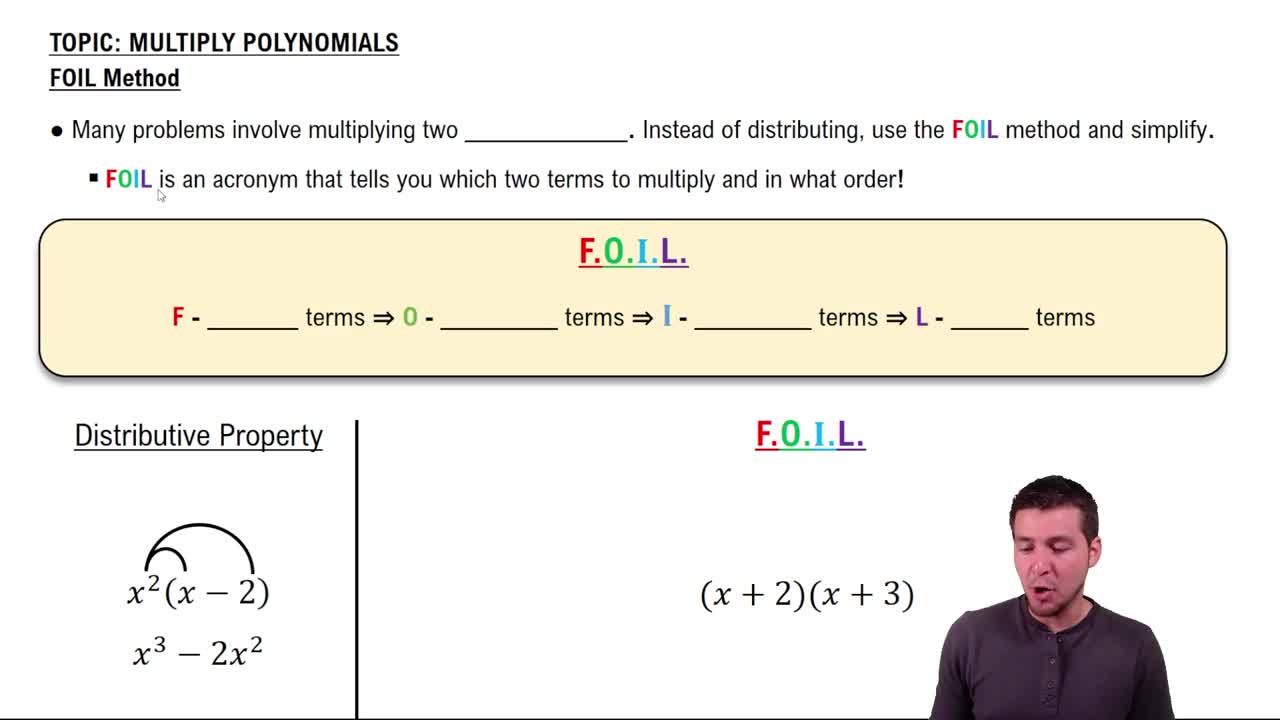
Apply the FOIL method, which stands for First, Outer, Inner, Last, to multiply the terms in the binomials.
First: Multiply the first terms of each binomial: \(2x \times 4x\).
Outer: Multiply the outer terms of the binomials: \(2x \times -5\).
Inner: Multiply the inner terms of the binomials: \(-3 \times 4x\).
비슷한 문제에 대한 검증된 영상 답변:
이 영상 해법은 위 문제에 도움이 된다고 튜터들이 추천한 것입니다.
영상 길이:
6m
영상 재생:
0 댓글
주요 개념
질문에 올바르게 답하기 위해 반드시 이해해야 하는 핵심 개념들은 다음과 같습니다.
FOIL Method
The FOIL method is a technique used to multiply two binomials. FOIL stands for First, Outside, Inside, Last, which refers to the order in which you multiply the terms of the binomials. This method helps ensure that all combinations of terms are accounted for, leading to the correct product.
A binomial is a polynomial that consists of exactly two terms, typically separated by a plus or minus sign. In the expression (2x−3)(4x−5), both (2x−3) and (4x−5) are binomials. Understanding the structure of binomials is essential for applying the FOIL method effectively.
The distributive property states that a(b + c) = ab + ac, allowing you to distribute a single term across terms within parentheses. This property is fundamental to the FOIL method, as it involves distributing each term in the first binomial to each term in the second binomial, ensuring all products are calculated.

 6:40분
6:40분 검증된 단계별 안내
 03:07
03:07