In Exercises 41–50, subtract the polynomials. Assume that all variable exponents represent whole numbers.
(3x⁴y² + 5x³y − 3y) − (2x⁴y² − 3x³y − 4y + 6x)
검증된 단계별 안내
1
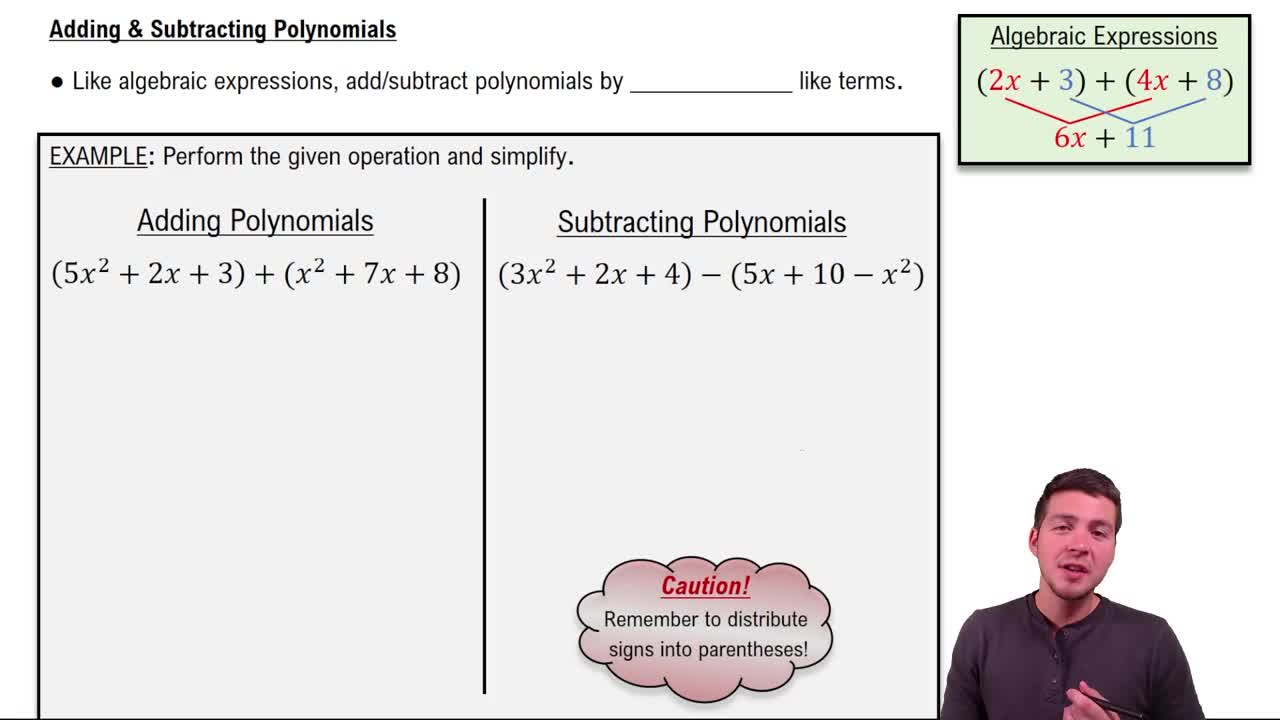
Identify the polynomials to be subtracted: \((3x^4y^2 + 5x^3y - 3y)\) and \((2x^4y^2 - 3x^3y - 4y + 6x)\).
Distribute the negative sign across the second polynomial: \(-(2x^4y^2 - 3x^3y - 4y + 6x) = -2x^4y^2 + 3x^3y + 4y - 6x\).
Rewrite the expression by combining the polynomials: \((3x^4y^2 + 5x^3y - 3y) + (-2x^4y^2 + 3x^3y + 4y - 6x)\).
Group like terms together: \((3x^4y^2 - 2x^4y^2) + (5x^3y + 3x^3y) + (-3y + 4y) + (-6x)\).
Simplify each group of like terms to find the resulting polynomial.
비슷한 문제에 대한 검증된 영상 답변:
이 영상 해법은 위 문제에 도움이 된다고 튜터들이 추천한 것입니다.
영상 길이:
5m
영상 재생:
0 댓글
주요 개념
질문에 올바르게 답하기 위해 반드시 이해해야 하는 핵심 개념들은 다음과 같습니다.
Polynomials
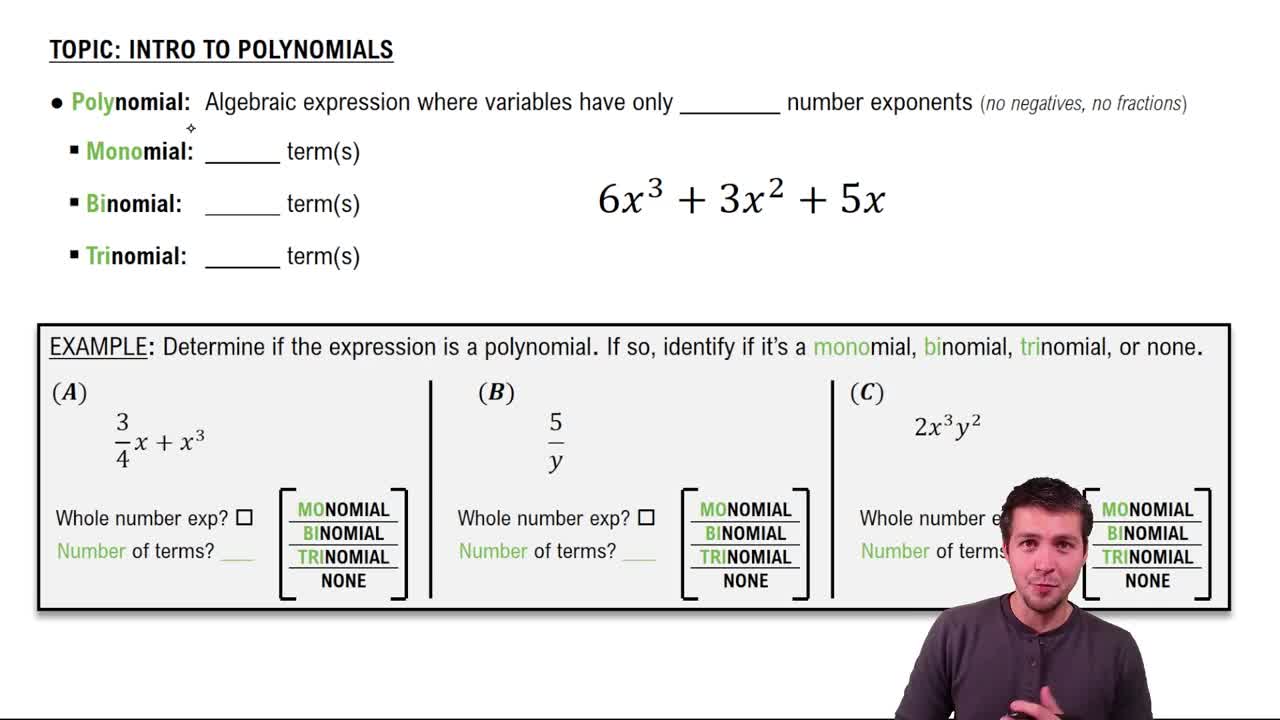
Polynomials are algebraic expressions that consist of variables raised to whole number exponents, combined using addition, subtraction, and multiplication. Each term in a polynomial is made up of a coefficient and a variable part. Understanding the structure of polynomials is essential for performing operations like addition and subtraction.
Subtracting polynomials involves distributing the negative sign across the terms of the polynomial being subtracted and then combining like terms. Like terms are those that have the same variable raised to the same exponent. This process requires careful attention to ensure that all terms are accounted for correctly.
Combining like terms is the process of simplifying an expression by adding or subtracting coefficients of terms that share the same variable and exponent. This step is crucial in polynomial operations, as it reduces the expression to its simplest form, making it easier to interpret and work with.

 5:31분
5:31분 검증된 단계별 안내
 05:13
05:13