 뒤로
뒤로College Algebra Chapter 2: The Rectangular Coordinate System, Linear Equations, and Inequalities
스터디 가이드 - 스마트 노트
 자료에 맞춘 맞춤형 노트, 핵심 정의, 예시, 맥락을 확장해 제공합니다.
The Rectangular Coordinate System and Graphs
The Cartesian Coordinate System
The Cartesian coordinate system is a two-dimensional plane defined by a horizontal axis (x-axis) and a vertical axis (y-axis). Each point in the plane is represented as an ordered pair (x, y), where x is the horizontal distance from the origin and y is the vertical distance from the origin.
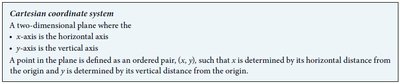
x-axis: Horizontal axis
y-axis: Vertical axis
Origin: The point (0, 0) where the axes intersect
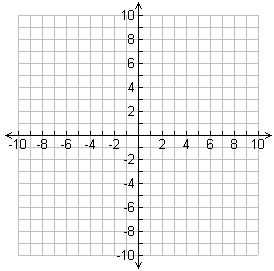
The plane is divided into four quadrants:
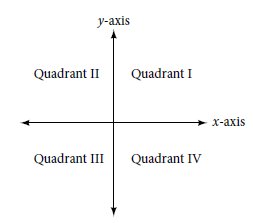
Quadrant I: (+, +)
Quadrant II: (−, +)
Quadrant III: (−, −)
Quadrant IV: (+, −)
Plotting Points
To plot a point such as (3, −1), move 3 units to the right along the x-axis and 1 unit down along the y-axis.
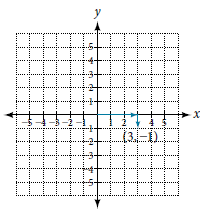
Example: Plot the points (−2, 4), (3, 5), and (0, −3) in the plane.
Distance and Midpoint Formulas
The Distance Formula
The distance formula is used to find the distance between two points in the plane. It is derived from the Pythagorean Theorem:

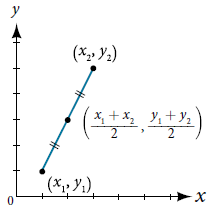
The Midpoint Formula
The midpoint formula finds the point exactly halfway between two given points and :
Linear Equations in One Variable
Definition and Forms
A linear equation in one variable can be written in the form , where and are real numbers and .

Conditional equation: True for specific values of the variable.
Identity: True for all values of the variable.
Inconsistent equation: No solution exists.
The Slope of a Line
Definition of Slope
The slope of a line, , represents the change in over the change in . For two points and , the slope is:

Slope-Intercept Form
The slope-intercept form of a linear equation is , where is the slope and is the y-intercept.
Forms of Linear Equations
Point-Slope Formula
Given one point and the slope, the point-slope formula gives the equation of a line:

Standard Form
The standard form of a linear equation is , where , , and are integers.
Parallel and Perpendicular Lines
Relationships of Slopes
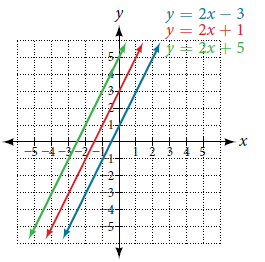
Parallel lines: Have the same slope but different y-intercepts.
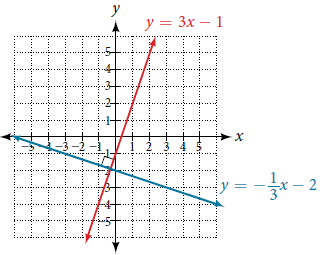
Perpendicular lines: Have slopes that are negative reciprocals of each other.
Modeling with Linear Equations
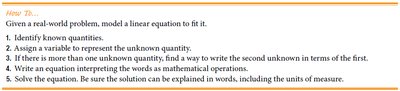
Steps for Modeling
Identify known quantities.
Assign a variable to represent the unknown quantity.
If there is more than one unknown, express one in terms of the other.
Write an equation based on the problem statement.
Solve the equation and interpret the solution in context.
Complex Numbers
Definition and Standard Form
A complex number is of the form , where and are real numbers and is the imaginary unit, defined by .
If , the number is real.
If and , the number is a pure imaginary number.
The Complex Conjugate
The complex conjugate of is . Multiplying a complex number by its conjugate yields a real number.

Quadratic Equations
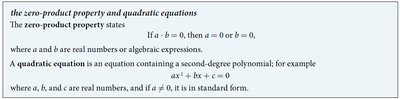
The Zero-Product Property
If , then or . This property is used to solve quadratic equations by factoring.
The Square Root Property
If , then , where is a nonzero real number.

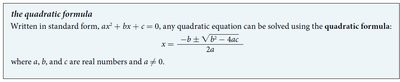
The Quadratic Formula
Any quadratic equation can be solved using the quadratic formula:
The Discriminant
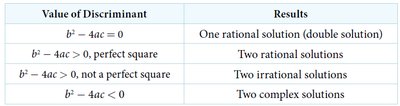
The discriminant is the expression under the radical in the quadratic formula. It determines the nature of the solutions:

Value of Discriminant | Results |
|---|---|
One rational solution (double solution) | |
, perfect square | Two rational solutions |
, not a perfect square | Two irrational solutions |
Two complex solutions |
Solving Radical Equations
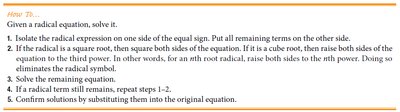
Steps for Solving
Isolate the radical expression on one side of the equation.
If the radical is a square root, square both sides; if a cube root, raise both sides to the third power, etc.
Solve the resulting equation.
If a radical remains, repeat steps 1–2.
Check all solutions in the original equation.
Absolute Value Equations and Inequalities
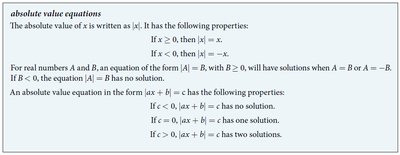
Absolute Value Equations
The absolute value of , written , is defined as:
If , then
If , then
For :
If , no solution
If , one solution
If , two solutions: or

Absolute Value Inequalities
For , the solution is . For , the solution is or .
Linear Inequalities
Graphing and Notation
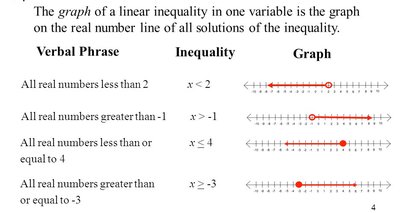
The solution set of a linear inequality can be represented on a number line and written in interval or set-builder notation.
Interval notation: Uses parentheses ( ) for open intervals and brackets [ ] for closed intervals.
Set-builder notation: Describes the set of all satisfying a condition, e.g., .
Summary Table: Discriminant and Solution Types
Value of Discriminant | Results |
|---|---|
One rational solution (double solution) | |
, perfect square | Two rational solutions |
, not a perfect square | Two irrational solutions |
Two complex solutions |
