 뒤로
뒤로College Algebra Practice Final Exam Step-by-Step Guidance
스터디 가이드 - 스마트 노트
 자료에 맞춘 맞춤형 노트, 핵심 정의, 예시, 맥락을 확장해 제공합니다.
Q1. Solve the system of equations by the elimination method: -x + 2y = 0 x + 2y = 9
Background
Topic: Systems of Linear Equations
This question tests your ability to solve a system of two linear equations using the elimination method.
Key Terms and Formulas:
System of equations: Two or more equations with the same variables.
Elimination method: A technique to eliminate one variable by adding or subtracting equations.
Step-by-Step Guidance
Write both equations in standard form:
Add the two equations together to eliminate :
Simplify the resulting equation to solve for .
Once you have , substitute it back into one of the original equations to solve for .
Try solving on your own before revealing the answer!
Final Answer: (9, 4)
By adding the equations, is eliminated and you solve for . Substitute back to find . The solution is the ordered pair .
Q2. Benjamin & Associates built condominiums with three-bedroom and four-bedroom units. If the total number of bedrooms is 693 and there are 195 units, how many three-bedroom and four-bedroom units are there?
Background
Topic: Systems of Linear Equations (Word Problems)
This question tests your ability to set up and solve a system of equations based on a real-world scenario.
Key Terms and Formulas:
Let = number of three-bedroom units
Let = number of four-bedroom units
Equations: and
Step-by-Step Guidance
Set up the two equations based on the information given:
Use the elimination or substitution method to solve for one variable.
Once you find one variable, substitute it back into the first equation to find the other.
Try solving on your own before revealing the answer!
Final Answer: 87 three-bedroom units, 108 four-bedroom units
Solving the system yields and .
Q3. Use the substitution or elimination method to solve the system: x − 2y = 15 3x − 6y = 15
Background
Topic: Systems of Linear Equations
This question tests your ability to solve a system using substitution or elimination.
Key Terms and Formulas:
Substitution method: Solve one equation for one variable and substitute into the other.
Elimination method: Multiply equations if needed to eliminate a variable.
Step-by-Step Guidance
Write both equations in standard form:
Notice that the second equation is a multiple of the first. Compare the two equations.
Determine if the system has one solution, infinitely many solutions, or no solution.
Try solving on your own before revealing the answer!
Final Answer: There are infinitely many solutions of the form
The second equation is a multiple of the first, so the system has infinitely many solutions.
Q4. Find the size of the matrix and determine its type:
Background
Topic: Matrices
This question tests your ability to identify the size and type of a matrix.
Key Terms and Formulas:
Matrix size: Number of rows × number of columns
Square matrix: Same number of rows and columns
Row matrix: Only one row
Column matrix: Only one column
Step-by-Step Guidance
Count the number of rows and columns in the matrix.
Determine if the matrix is square, row, column, or none of these based on its dimensions.
Try solving on your own before revealing the answer!
Final Answer: The size is 4 × 2; it is none of these (not square, row, or column matrix).
The matrix has 4 rows and 2 columns, so it is not square, row, or column.
Q5. Let and be matrices. Find .
Background
Topic: Matrix Operations
This question tests your ability to subtract matrices element-wise.
Key Terms and Formulas:
Matrix subtraction: Subtract corresponding elements.
Step-by-Step Guidance
Write both matrices and .
Subtract each element of from the corresponding element of .
Try solving on your own before revealing the answer!
Final Answer:
Subtracting each element gives the resulting matrix.
Q6. Use matrices and to find .
Background
Topic: Matrix Multiplication
This question tests your ability to multiply two matrices.
Key Terms and Formulas:
Matrix multiplication: Multiply rows of by columns of .
Formula:
Step-by-Step Guidance
Write matrices and .
Multiply each row of by each column of to find the elements of .
Calculate each element using the formula for matrix multiplication.
Try solving on your own before revealing the answer!
Final Answer:
Each element is calculated by multiplying and summing the appropriate entries.
Q7. The augmented matrix is in row-echelon form. Use back substitution to solve the system.
Background
Topic: Solving Systems with Matrices
This question tests your ability to use back substitution with a row-echelon matrix.
Key Terms and Formulas:
Row-echelon form: Matrix form where each row has more leading zeros than the previous.
Back substitution: Solve for variables starting from the last row.
Step-by-Step Guidance
Identify the variables corresponding to each row.
Start with the last row and solve for the variable.
Substitute the value into the previous row to solve for the next variable.
Try solving on your own before revealing the answer!
Final Answer: (1, -2, -3)
Back substitution yields , , .
Q8. Graph the solution set of the system of inequalities:
Background
Topic: Systems of Linear Inequalities
This question tests your ability to graph the solution region for a system of inequalities.
Key Terms and Formulas:
Linear inequality: An inequality involving a linear expression.
Solution region: The area where all inequalities are satisfied.
Step-by-Step Guidance
Graph each inequality as a boundary line (dashed for strict inequalities).
Determine which side of each line satisfies the inequality.
Shade the region where both inequalities are true.

Try solving on your own before revealing the answer!
Final Answer: The solution region is the yellow area where both inequalities are satisfied.
The graph shows the intersection of the regions for both inequalities.
Q9. Graph the solution set of the system of inequalities:
Background
Topic: Systems of Linear Inequalities
This question tests your ability to graph the solution region for a system of inequalities.
Key Terms and Formulas:
Linear inequality: An inequality involving a linear expression.
Solution region: The area where all inequalities are satisfied.
Step-by-Step Guidance
Graph each inequality as a boundary line (solid for or ).
Determine which side of each line satisfies the inequality.
Shade the region where both inequalities are true.
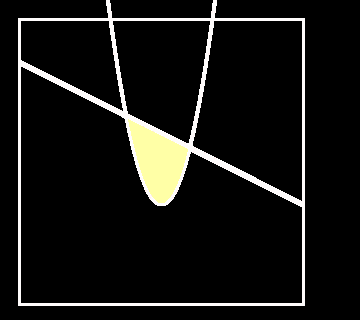
Try solving on your own before revealing the answer!
Final Answer: The solution region is the yellow area where both inequalities are satisfied.
The graph shows the intersection of the regions for both inequalities.
