 뒤로
뒤로College Algebra Study Notes: Equations, Functions, and Graphs
스터디 가이드 - 스마트 노트
 자료에 맞춘 맞춤형 노트, 핵심 정의, 예시, 맥락을 확장해 제공합니다.
Equations and Inequalities
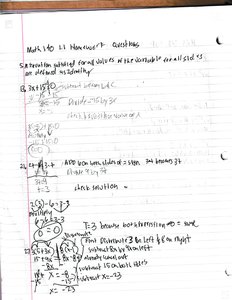
Solving Linear Equations
Linear equations are equations of the first degree, meaning the variable is raised only to the first power. The general form is ax + b = c. Solving these equations involves isolating the variable on one side.
Combine like terms on each side if necessary.
Move all variable terms to one side and constants to the other.
Divide or multiply to solve for the variable.
Check your solution by substituting back into the original equation.
Example: Solve
Subtract 7 from both sides:
Divide by 3:
Solving Quadratic Equations
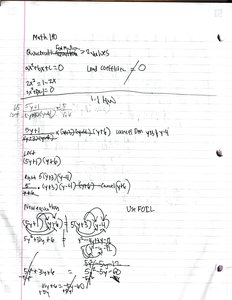
Quadratic equations have the form ax^2 + bx + c = 0. There are several methods to solve them:
Factoring: Express the quadratic as a product of two binomials and set each factor to zero.
Quadratic Formula:
Completing the Square: Rewrite the equation in the form and solve for x.
Example: Solve
Factor:
Solutions:
Solving Systems of Equations
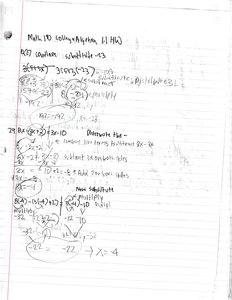
Systems of equations involve finding values that satisfy two or more equations simultaneously. Common methods include:
Substitution: Solve one equation for one variable and substitute into the other.
Elimination: Add or subtract equations to eliminate one variable.
Example: Solve the system:
Add equations:
Substitute:
Functions and Their Graphs
Definition of a Function
A function is a relation in which each input (x-value) has exactly one output (y-value). The set of all possible inputs is the domain, and the set of all possible outputs is the range.
Notation: denotes a function named f with input x.
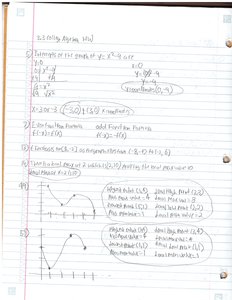
Vertical Line Test: A graph represents a function if no vertical line intersects the graph more than once.
Example:
Graphing Linear and Quadratic Functions
Graphing functions helps visualize their behavior. Linear functions produce straight lines, while quadratic functions produce parabolas.
Linear: (slope-intercept form)
Quadratic:
Vertex: The highest or lowest point of a parabola, found at
Finding Intercepts
Intercepts are points where the graph crosses the axes.
x-intercept: Set and solve for .
y-intercept: Set and solve for .
Example: For , the y-intercept is and the x-intercept is $2$.
Polynomial and Rational Functions
Polynomial Functions
A polynomial function is a function of the form , where the exponents are whole numbers and coefficients are real numbers.
Degree: The highest exponent of x.
Leading Coefficient: The coefficient of the term with the highest degree.
End Behavior: Determined by the degree and leading coefficient.
Example:
Factoring Polynomials
Factoring is the process of expressing a polynomial as a product of its factors. This is useful for solving polynomial equations.
Common Factoring: Factor out the greatest common factor (GCF).
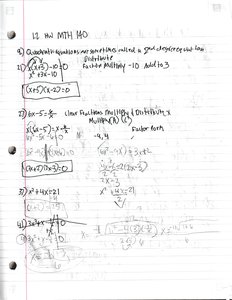
Factoring Trinomials: Find two numbers that multiply to ac and add to b in .
Difference of Squares:
Example:
Rational Functions
A rational function is a function of the form , where and are polynomials and .
Domain: All real numbers except where .
Vertical Asymptotes: Values of x where .
Horizontal Asymptotes: Determined by the degrees of and .
Exponential and Logarithmic Functions
Exponential Functions
An exponential function has the form , where , , and .
Growth: If , the function increases rapidly.
Decay: If , the function decreases rapidly.
Example:
Logarithmic Functions
A logarithmic function is the inverse of an exponential function and has the form , where , .
Domain:
Range: All real numbers
Key Property:
Analytic Geometry
Distance and Midpoint Formulas
Analytic geometry involves using algebraic methods to solve geometric problems.
Distance Formula:
Midpoint Formula:
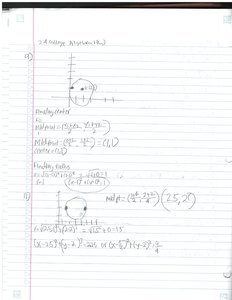
Example: Find the distance and midpoint between (1,2) and (5,6).
Distance:
Midpoint:
Circles
The equation of a circle with center (h, k) and radius r is .
Center: (h, k)
Radius: r
Example: has center (2, -3) and radius 4.
Additional Key Concepts
Interval Notation
Interval notation is used to describe sets of numbers, often solutions to inequalities.
Open interval: (a, b) means all numbers between a and b, not including a or b.
Closed interval: [a, b] means all numbers between a and b, including a and b.
Infinity: Use (a, ∞) or (−∞, b) for unbounded intervals.
Example: is written as (2, ∞).
Properties of Functions
Understanding the properties of functions is essential for analyzing their behavior.
Even Function: (symmetric about the y-axis)
Odd Function: (symmetric about the origin)
Increasing/Decreasing: A function is increasing if for .
Summary Table: Methods for Solving Equations
Equation Type | Method | Example |
|---|---|---|
Linear | Isolate variable | |
Quadratic | Factoring, Quadratic Formula | |
System (2 variables) | Substitution, Elimination | |
Polynomial | Factoring, Synthetic Division |
Additional info: Some steps and explanations have been expanded for clarity and completeness based on standard College Algebra curriculum.
