 뒤로
뒤로College Algebra: Transformations and Operations with Functions
스터디 가이드 - 스마트 노트
 자료에 맞춘 맞춤형 노트, 핵심 정의, 예시, 맥락을 확장해 제공합니다.
Ch.4 - Additional Topics with Functions
Transformations of Functions
Transformations are operations that alter the position or shape of a function's graph. The three primary types of transformations are reflections, shifts, and stretches/shrinks. Each transformation affects the function in a specific way, as summarized below:
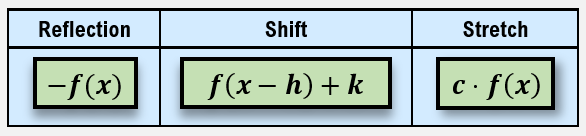
Reflection: Flips the graph over a specified axis. For example, reflects over the x-axis, and reflects over the y-axis.
Shift (Translation): Moves the graph horizontally and/or vertically. The general form is , where is the horizontal shift and is the vertical shift.
Stretch/Shrink: Alters the graph's size. Multiplying by a constant outside the function, , stretches (if ) or shrinks (if ) the graph vertically. Multiplying inside the function, , affects the graph horizontally.
Example: For , the following transformations produce:
(shifted right 3 units and up 2 units)
(reflected over the x-axis)
(reflected over the x-axis and vertically stretched by 4)
Reflections
A reflection is a transformation where the graph is flipped over the x-axis or y-axis:
Reflection over x-axis:
Reflection over y-axis:
When reflecting over the x-axis, the y-values change sign; when reflecting over the y-axis, the x-values change sign.
Example: Given , the reflection over the x-axis is .
Shifting a Function
A shift (translation) moves the graph horizontally and/or vertically:
Vertical shift: shifts up if , down if .
Horizontal shift: shifts right if , left if .
Vertical shifts affect the y-values; horizontal shifts affect the x-values.
Example: shifts right 2 units and up 3 units.
Stretches and Shrinks
Stretches and shrinks occur when a function is multiplied by a constant:
Vertical stretch/shrink:
Horizontal stretch/shrink:
If , the graph stretches (becomes taller/narrower vertically or narrower horizontally).
If , the graph shrinks (becomes shorter/wider vertically or wider horizontally).
Example: is a vertical stretch by 2; is a horizontal stretch by 2.
Domain and Range of Transformed Functions
Transformations can change the domain and range of a function. To find the new domain and range, analyze the transformed graph or apply the transformation rules to the original domain and range.
Example: For , domain is and range is . For , domain is and range is .
Function Operations
Adding and Subtracting Functions
Functions are added or subtracted by combining like terms, similar to polynomials:
The domain of or is the intersection of the domains of and .
Example: If and , then , with domain .
Multiplying and Dividing Functions
Functions can also be multiplied or divided:
, where
The domain of the product is the intersection of the domains of and . For the quotient, exclude values where .
Example: If and , then , with domain .
Function Composition
Composing Functions
Function composition involves substituting one function into another. The notation means .
First, evaluate the inside function , then substitute the result into .
Example: If and , then .
Domain of Composite Functions
To find the domain of :
Find the domain of .
Find the domain of and exclude any for which is not in the domain of .
Example: If and , then , with domain and (i.e., ).
Decomposing Functions
Function decomposition is the process of expressing a function as a composition of two or more simpler functions.
Example: can be written as where and .
Additional info: This guide covers the essential concepts of function transformations and operations, including graphical and algebraic perspectives, as well as domain and range considerations. Practice problems and examples are included to reinforce understanding.
