 뒤로
뒤로Exponential and Logarithmic Functions: Exponential Functions
스터디 가이드 - 스마트 노트
 자료에 맞춘 맞춤형 노트, 핵심 정의, 예시, 맥락을 확장해 제공합니다.
Chapter 4: Exponential and Logarithmic Functions
4.1 Exponential Functions
Exponential functions are a fundamental class of functions in algebra, characterized by a constant base raised to a variable exponent. They are widely used in modeling growth and decay in natural and financial contexts.
Definition of the Exponential Function
Exponential Function: A function of the form , where is a positive real number and .
The base determines the rate and direction of growth or decay.
The domain of is all real numbers, and the range is all positive real numbers.
Evaluating Exponential Functions
To evaluate an exponential function, substitute the given value of into the formula and compute the result.
Example: Evaluate at .
Solution:
Graphing Exponential Functions
To graph an exponential function, create a table of values for selected -values, plot the corresponding points, and connect them with a smooth curve. The graph will have a horizontal asymptote at .
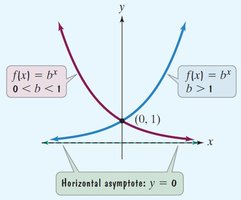
For , the function shows exponential growth.
For , the function shows exponential decay.
All exponential functions of this form pass through the point .
Transformations Involving Exponential Functions
Exponential function graphs can be shifted, reflected, or stretched/compressed using transformations:
Horizontal Shifts: shifts the graph units to the right.
Vertical Shifts: shifts the graph units up.
Reflections: reflects the graph across the -axis.
Horizontal Asymptote: The line is a horizontal asymptote for all basic exponential functions.
Example: The graph of is the graph of shifted 1 unit to the right.
The Natural Base
The number is an important mathematical constant known as the natural base.
Exponential functions with base are called natural exponential functions: .
These functions are widely used in calculus, science, and finance.
Applications: Compound Interest
Exponential functions are used to model compound interest, where interest is earned on both the initial principal and accumulated interest.
Compound Interest Formula (n times per year):
= final amount
= principal (initial amount)
= annual interest rate (decimal)
= number of compounding periods per year
= number of years
Continuous Compound Interest Formula:
Interest is compounded continuously at rate for years.
Example: If , , , , then
Calculate to find the final amount.
Applications: Population Growth
Exponential functions can model population growth, radioactive decay, and other real-world phenomena.
Example: The population of a species increases according to , where is the initial population and is the growth rate.
