 뒤로
뒤로Exponential and Logarithmic Functions: Logarithmic Functions
스터디 가이드 - 스마트 노트
 자료에 맞춘 맞춤형 노트, 핵심 정의, 예시, 맥락을 확장해 제공합니다.
Exponential and Logarithmic Functions
Logarithmic Functions
Logarithmic functions are the inverses of exponential functions and are essential in solving equations involving exponents. This section covers the definition, properties, evaluation, and applications of logarithmic functions, as well as their graphs and domains.
Definition of the Logarithmic Function
Logarithmic Function: For x > 0 and b > 0, b \neq 1, the logarithmic function with base b is defined as:
This means that the logarithm of x with base b is the exponent to which b must be raised to obtain x.
Changing Between Logarithmic and Exponential Forms
To convert from logarithmic to exponential form:
To convert from exponential to logarithmic form:
Example: means .
Evaluating Logarithms
To evaluate a logarithm, determine the exponent that the base must be raised to in order to produce the given number.
Example: because .
Example: because .
Example: because .
Example: because .
Basic Logarithmic Properties Involving One
because .
because .
Example: and .
Inverse Properties of Logarithms
For and :
These properties show that logarithms and exponentials are inverse operations.
Graphs of Exponential and Logarithmic Functions
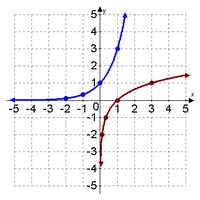
The graph of a logarithmic function is the reflection of the graph of its corresponding exponential function across the line . The exponential function and the logarithmic function are inverses of each other.
Characteristics of Logarithmic Functions
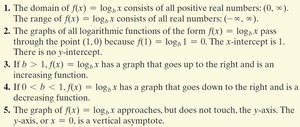
The domain of is (all positive real numbers).
The range is (all real numbers).
The graph passes through because .
If , the function increases; if , the function decreases.
The y-axis () is a vertical asymptote.
Domain of a Logarithmic Function
The domain of consists of all for which .
Example: For , the domain is , so .
The graph will have a vertical asymptote at .
Common Logarithms
The logarithmic function with base 10 is called the common logarithm.
It is written as (without a base).
Example Application: The percentage of adult height attained by a boy at age 10 can be modeled using a logarithmic function, yielding approximately 80%.
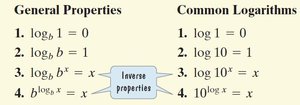
Properties of Common Logarithms
General Properties | Common Logarithms |
|---|---|
1. | 1. |
2. | 2. |
3. | 3. |
4. | 4. |
Natural Logarithms
The logarithmic function with base (where ) is called the natural logarithm.
It is written as .
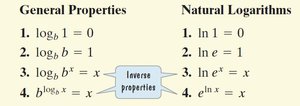
Properties of Natural Logarithms
General Properties | Natural Logarithms |
|---|---|
1. | 1. |
2. | 2. |
3. | 3. |
4. | 4. |
Applications of Logarithmic Functions
Logarithmic functions are used to model real-world phenomena such as growth, decay, and temperature changes.
Example: The temperature increase in a vehicle can be modeled by a logarithmic function. For instance, after 30 minutes, the temperature may increase by approximately 34°F.
