 뒤로
뒤로Exponential Functions and Their Applications
스터디 가이드 - 스마트 노트
 자료에 맞춘 맞춤형 노트, 핵심 정의, 예시, 맥락을 확장해 제공합니다.
Exponential and Logarithmic Functions
Exponential Functions
Exponential functions are a fundamental class of functions in algebra, characterized by a constant base raised to a variable exponent. They are widely used to model growth and decay in various real-world contexts, such as population growth, radioactive decay, and financial investments.
Definition: An exponential function with base b is defined as f(x) = b^x, where b is a positive constant other than 1 (b > 0 and b \neq 1), and x is any real number.
Domain: All real numbers.
Range: All positive real numbers (f(x) > 0).
Horizontal Asymptote: The line y = 0 is a horizontal asymptote for all exponential functions of this form.
Evaluating Exponential Functions
To evaluate an exponential function at a given value of x, substitute the value into the function and compute the result.
Example: If f(x) = 2^x, then f(3) = 2^3 = 8.
Application: If f(x) = 80 \cdot 2^{0.5x} models the average amount spent at a shopping mall after x hours, then after 3 hours: (Rounded to the nearest dollar, $226$.)
Graphing Exponential Functions
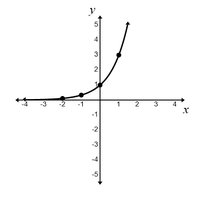
Graphing exponential functions involves plotting points for various values of x and connecting them with a smooth curve. The graph always passes through (0,1) for f(x) = b^x and increases rapidly for b > 1.
Key Features:
Passes through (0,1)
Horizontal asymptote at y = 0
Rapid growth for positive x if b > 1
Transformations of Exponential Functions
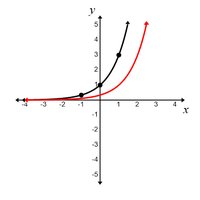
Exponential function graphs can be shifted, reflected, or stretched/compressed by modifying the function's formula. Common transformations include horizontal and vertical shifts.
Horizontal Shift: f(x) = b^{x-h} shifts the graph h units to the right.
Vertical Shift: f(x) = b^x + k shifts the graph k units up.
Reflection: f(x) = b^{-x} reflects the graph across the y-axis.
Example: To graph f(x) = 2^{x-1}, shift the graph of f(x) = 2^x one unit to the right.
Characteristics of Exponential Functions
Continuous and smooth curves
One-to-one functions (pass the horizontal line test)
Always positive outputs for real-valued exponents
Rapid growth or decay depending on the base
The Natural Base e
The number e is an important mathematical constant, approximately equal to 2.718281828. It is the base of the natural exponential function and arises naturally in many contexts involving continuous growth or decay.
Definition:
Natural Exponential Function: f(x) = e^x
e is irrational (its decimal expansion never terminates or repeats)
Evaluating Functions with Base e
To evaluate a function with base e, substitute the value of x and use a calculator for the exponentiation.
Example: If f(x) = 1200e^{0.04x} models the gray wolf population x years after 1978, then for 2017 (x = 39): (Population is approximately 5712 wolves.)
Compound Interest Formulas
Exponential functions are used to model compound interest, where interest is earned on both the initial principal and the accumulated interest.
For n compounding periods per year: Where:
A = final amount
P = principal (initial amount)
r = annual interest rate (decimal)
n = number of compounding periods per year
t = number of years
For continuous compounding:
Example: Quarterly Compounding
Problem: annual interest, compounded quarterly, for 5 years.
Solution:
Example: Continuous Compounding
Problem: annual interest, compounded continuously, for 5 years.
Solution:
