뒤로
뒤로Factoring and Quadratic Functions: College Algebra Study Guide
스터디 가이드 - 스마트 노트
 자료에 맞춘 맞춤형 노트, 핵심 정의, 예시, 맥락을 확장해 제공합니다.
Factoring Polynomials
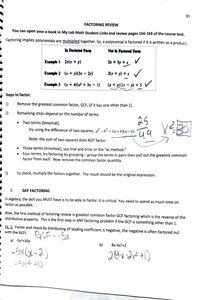
Factoring Review
Factoring is a fundamental algebraic process that rewrites a polynomial as a product of simpler polynomials. A polynomial is considered factored if it is written as a product of two or more nontrivial factors.
In Factored Form:
Not in Factored Form:
Steps to factor:
Remove the greatest common factor (GCF), if it is other than 1.
Remaining terms are grouped and factored further.
Check your answer by multiplying the factors.
Example: Factor
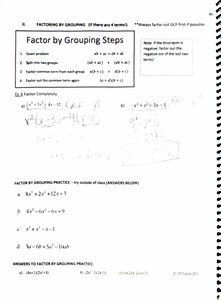
Factoring by Grouping
Factoring by grouping is used when a polynomial has four terms. The process involves grouping terms to factor out common factors and then factoring the resulting binomials.
Group terms
Split into two groups
Factor common term from each group
Factor out the common binomial
Example:
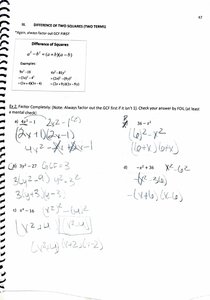
Difference of Squares
The difference of squares is a special factoring pattern for expressions of the form , which factors as .
Always factor out the GCF first.
Check your answer by multiplying the factors.
Example:
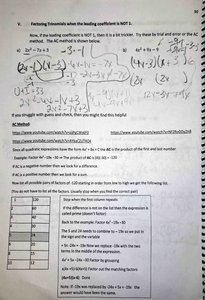
Factoring Trinomials
Trinomials of the form can be factored using various methods, including trial and error or the AC method. If the leading coefficient is 1, the process is simpler; otherwise, use the AC method.
Find two numbers that multiply to and add to .
Rewrite the middle term and factor by grouping.
Example:
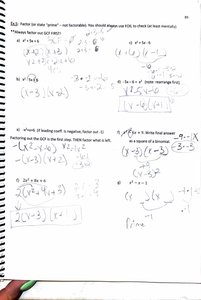
Prime Polynomials
A polynomial is prime if it cannot be factored further over the integers.
Check for GCF and factor if possible.
If no further factoring is possible, the polynomial is prime.
Graph Reading and Interpretation
Graph Reading
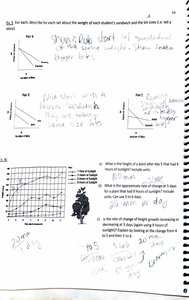
Graphs are visual representations of functions and their behavior. Understanding how to interpret graphs is essential for analyzing functions in algebra.
Identify axes and units
Describe the relationship between variables
Interpret slope and shape
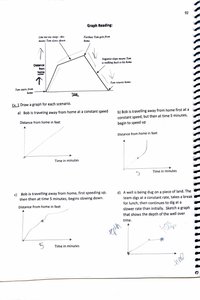
Distance vs. Time Graphs
Distance-time graphs show how distance changes with respect to time. The slope represents speed, and the shape indicates acceleration or deceleration.
Constant slope: constant speed
Curved slope: changing speed
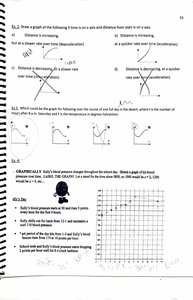
Rate of Change and Applications
The rate of change is a key concept in algebra, representing how one quantity changes with respect to another. In graphs, it is often visualized as the slope.
Positive slope: increasing function
Negative slope: decreasing function
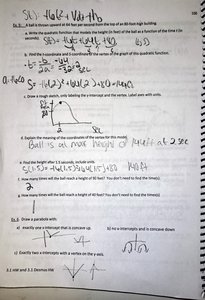
Quadratic Functions and Parabolas
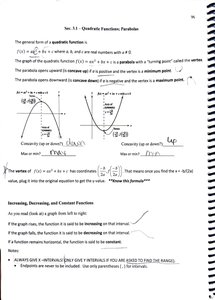
Quadratic Functions: Parabolas
A quadratic function is a function of the form , where . Its graph is a parabola, which opens upward if and downward if .
The vertex is the turning point of the parabola.
The axis of symmetry is .
The vertex coordinates are .
Example:
Vertex, Axis of Symmetry, Domain, and Range
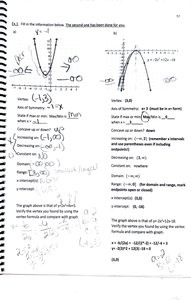
For a quadratic function, the vertex, axis of symmetry, domain, and range are important characteristics.
Vertex:
Axis of Symmetry:
Domain: All real numbers
Range: Depends on whether the parabola opens up or down
Applications of Quadratic Functions
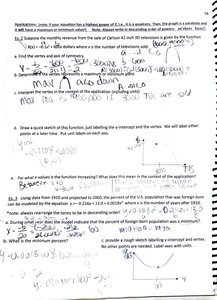
Quadratic functions are used to model various real-world situations, such as projectile motion and population growth.
Identify the y-intercept and vertex
Sketch the function and interpret its meaning
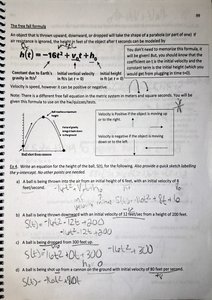
The Free Fall Formula
The height of an object thrown, dropped, or projected can be modeled by a quadratic function:
(for feet and seconds)
(for meters and seconds)
Where is the initial velocity and is the initial height.
Graphing Quadratic Models
Graphing quadratic models involves identifying the vertex, y-intercept, and axis of symmetry, and sketching the parabola to represent the situation.
Label axes and units
Interpret the meaning of the vertex and intercepts