 뒤로
뒤로Functions and Their Graphs: Key Concepts and Applications
스터디 가이드 - 스마트 노트
 자료에 맞춘 맞춤형 노트, 핵심 정의, 예시, 맥락을 확장해 제공합니다.
Functions and Graphs
Increasing, Decreasing, and Constant Functions
Understanding how a function behaves on different intervals is fundamental in College Algebra. A function can be classified as increasing, decreasing, or constant based on the relationship between its values at different points.
Increasing Function: A function is increasing on an open interval I if whenever for any and in the interval.
Decreasing Function: A function is decreasing on an open interval I if whenever for any and in the interval.
Constant Function: A function is constant on an open interval I if for any and in the interval.
Example: Consider a function whose graph rises, falls, and then remains flat. The intervals where the graph rises are increasing, where it falls are decreasing, and where it is flat are constant.

Relative Maxima and Minima
Relative maxima and minima are important for analyzing the peaks and valleys of a function's graph. These points represent local highest and lowest values within a specific interval.
Relative Maximum: is a relative maximum if there exists an open interval containing such that for all in the interval.
Relative Minimum: is a relative minimum if there exists an open interval containing such that for all in the interval.
Example: If a graph has a peak at and a valley at , then is a relative maximum and is a relative minimum.
Even and Odd Functions
Classifying functions as even or odd helps in understanding their symmetry properties, which is useful for graphing and analysis.
Even Function: for all in the domain. The graph is symmetric with respect to the y-axis.
Odd Function: for all in the domain. The graph is symmetric with respect to the origin.
Neither: If a function does not satisfy either condition, it is neither even nor odd.
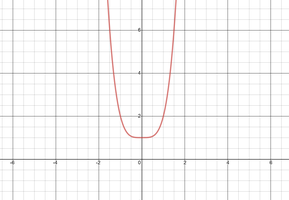
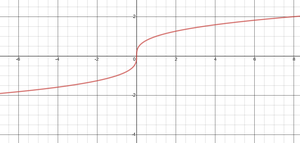
Example: The function is even, while is odd.
Piecewise Functions
A piecewise function is defined by different expressions over different parts of its domain. These functions are useful for modeling situations where a rule changes based on the input value.
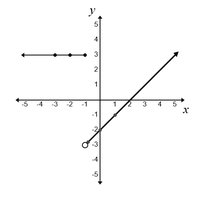
Definition: A function defined by two or more equations over specified intervals.
Example: A function defined as for and for .
Application: Piecewise functions are often used in real-world scenarios, such as tax brackets or shipping costs.
Difference Quotient
The difference quotient is a fundamental concept in calculus and algebra, used to measure the average rate of change of a function over an interval.
Definition: The difference quotient of a function is given by: for .
Example: If , then: .
Application: The difference quotient is used to find the slope of a secant line and is foundational for understanding derivatives.
