 뒤로
뒤로Quadratic Equations: Methods, Applications, and the Pythagorean Theorem
스터디 가이드 - 스마트 노트
 자료에 맞춘 맞춤형 노트, 핵심 정의, 예시, 맥락을 확장해 제공합니다.
Quadratic Equations and Their Solutions
Definition of a Quadratic Equation
A quadratic equation in x is an equation that can be written in the general form:
where a, b, and c are real numbers, with a ≠ 0. Quadratic equations are also called second-degree polynomial equations in x.
Methods for Solving Quadratic Equations
Factoring
Square Root Property
Quadratic Formula
Using the Discriminant
Solving Quadratic Equations by Factoring
The Zero-Product Principle
The zero-product principle states that if the product of two algebraic expressions is zero, then at least one of the factors must be zero:
If , then or .
Steps for Solving by Factoring
Rewrite the equation in general form: .
Factor the quadratic expression completely.
Set each factor containing a variable equal to zero.
Solve the resulting linear equations.
Check the solutions in the original equation.
Example: Solving by Factoring
Suppose we have .
Step 1: Already in general form.
Step 2: Factor: .
Step 3: Set each factor to zero: or .
Step 4: Solutions: or .
Step 5: Check in the original equation.
Solving Quadratic Equations by the Square Root Property
Quadratic equations of the form (where u is an algebraic expression and d is a nonzero real number) can be solved using the Square Root Property:
If , then or .
Equivalently, .
Example: Solving by the Square Root Property
Solve :
Take the square root of both sides: .
So, or .
Solving Quadratic Equations Using the Quadratic Formula
The quadratic formula provides the solutions to any quadratic equation (with ):
Example: Using the Quadratic Formula
Solve :
Here, , , .
Plug into the formula:
The Discriminant
The discriminant of a quadratic equation is the expression under the square root in the quadratic formula:
The discriminant determines the number and type of solutions:
If : Two unequal real solutions
If : One real (repeated) solution
If : Two imaginary (complex) solutions
Example: Using the Discriminant
For , , , :
(positive, so two real solutions)
Applications of Quadratic Equations
Modeling with Quadratic Equations
Quadratic equations are used to model various real-world phenomena, such as projectile motion, area problems, and physical relationships.
Example: Blood Pressure Model
The formula models a woman’s normal systolic blood pressure, P, at age A. To find the age for a given blood pressure, solve the quadratic equation for A.
The Pythagorean Theorem
Statement and Formula
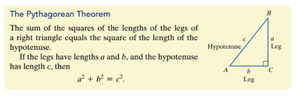
The Pythagorean Theorem relates the lengths of the sides of a right triangle. If the legs have lengths a and b, and the hypotenuse has length c, then:
Example: Application to a Wheelchair Ramp
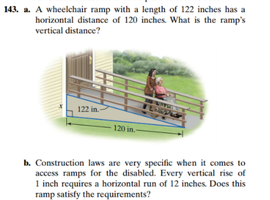
A wheelchair ramp with a length of 122 inches (hypotenuse) and a horizontal distance of 120 inches (one leg) is given. To find the vertical distance (other leg), use the Pythagorean Theorem:
Let x be the vertical distance.
Set up the equation:
Solve for x:
inches
Checking Construction Requirements
Construction laws may require that every vertical rise of 1 inch corresponds to a horizontal run of 12 inches. For a vertical rise of 22 inches, the required horizontal run would be inches. Since the ramp's horizontal run is only 120 inches, it does not satisfy the requirement.
Additional info: The Pythagorean Theorem is a fundamental tool in geometry and algebra for relating the sides of right triangles, and is frequently used in practical applications such as construction, navigation, and physics.
