 뒤로
뒤로Rational Functions and Their Graphs: College Algebra Study Guide
스터디 가이드 - 스마트 노트
 자료에 맞춘 맞춤형 노트, 핵심 정의, 예시, 맥락을 확장해 제공합니다.
Chapter 3: Polynomial and Rational Functions
3.5 Rational Functions and Their Graphs
This section explores rational functions, their domains, asymptotes, transformations, and applications. Rational functions are quotients of polynomial functions and are fundamental in understanding advanced algebraic concepts and real-world modeling.
Rational Functions
Definition: A rational function is any function that can be written as the quotient of two polynomial functions:
, where and are polynomials and .
The domain of a rational function is all real numbers except those that make the denominator zero.
Example: For , the domain is all real numbers except .
Example: For , the domain is all real numbers except and .
Example: For , the denominator never equals zero for real , so the domain is all real numbers.
Arrow Notation
Arrow notation is used to describe the behavior of functions as approaches certain values, such as infinity or points of discontinuity.
Vertical Asymptotes
Definition: The line is a vertical asymptote of the graph of if increases or decreases without bound as approaches .
Vertical asymptotes occur at values of that make the denominator zero (after canceling common factors).
Example: For , the vertical asymptotes are and .
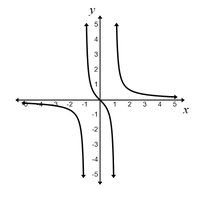
Example: For , there are no vertical asymptotes because the denominator has no real zeros.
Horizontal Asymptotes
Definition: The line is a horizontal asymptote of the graph of if approaches as increases or decreases without bound.
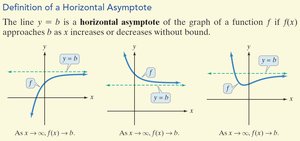
Locating Horizontal Asymptotes
To determine the horizontal asymptote for :
If , the horizontal asymptote is (the x-axis).
If , the horizontal asymptote is (ratio of leading coefficients).
If , there is no horizontal asymptote.
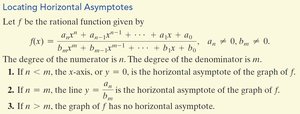
Example: For , the horizontal asymptote is .
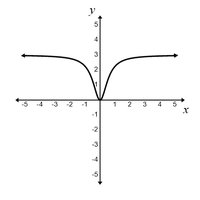
Example: For , the horizontal asymptote is .
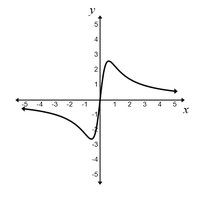
Example: For , there is no horizontal asymptote.
Basic Reciprocal Functions
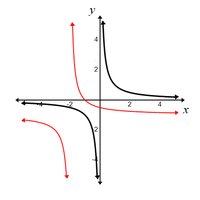
The basic reciprocal functions and are foundational examples of rational functions. Their graphs exhibit symmetry and characteristic asymptotes.
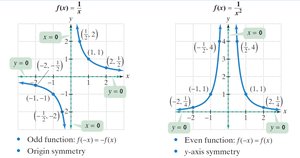
Transformations of Rational Functions
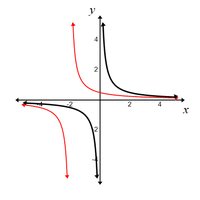
Transformations such as shifts and reflections can be applied to rational functions to alter their graphs. The location of asymptotes changes accordingly.
Example: Shifting two units left gives , moving the vertical asymptote to .
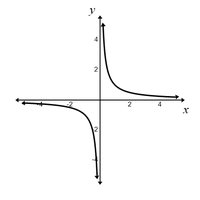
Example: Shifting one unit down gives , moving the horizontal asymptote to .
Strategy for Graphing Rational Functions
To graph (with no common factors):
Determine symmetry (y-axis or origin).
Find the y-intercept by evaluating .
Find x-intercepts by solving .
Find vertical asymptotes by solving .
Find horizontal asymptotes using degree rules.
Plot points between and beyond intercepts and asymptotes.
Draw the graph using all gathered information.
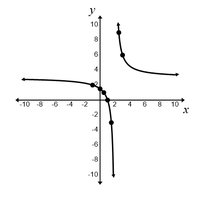
Example: For :
No symmetry.
Y-intercept: .
X-intercept: .
Vertical asymptote: .
Horizontal asymptote: (degrees equal, leading coefficients).
Plot points near asymptotes and intercepts.
Slant (Oblique) Asymptotes
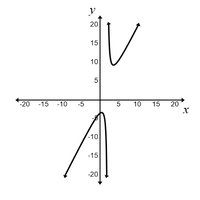
A rational function has a slant asymptote if the degree of the numerator is one more than the degree of the denominator. The slant asymptote is found by dividing the numerator by the denominator.
Example: For , divide by to get the slant asymptote .
Applications of Rational Functions
Rational functions are used in modeling real-world situations, such as cost functions in manufacturing.
Cost Function: (fixed plus variable costs).
Average Cost Function: .
As production increases, the average cost per item approaches the variable cost ().
Example: For , ; for , ; for , .
Interpretation: The horizontal asymptote means that as more wheelchairs are produced, the average cost per wheelchair approaches $400$.
