 뒤로
뒤로Solving and Graphing Linear Equations and Inequalities
스터디 가이드 - 스마트 노트
 자료에 맞춘 맞춤형 노트, 핵심 정의, 예시, 맥락을 확장해 제공합니다.
Q1. Solve the following equations for \( \lambda \) or \( x \):
e) \( \lambda = -\frac{3}{7}x - 7 \)
q) \( \lambda = 0 \)
c) \( \lambda + 3 = -5x \)
p) \( \lambda - 5x = 2 \)
s) \( x = -2 \)
Background
Topic: Solving Linear Equations
This question tests your ability to solve basic linear equations for a given variable. These are foundational skills in College Algebra, as they are used to find unknowns and analyze relationships between variables.
Key Terms and Formulas:
Linear Equation: An equation of the form \( ax + b = c \) or \( y = mx + b \).
Isolate the Variable: Use algebraic operations to get the variable alone on one side of the equation.
Step-by-Step Guidance
For each equation, identify the variable you are solving for (either \( \lambda \) or \( x \)).
Use inverse operations (addition/subtraction, multiplication/division) to isolate the variable on one side of the equation.
For equations with more than one variable, rearrange the equation so that the variable of interest is by itself.
For equations like \( x = -2 \) or \( \lambda = 0 \), the solution is already given.
For equations with fractions, multiply both sides by the denominator to clear the fraction before isolating the variable.
Try solving on your own before revealing the answer!
Final Answers:
e) \( \lambda = -\frac{3}{7}x - 7 \) (already solved for \( \lambda \))
q) \( \lambda = 0 \) (already solved for \( \lambda \))
c) \( \lambda = -5x - 3 \)
p) \( \lambda = 5x + 2 \)
s) \( x = -2 \) (already solved for \( x \))
Each equation is solved for the indicated variable using basic algebraic manipulation.
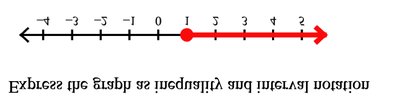
Q2. Express the given graph as an inequality and in interval notation:
Background
Topic: Graphing Inequalities and Interval Notation
This question tests your ability to interpret a number line graph and write the corresponding inequality and interval notation. This is a key skill for understanding solution sets in algebra.
Key Terms and Formulas:
Inequality: A mathematical statement that relates expressions using symbols like \( >, <, \geq, \leq \).
Interval Notation: A way to describe sets of numbers using parentheses and brackets.
Step-by-Step Guidance
Observe the number line: The closed circle at 1 means the value 1 is included in the solution set.
The arrow to the right indicates all values greater than or equal to 1 are included.
Write the inequality that matches this description.
Express the solution in interval notation, using a bracket to include 1 and a parenthesis for infinity.
Try solving on your own before revealing the answer!
Final Answer:
Inequality: \( x \geq 1 \)
Interval Notation: \( [1, \infty) \)
The closed circle means 1 is included, and the arrow shows all numbers greater than or equal to 1.
Q3. Express the given graph as an inequality and in interval notation:

Background
Topic: Graphing Inequalities and Interval Notation
This question tests your ability to interpret a number line graph and write the corresponding inequality and interval notation.
Key Terms and Formulas:
Open Circle: The endpoint is not included in the solution set.
Shading to the Left: Indicates all values less than the endpoint.
Step-by-Step Guidance
Notice the open circle at 3, which means 3 is not included in the solution set.
The arrow to the left shows all values less than 3 are included.
Write the inequality that matches this description.
Express the solution in interval notation, using a parenthesis to exclude 3.
Try solving on your own before revealing the answer!
Final Answer:
Inequality: \( x < 3 \)
Interval Notation: \( (-\infty, 3) \)
The open circle means 3 is not included, and the arrow shows all numbers less than 3.
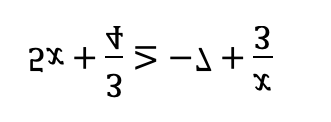
Q4. Solve the inequality: \( 2x + \frac{4}{3} \geq -4 + \frac{3}{x} \)
Background
Topic: Solving Rational Inequalities
This question tests your ability to solve inequalities involving fractions and variables. These require careful manipulation and consideration of the domain.
Key Terms and Formulas:
Rational Inequality: An inequality that contains fractions with variables in the denominator.
Domain: The set of all possible values for which the expression is defined (e.g., \( x \neq 0 \) if \( x \) is in the denominator).
Step-by-Step Guidance
Identify the domain restrictions (e.g., \( x \neq 0 \)).
Move all terms to one side to set the inequality to zero: \( 2x + \frac{4}{3} + 4 - \frac{3}{x} \geq 0 \).
Combine like terms and write as a single rational expression.
Find a common denominator to combine the terms.
Set the numerator equal to zero to find critical points, and test intervals to determine where the inequality holds.
Try solving on your own before revealing the answer!
Final Answer:
The solution is \( x \geq \text{(value from solving the rational inequality)} \), excluding any values that make the denominator zero.
Check your work by testing values in each interval determined by the critical points.
