 뒤로
뒤로Solving Linear Equations and Applications in College Algebra
스터디 가이드 - 스마트 노트
 자료에 맞춘 맞춤형 노트, 핵심 정의, 예시, 맥락을 확장해 제공합니다.
Equations and Inequalities
Models and Applications
Mathematical models use equations to represent real-world situations, allowing us to solve practical problems by translating words into algebraic expressions. The process of solving word problems with linear equations involves a systematic approach to ensure accuracy and clarity.
Step 1: Let x represent one of the unknown quantities.
Step 2: Represent other unknown quantities in terms of x.
Step 3: Write an equation in x that models the conditions of the problem.
Step 4: Solve the equation and answer the question.
Step 5: Check the solution in the original wording of the problem, not just in the equation.
Example 1: Salary Comparison Problem
This example demonstrates how to use a linear equation to compare the median starting salaries of three majors, given their relationships and total sum.
Let x: Median starting salary of an education major.
Computer Science: x + 21 (thousand dollars)
Economics: x + 14 (thousand dollars)
Equation: x + (x + 21) + (x + 14) = 140
Solution: x = 35 (Education), 56 (Computer Science), 49 (Economics)
Verification: 35 + 56 + 49 = 140
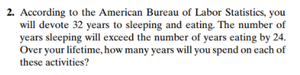
Example 2: Years Spent Sleeping and Eating
This problem asks you to determine the number of years spent on two activities, given their sum and the difference between them.
Let x: Years spent eating.
Years sleeping: x + 24
Equation: x + (x + 24) = 32
Solution: 2x + 24 = 32 \Rightarrow 2x = 8 \Rightarrow x = 4
Years eating: 4
Years sleeping: 28
Example 3: Comparing Texting Plans
Linear equations can be used to compare costs and determine break-even points between two pricing plans.
Let x: Number of text messages.
Plan A:
Plan B:
Equation:
Solution:
Verification: Both plans cost $39 for 300 messages.
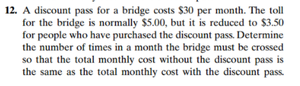
Example 4: Bridge Toll Cost Comparison
This example involves finding the number of times a bridge must be crossed for two payment options to cost the same.
Let x: Number of bridge crossings per month.
Without pass:
With pass:
Equation:
Solution:
Verification: For 20 crossings, both options cost $100.
Example 5: Price Reduction Problem
Solving for the original price before a percentage reduction is a common application of linear equations.
Let x: Price before reduction.
Equation:
Solution:
Verification:
Example 6: Investment Problem
Problems involving investments at different interest rates can be modeled with linear equations to find the amount invested at each rate.
Let x: Amount invested at 9%.
Amount at 11%:
Equation:
Solution: at 9%, $1850$ at 11%
Verification:
Example 7: Basketball Court Dimensions
Geometry problems often require setting up equations based on perimeter or area formulas.
Let x: Width of the court.
Length:
Equation:
Solution: ft (width), ft (length)
Verification:
Solving a Formula for a Variable
Solving a formula for a variable means rewriting the formula so that the variable is isolated on one side of the equation. This is useful for rearranging equations to solve for different quantities in applications.
Example: Rearranging the area formula for a rectangle to solve for gives .
Common Formulas for Area, Perimeter, and Volume
Many application problems require knowledge of standard geometric formulas. The following table summarizes common formulas used in College Algebra.
Shape | Area (A) | Perimeter/Circumference (P or C) | Volume (V) |
|---|---|---|---|
Square | |||
Rectangle | |||
Circle | |||
Triangle | |||
Trapezoid | |||
Cube | |||
Rectangular Solid | |||
Circular Cylinder | |||
Sphere | |||
Cone |
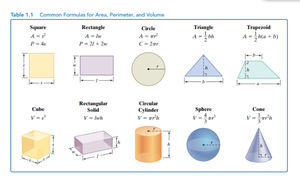
Additional info: The examples and table above provide a foundation for solving a wide range of application problems in College Algebra, including those involving geometry, finance, and everyday decision-making.
