 뒤로
뒤로Step-by-Step Guidance for Trigonometry and Pythagorean Theorem Problems (College Algebra)
스터디 가이드 - 스마트 노트
 자료에 맞춘 맞춤형 노트, 핵심 정의, 예시, 맥락을 확장해 제공합니다.
Q4. John puts the base of a 13-foot ladder 7 feet from the wall of his house. How far up the wall does the ladder reach? Round your answer to two decimal places.
Background
Topic: Pythagorean Theorem in Right Triangles
This question tests your ability to apply the Pythagorean Theorem to solve for a missing side in a right triangle, a common application in trigonometry and College Algebra.
Key Terms and Formulas
Pythagorean Theorem:
and are the legs (shorter sides) of the right triangle.
is the hypotenuse (the longest side, opposite the right angle).
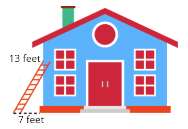
Step-by-Step Guidance
Identify the sides of the triangle: the ladder (13 ft) is the hypotenuse, the distance from the wall (7 ft) is one leg, and the height up the wall is the other leg.
Set up the Pythagorean Theorem: , where is the height up the wall.
Calculate and to get the numerical values for the equation.
Rearrange the equation to solve for by subtracting from .
Try solving on your own before revealing the answer!
Final Answer: 11.38 feet
Using the Pythagorean Theorem:
Rounded to two decimal places, the ladder reaches approximately 11.38 feet up the wall.
