Ch. 1 - Equations and Inequalities
Blitzer - College Algebra 8th Edition
Blitzer8th EditionCollege AlgebraISBN: 9780136970514당신이 사용하는 게 아니라요?교과서 변경
2장, 문제 22

Solve each equation. Then state whether the equation is an identity, a conditional equation, or an inconsistent equation. 7x + 13 = 2(2x-5) + 3x + 23

검증된 단계별 안내
1
Start by expanding the right-hand side of the equation \(7x + 13 = 2(2x - 5) + 3x + 23\). Use the distributive property to multiply \(2\) by each term inside the parentheses: \(2 \times 2x\) and \(2 \times (-5)\).
Rewrite the equation after distribution: \(7x + 13 = 4x - 10 + 3x + 23\). Next, combine like terms on the right-hand side: combine \$4x\( and \)3x\(, and combine \)-10$ and \(23\).
After combining like terms, the equation becomes \(7x + 13 = 7x + 13\). Now, subtract \$7x$ from both sides to isolate the constants and variables separately.
Simplify the resulting equation after subtraction. You should get an equation involving only constants. Analyze this simplified equation to determine if it is always true, sometimes true, or never true.
Based on the simplified equation, classify the original equation as an identity (true for all values of \(x\)), a conditional equation (true for specific values of \(x\)), or an inconsistent equation (no solution).

비슷한 문제에 대한 검증된 영상 답변:

이 영상 해법은 위 문제에 도움이 된다고 튜터들이 추천한 것입니다.
영상 길이:
2m
도움이 되었나요?

주요 개념

질문에 올바르게 답하기 위해 반드시 이해해야 하는 핵심 개념들은 다음과 같습니다.

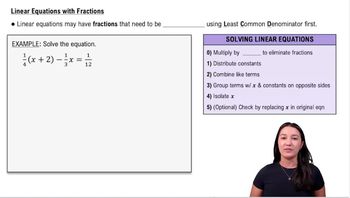
Solving Linear Equations

Solving linear equations involves isolating the variable on one side of the equation using inverse operations such as addition, subtraction, multiplication, and division. The goal is to find the value of the variable that makes the equation true.
추천 영상:
04:02
Solving Linear Equations with Fractions

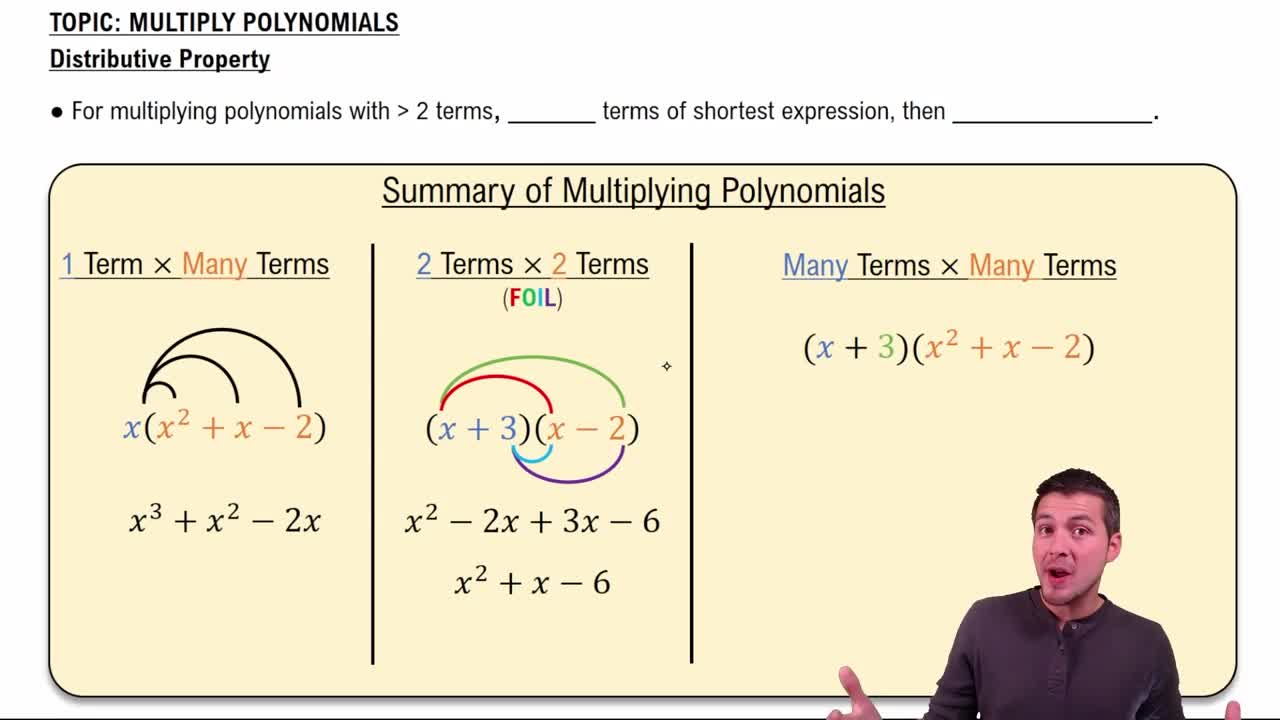
Distributive Property

The distributive property allows you to multiply a single term by each term inside parentheses, transforming expressions like a(b + c) into ab + ac. This step is essential for simplifying and solving equations involving parentheses.
추천 영상:
04:15
Multiply Polynomials Using the Distributive Property

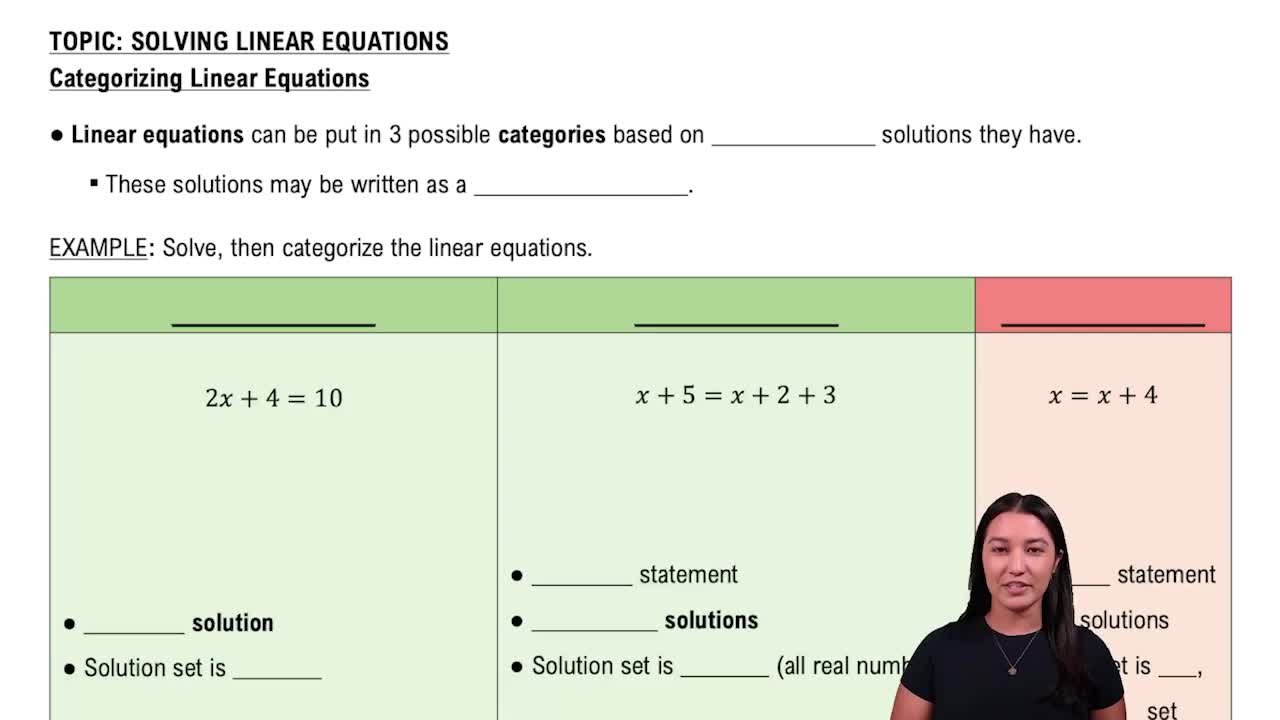
Types of Equations: Identity, Conditional, and Inconsistent

An identity is true for all variable values, a conditional equation is true for specific values, and an inconsistent equation has no solution. Identifying the type depends on the solution set after solving the equation.
추천 영상:
06:00
Categorizing Linear Equations