Ch. 1 - Equations and Inequalities
Blitzer - College Algebra 8th Edition
Blitzer8th EditionCollege AlgebraISBN: 9780136970514당신이 사용하는 게 아니라요?교과서 변경
2장, 문제 53

In Exercises 53–60, write each power of i as as i, - 1, - i, or 1. i31

검증된 단계별 안내
1
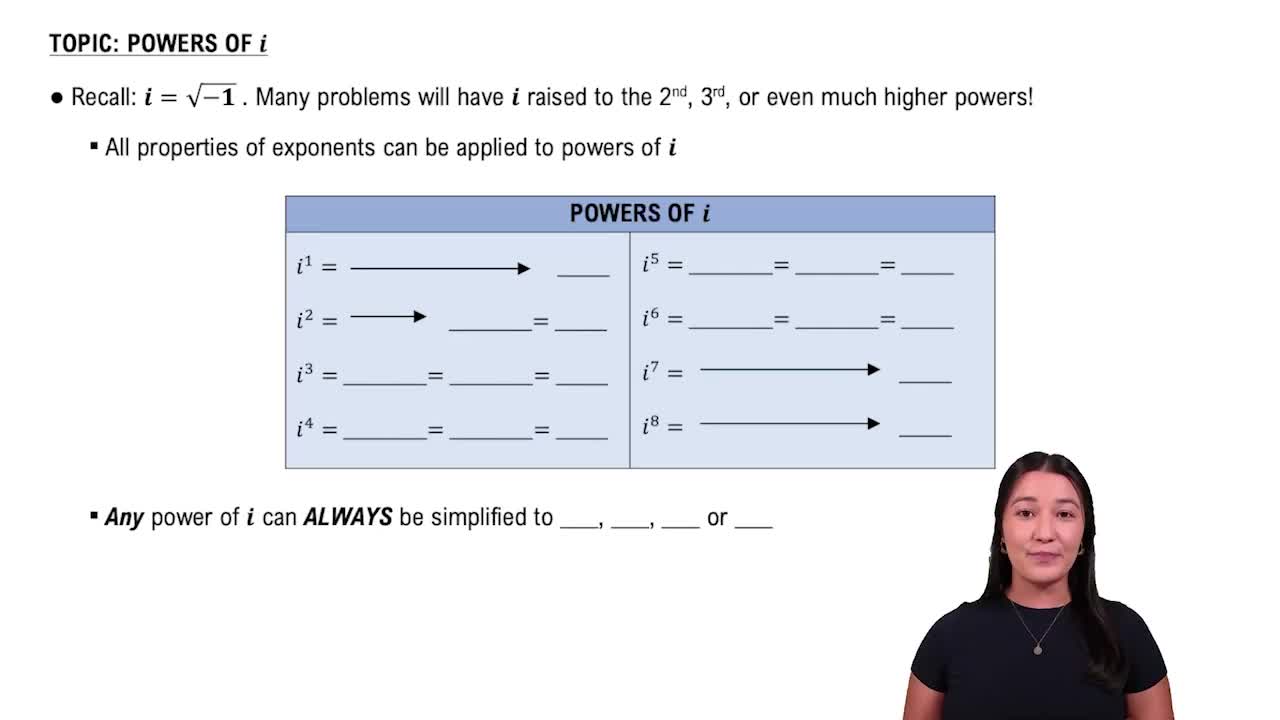
Step 1: Recall the cyclical nature of powers of i. The powers of i repeat in a cycle of four: i^1 = i, i^2 = -1, i^3 = -i, and i^4 = 1. This cycle repeats for higher powers of i.
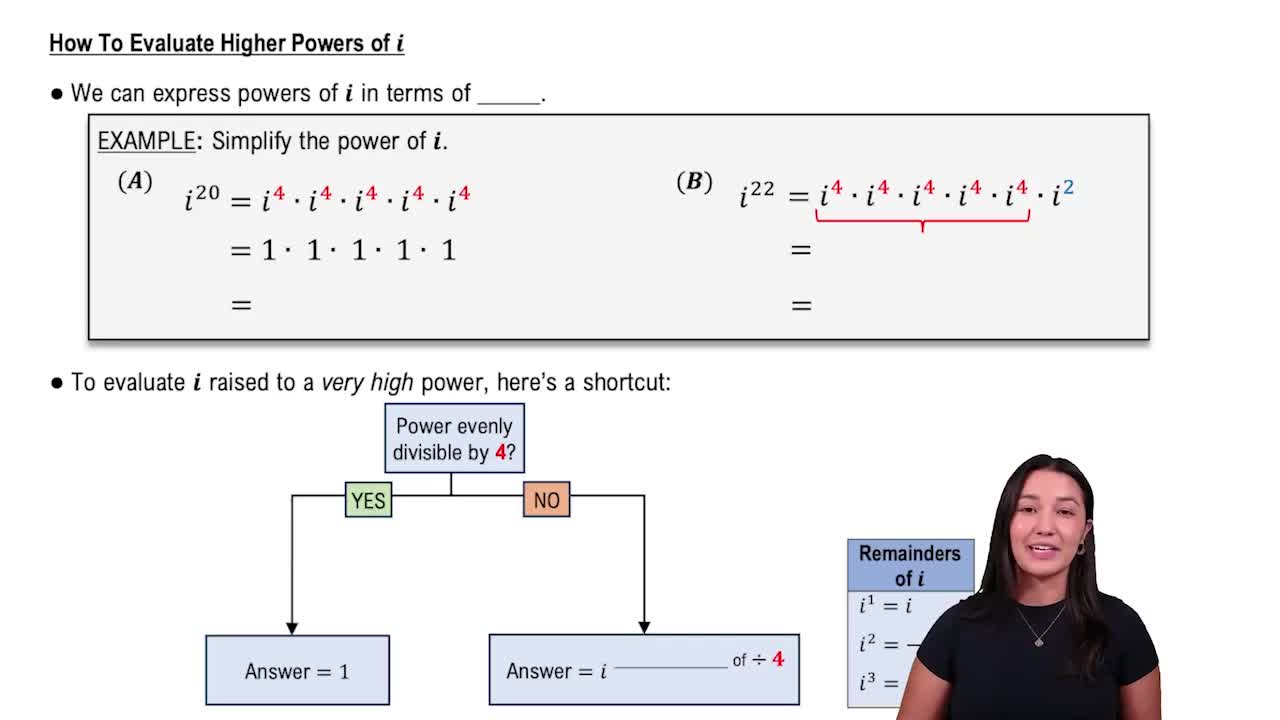
Step 2: To determine the value of i^31, divide the exponent (31) by 4 and find the remainder. This is because the cycle repeats every 4 powers.
Step 3: Perform the division: 31 ÷ 4. The quotient is 7, and the remainder is 3. This means i^31 is equivalent to i^3.
Step 4: Refer back to the cycle of powers of i. From the cycle, i^3 = -i.
Step 5: Conclude that i^31 simplifies to -i based on the cyclical pattern of powers of i.

비슷한 문제에 대한 검증된 영상 답변:

이 영상 해법은 위 문제에 도움이 된다고 튜터들이 추천한 것입니다.
영상 길이:
3m

주요 개념

질문에 올바르게 답하기 위해 반드시 이해해야 하는 핵심 개념들은 다음과 같습니다.

Powers of i

The imaginary unit i is defined as the square root of -1. Its powers cycle through four distinct values: i^1 = i, i^2 = -1, i^3 = -i, and i^4 = 1. This cyclical pattern repeats every four powers, which is crucial for simplifying higher powers of i.
추천 영상:
04:10
Powers of i

Modulus and Division

To simplify powers of i, we can use the modulus of the exponent with respect to 4. For example, to find i^31, we calculate 31 mod 4, which gives us a remainder of 3. This means i^31 is equivalent to i^3, allowing us to simplify the expression effectively.
추천 영상:
05:10
Higher Powers of i

Complex Numbers

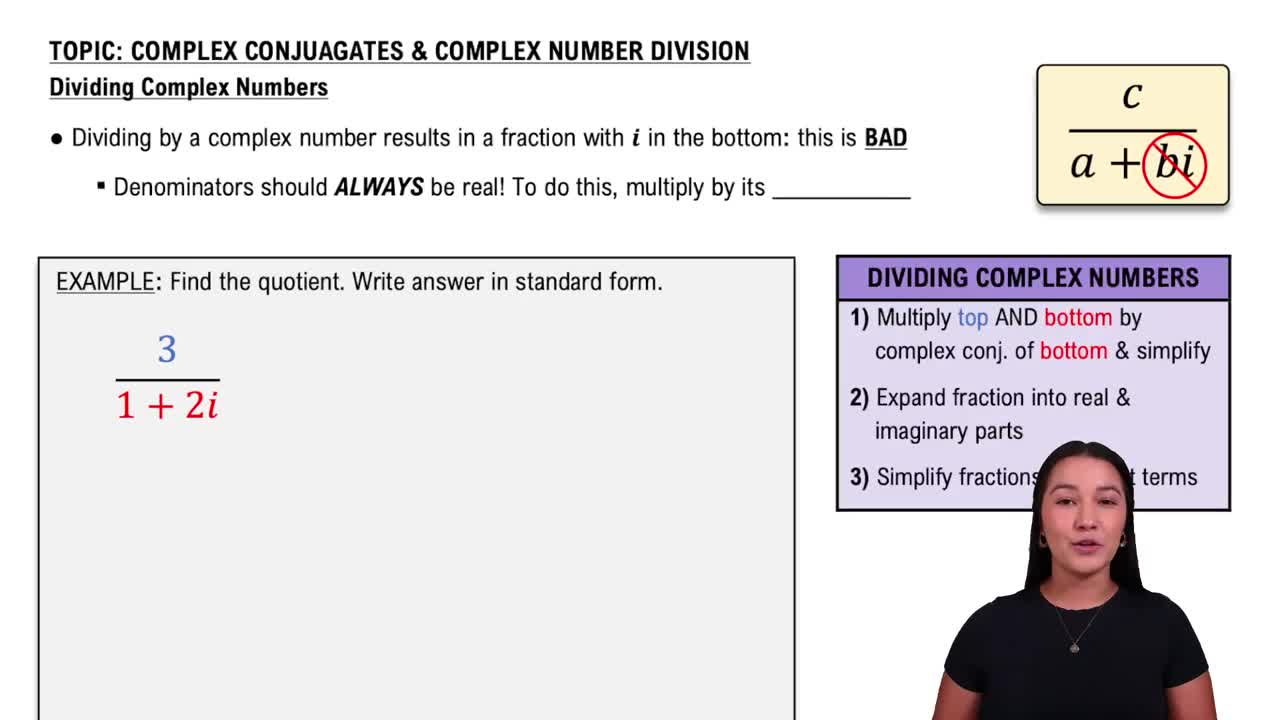
Complex numbers are numbers that have a real part and an imaginary part, expressed in the form a + bi, where a and b are real numbers. Understanding complex numbers is essential for working with powers of i, as they form the basis for many operations in algebra involving imaginary units.
추천 영상:
04:22
Dividing Complex Numbers