Ch. 1 - Equations and Inequalities
Blitzer - College Algebra 8th Edition
Blitzer8th EditionCollege AlgebraISBN: 9780136970514당신이 사용하는 게 아니라요?교과서 변경
2장, 문제 73

In Exercises 61–76, solve each absolute value equation or indicate that the equation has no solution. |x + 1| + 5 = 3

검증된 단계별 안내
1
Start with the given equation: \(|x + 1| + 5 = 3\).
Isolate the absolute value expression by subtracting 5 from both sides: \(|x + 1| = 3 - 5\).
Simplify the right side: \(|x + 1| = -2\).
Recall that the absolute value of any expression is always greater than or equal to zero, so \(|x + 1| = -2\) has no solution because an absolute value cannot be negative.
Conclude that the equation has no solution.

비슷한 문제에 대한 검증된 영상 답변:

이 영상 해법은 위 문제에 도움이 된다고 튜터들이 추천한 것입니다.
영상 길이:
1m
도움이 되었나요?

주요 개념

질문에 올바르게 답하기 위해 반드시 이해해야 하는 핵심 개념들은 다음과 같습니다.

Absolute Value Definition

The absolute value of a number represents its distance from zero on the number line, always as a non-negative value. For any expression |A| = B, if B is negative, there is no solution because absolute values cannot be negative.
추천 영상:
08:07
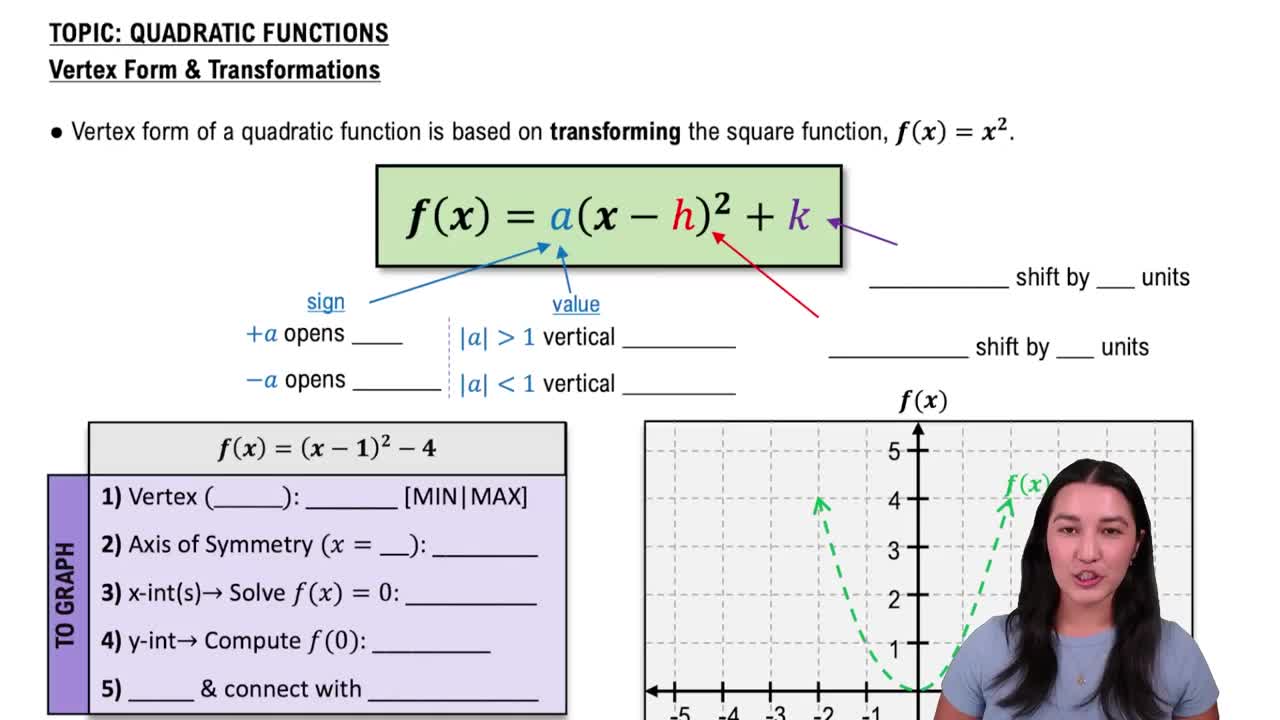
Vertex Form

Solving Absolute Value Equations

To solve an equation involving absolute value, isolate the absolute value expression first. Then, set up two separate equations: one where the inside expression equals the positive value, and one where it equals the negative value, solving each separately.
추천 영상:
5:02
Solving Logarithmic Equations

Checking for No Solution

If isolating the absolute value results in a negative number on the right side, the equation has no solution. This is because absolute values cannot be negative, so no real number satisfies the equation.
추천 영상:
05:21
Restrictions on Rational Equations