The rule for rewriting an absolute value equation without absolute value bars can be extended to equations with two sets of absolute value bars: If u and v represent algebraic expressions, then |u| = |v| is equivalent to u = v or u = - v. Use this to solve the equations in Exercises 77–84. |4x - 3| = |4x - 5|
Ch. 1 - Equations and Inequalities

2장, 문제 79a
Compute the discriminant. Then determine the number and type of solutions for the given equation. x2 - 2x + 1 = 0
검증된 단계별 안내1
Identify the coefficients of the quadratic equation in standard form, which is ax^2 + bx + c = 0. For the given equation x^2 - 2x + 1 = 0, the coefficients are: a = 1, b = -2, and c = 1.
Recall the formula for the discriminant, which is Δ = b^2 - 4ac. The discriminant helps determine the number and type of solutions for a quadratic equation.
Substitute the values of a, b, and c into the discriminant formula: Δ = (-2)^2 - 4(1)(1).
Simplify the expression for the discriminant. First, calculate (-2)^2, then calculate 4(1)(1), and finally subtract the second result from the first.
Interpret the value of the discriminant: If Δ > 0, there are two distinct real solutions. If Δ = 0, there is exactly one real solution (a repeated root). If Δ < 0, there are two complex solutions. Use this interpretation to determine the number and type of solutions for the given equation.

비슷한 문제에 대한 검증된 영상 답변:
이 영상 해법은 위 문제에 도움이 된다고 튜터들이 추천한 것입니다.
영상 길이:
2m도움이 되었나요?
주요 개념
질문에 올바르게 답하기 위해 반드시 이해해야 하는 핵심 개념들은 다음과 같습니다.
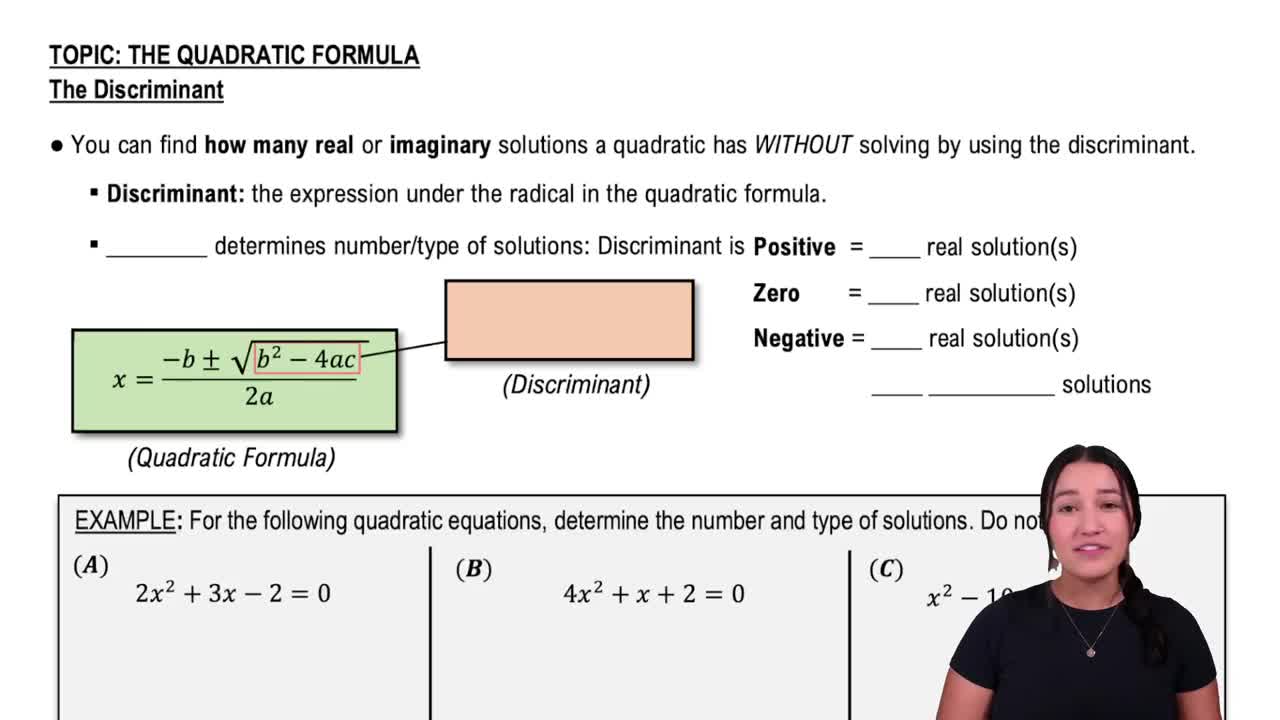
Discriminant
The discriminant is a key component of the quadratic formula, given by the expression b² - 4ac for a quadratic equation in the form ax² + bx + c = 0. It helps determine the nature of the roots of the equation. If the discriminant is positive, there are two distinct real solutions; if it is zero, there is exactly one real solution (a repeated root); and if it is negative, there are two complex solutions.
추천 영상:
The Discriminant
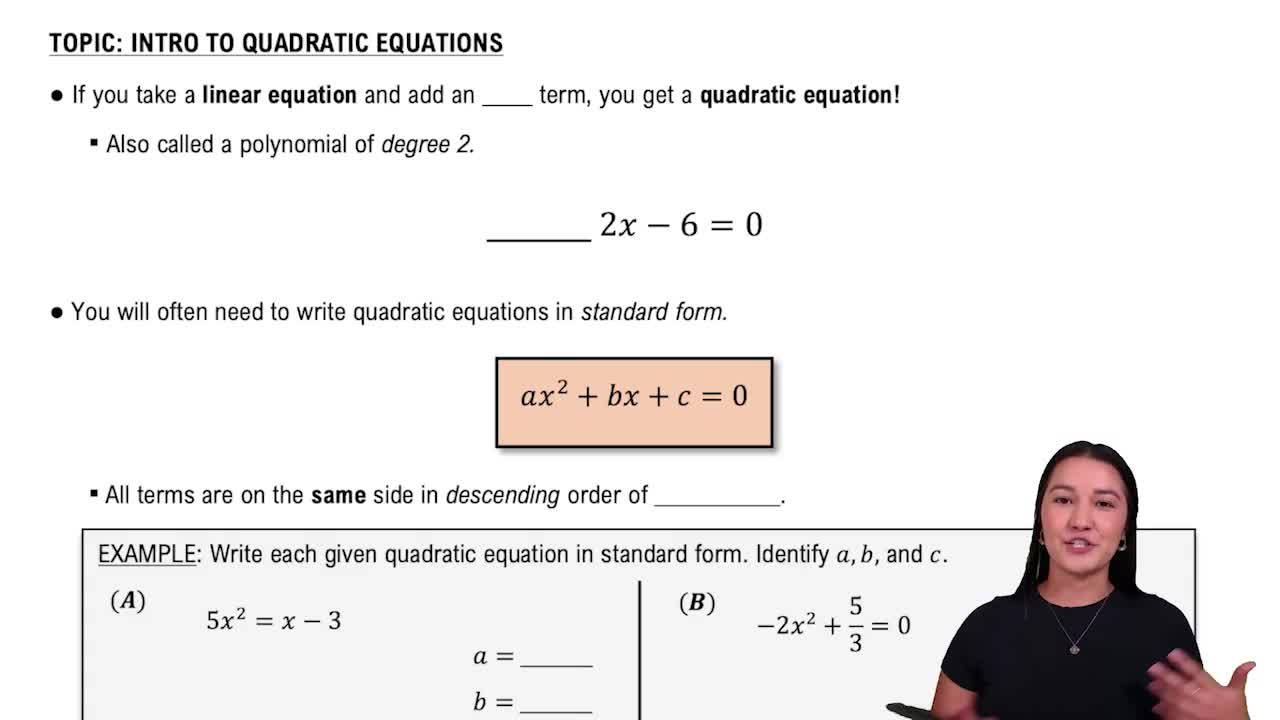
Quadratic Equation
A quadratic equation is a polynomial equation of degree two, typically expressed in the standard form ax² + bx + c = 0, where a, b, and c are constants and a ≠ 0. The solutions to a quadratic equation can be found using various methods, including factoring, completing the square, or applying the quadratic formula. Understanding the structure of quadratic equations is essential for analyzing their solutions.
추천 영상:
Introduction to Quadratic Equations
Types of Solutions
The types of solutions for a quadratic equation are classified based on the value of the discriminant. Real solutions occur when the discriminant is non-negative, while complex solutions arise when the discriminant is negative. This classification is crucial for understanding the behavior of the graph of the quadratic function, which can intersect the x-axis at different points depending on the nature of the solutions.
추천 영상:
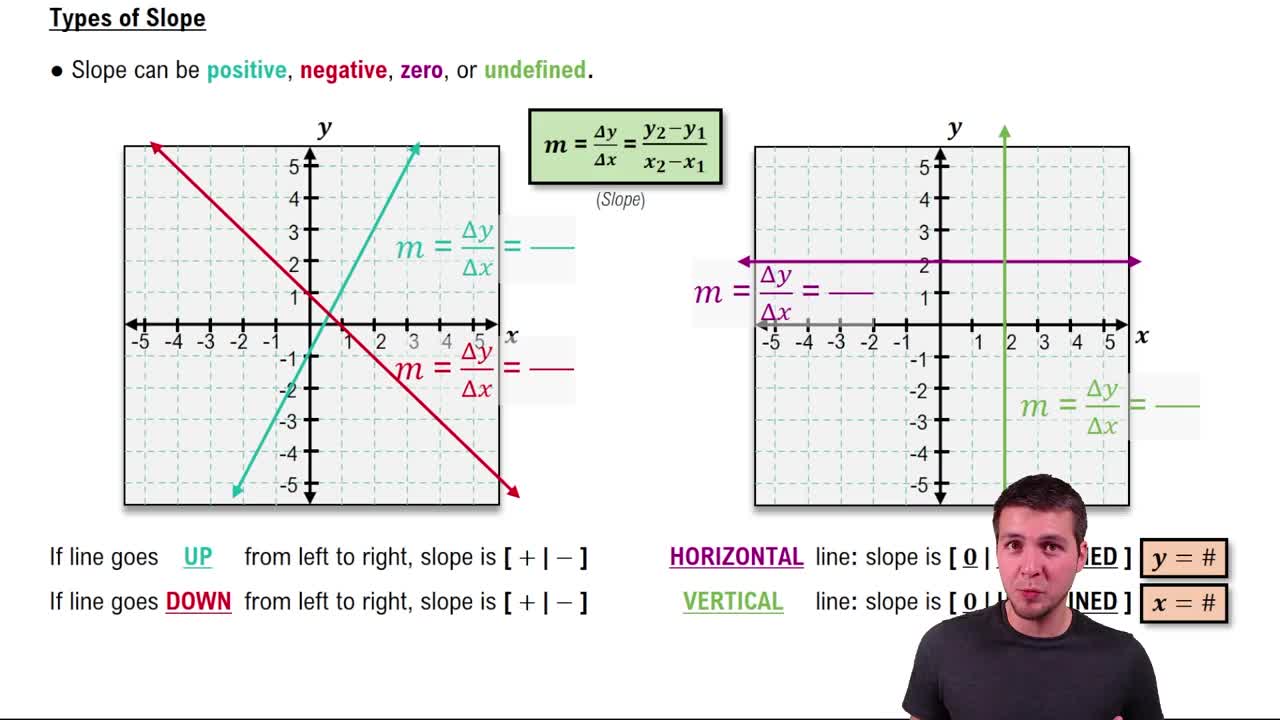
Types of Slope
관련 실천
교과서 질문
721
views
교과서 질문
In Exercises 77–92, use the graph to determine a. the function's domain; b.the x-intercepts, if any; and e. the missing function values, indicated by question marks, below each graph.
1153
views
교과서 질문
Solve each absolute value inequality. 5|2x + 1| - 3 ≥ 9
594
views
교과서 질문
In Exercises 59–94, solve each absolute value inequality. 3|x - 1| + 2 ≥ 8
873
views
교과서 질문
The rule for rewriting an absolute value equation without absolute value bars can be extended to equations with two sets of absolute value bars: If u and v represent algebraic expressions, then |u| = |v| is equivalent to u = v or u = - v. Use this to solve the equations in Exercises 77–84.
896
views
교과서 질문
List the quadrant or quadrants satisfying each condition. x3 > 0 and y3 <0
1230
views
