Simplify and write the result in standard form. √-49
Ch. 1 - Equations and Inequalities

2장, 문제 30
Solve each equation in Exercises 15–34 by the square root property. (4x - 1)2 = 16
검증된 단계별 안내1
Start by applying the square root property to both sides of the equation. The square root property states that if \((a)^2 = b\), then \(a = \pm \sqrt{b}\). Here, \((4x - 1)^2 = 16\), so take the square root of both sides to get \(4x - 1 = \pm \sqrt{16}\).
Simplify the square root on the right-hand side. Since \(\sqrt{16} = 4\), the equation becomes \(4x - 1 = \pm 4\). This means there are two cases to solve: \(4x - 1 = 4\) and \(4x - 1 = -4\).
Solve the first case, \(4x - 1 = 4\). Add 1 to both sides to isolate the \(4x\) term, resulting in \(4x = 5\). Then divide both sides by 4 to solve for \(x\), giving \(x = \frac{5}{4}\).
Solve the second case, \(4x - 1 = -4\). Add 1 to both sides to isolate the \(4x\) term, resulting in \(4x = -3\). Then divide both sides by 4 to solve for \(x\), giving \(x = \frac{-3}{4}\).
Combine the solutions from both cases. The solutions to the equation are \(x = \frac{5}{4}\) and \(x = \frac{-3}{4}\).

비슷한 문제에 대한 검증된 영상 답변:
이 영상 해법은 위 문제에 도움이 된다고 튜터들이 추천한 것입니다.
영상 길이:
3m도움이 되었나요?
주요 개념
질문에 올바르게 답하기 위해 반드시 이해해야 하는 핵심 개념들은 다음과 같습니다.
Square Root Property
The square root property states that if a quadratic equation is in the form (ax + b)^2 = c, then the solutions can be found by taking the square root of both sides. This results in two possible equations: ax + b = √c and ax + b = -√c. This property is essential for solving equations that involve squares.
추천 영상:
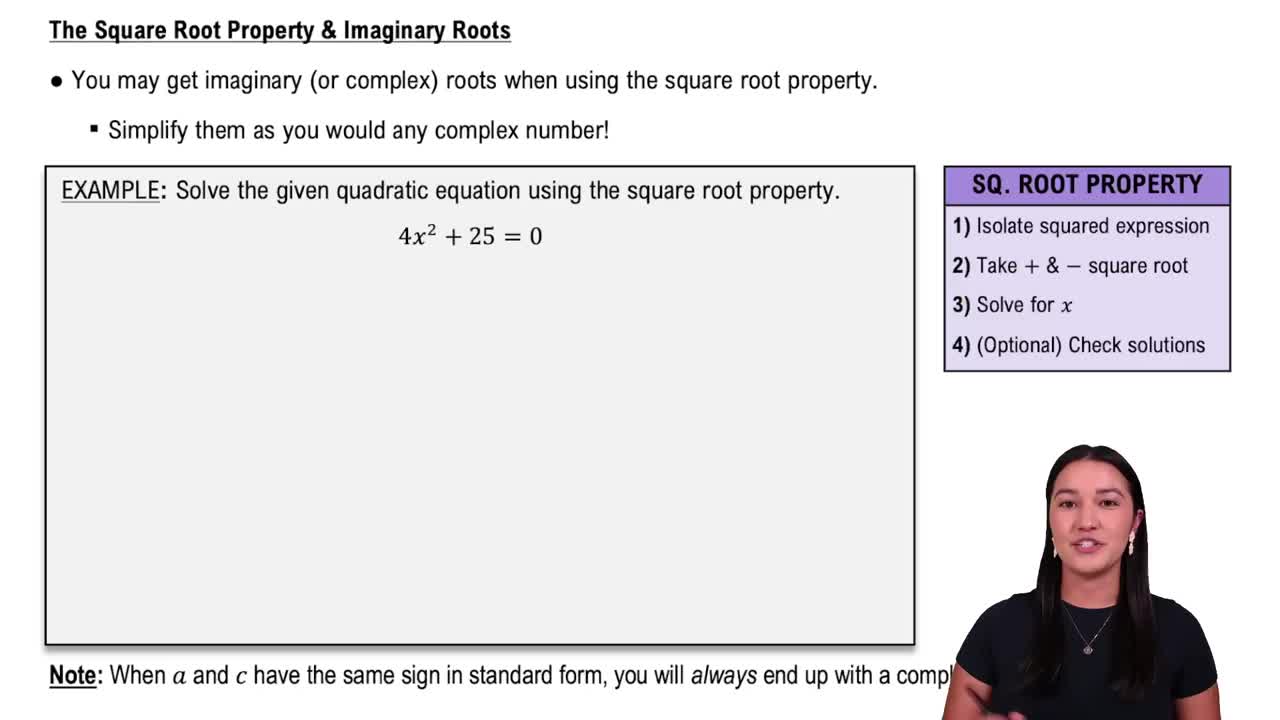
Imaginary Roots with the Square Root Property
Isolating the Variable
Isolating the variable involves rearranging the equation to get the variable on one side and the constants on the other. In the context of the square root property, this often means simplifying the equation to the form (ax + b)^2 = c before applying the square root. This step is crucial for accurately finding the values of the variable.
추천 영상:
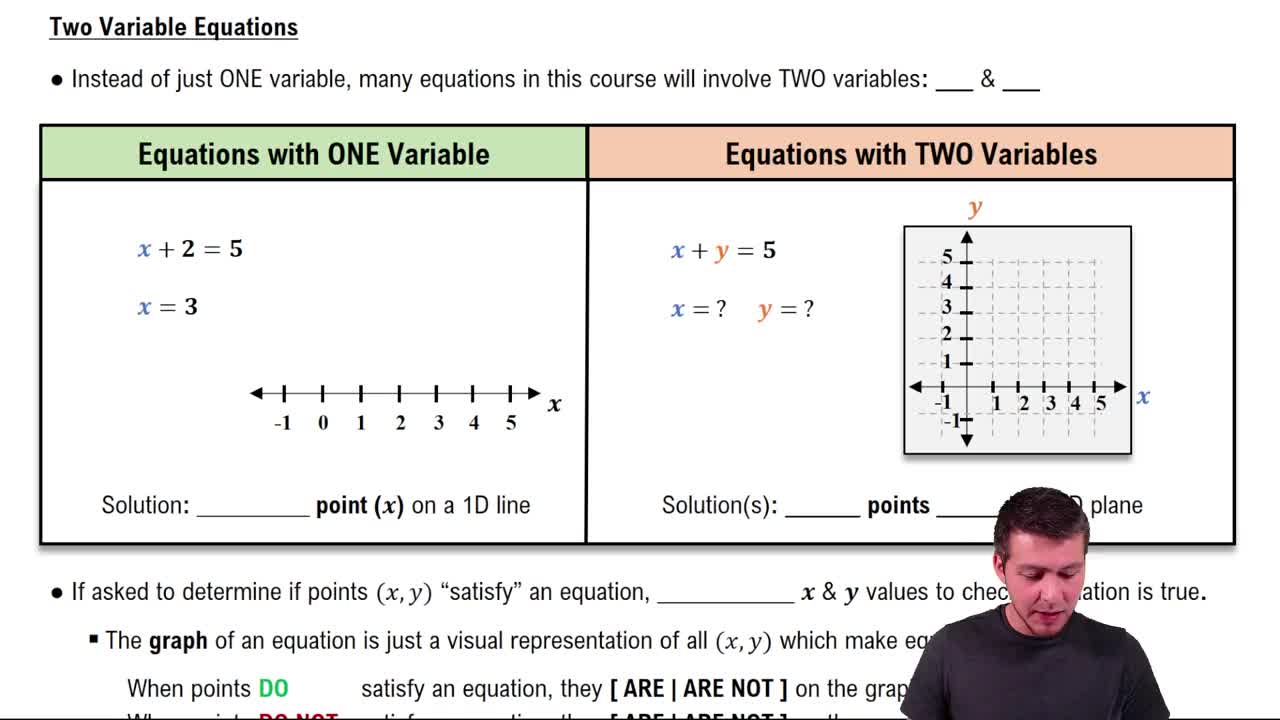
Equations with Two Variables
Extraneous Solutions
Extraneous solutions are solutions that emerge from the algebraic process but do not satisfy the original equation. When using the square root property, it is important to check each potential solution by substituting it back into the original equation to ensure it is valid. This helps avoid incorrect conclusions drawn from the algebraic manipulation.
추천 영상:
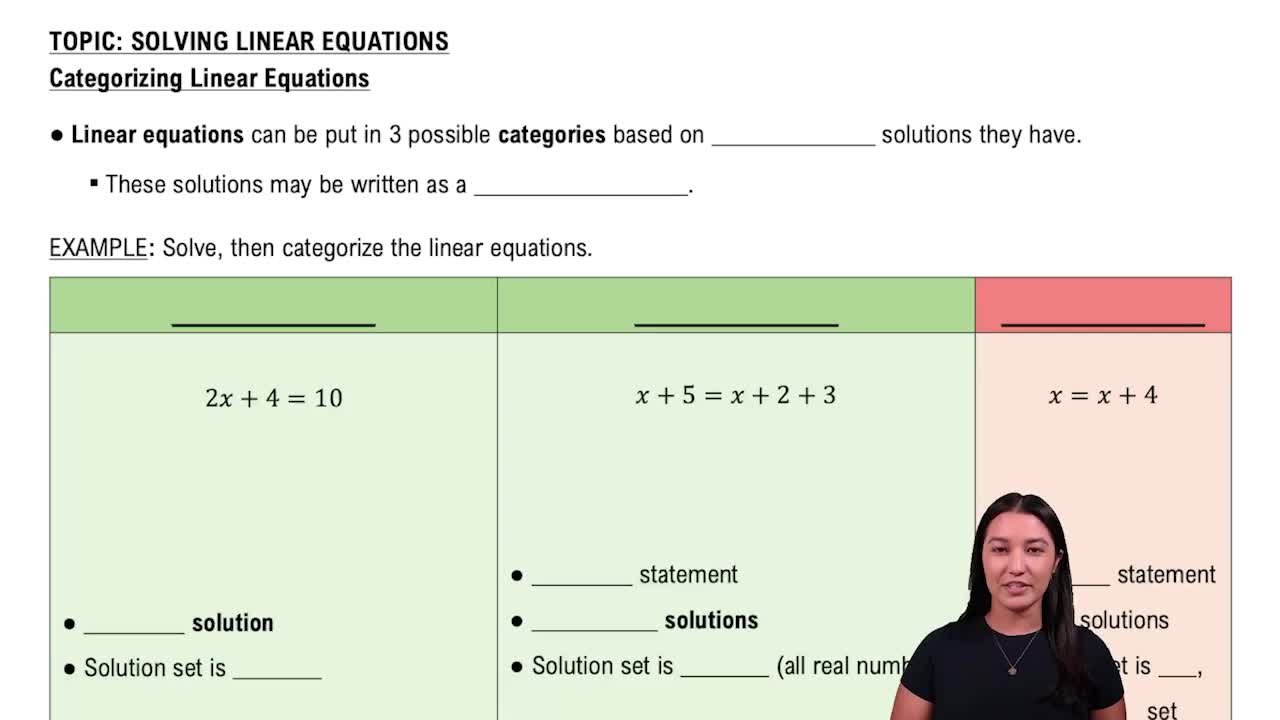
Categorizing Linear Equations
관련 실천
교과서 질문
853
views
교과서 질문
Solve each radical equation in Exercises 11–30. Check all proposed solutions.
757
views
교과서 질문
In all exercises, other than exercises with no solution, use interval notation to express solution sets and graph each solution set on a number line. In Exercises 27–50, solve each linear inequality. 3x - 7 ≥ 13
909
views
교과서 질문
Exercises 27–40 contain linear equations with constants in denominators. Solve each equation. 20 - x/3 = x/2
943
views
교과서 질문
Exercises 27–40 contain linear equations with constants in denominators. Solve each equation. x/5 - 1/2 = x/6
1019
views
1
rank
교과서 질문
An automobile repair shop charged a customer \$1182, listing \$357 for parts and the remainder for labor. If the cost of labor is \$75 per hour, how many hours of labor did it take to repair the car?
706
views