Ch. 2 - Functions and Graphs
Blitzer - College Algebra 8th Edition
Blitzer8th EditionCollege AlgebraISBN: 9780136970514당신이 사용하는 게 아니라요?교과서 변경
3장, 문제 9

In Exercises 1–10, determine whether each relation is a function. Give the domain and range for each relation. {(1, 4), (1, 5), (1, 6)}

검증된 단계별 안내
1
Recall that a relation is a function if each input (or x-value) corresponds to exactly one output (or y-value).
Examine the given relation: \(\{(1, 4), (1, 5), (1, 6)\}\). Notice that the input value 1 is paired with multiple outputs (4, 5, and 6).
Since the input 1 corresponds to more than one output, this relation is not a function.
Identify the domain by listing all unique input values. Here, the domain is \(\{1\}\) because 1 is the only input.
Identify the range by listing all output values. Here, the range is \(\{4, 5, 6\}\) because these are all the outputs paired with the input.

비슷한 문제에 대한 검증된 영상 답변:

이 영상 해법은 위 문제에 도움이 된다고 튜터들이 추천한 것입니다.
영상 길이:
1m
도움이 되었나요?

주요 개념

질문에 올바르게 답하기 위해 반드시 이해해야 하는 핵심 개념들은 다음과 같습니다.

Definition of a Function

A function is a relation where each input (domain element) corresponds to exactly one output (range element). If any input is paired with more than one output, the relation is not a function. This concept helps determine if the given set of ordered pairs qualifies as a function.
추천 영상:
5:57
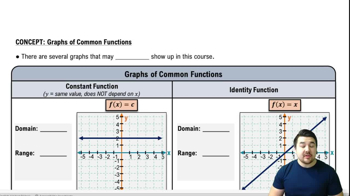
Graphs of Common Functions

Domain of a Relation

The domain is the set of all first elements (inputs) in the ordered pairs of a relation. Identifying the domain involves listing all unique x-values from the given pairs, which is essential for understanding the inputs the relation covers.
추천 영상:
5:20
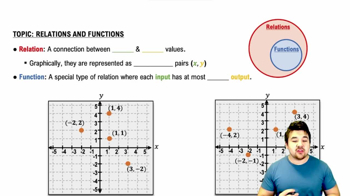
Relations and Functions

Range of a Relation

The range is the set of all second elements (outputs) in the ordered pairs of a relation. Finding the range involves listing all unique y-values from the pairs, which shows all possible outputs the relation produces.
추천 영상:
5:20
Relations and Functions