Find the average rate of change of the function from x1 to x2. f(x) = 3x from x1 = 0 to x2 = 5
Ch. 2 - Functions and Graphs

3장, 문제 13
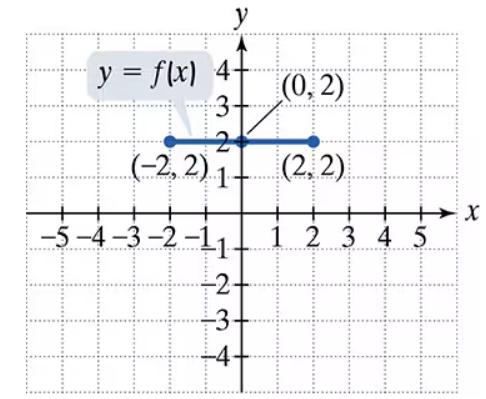
Use the graph of y = f(x) to graph each function g.

g(x) = f(x/2)
검증된 단계별 안내1
Step 1: Understand the transformation g(x) = f(x/2). This transformation involves a horizontal stretch of the graph of f(x) by a factor of 2. Each x-coordinate of the points on the graph of f(x) will be multiplied by 2, while the y-coordinates remain unchanged.
Step 2: Identify the key points on the graph of f(x). From the graph, the points are (1, -3) and (4, -3). These points will be transformed according to the horizontal stretch.
Step 3: Apply the transformation to the x-coordinates of the points. Multiply each x-coordinate by 2: For (1, -3), the new x-coordinate is 1 * 2 = 2, so the transformed point is (2, -3). For (4, -3), the new x-coordinate is 4 * 2 = 8, so the transformed point is (8, -3).
Step 4: Plot the transformed points (2, -3) and (8, -3) on the graph. These points represent the new positions of the graph after the horizontal stretch.
Step 5: Draw the graph of g(x) = f(x/2) by connecting the transformed points with a horizontal line, maintaining the same y-value (-3) across the stretch.

비슷한 문제에 대한 검증된 영상 답변:
이 영상 해법은 위 문제에 도움이 된다고 튜터들이 추천한 것입니다.
영상 길이:
1m도움이 되었나요?
주요 개념
질문에 올바르게 답하기 위해 반드시 이해해야 하는 핵심 개념들은 다음과 같습니다.
Function Transformation
Function transformation refers to the process of altering the graph of a function through various operations, such as shifting, stretching, or compressing. In this case, the function g(x) = f(x/2) represents a horizontal stretch of the original function f(x) by a factor of 2, meaning that every x-coordinate in the graph of f(x) is doubled in g(x).
추천 영상:
Domain & Range of Transformed Functions
Horizontal Stretch
A horizontal stretch occurs when the x-values of a function are multiplied by a factor less than 1. For g(x) = f(x/2), the x-values are effectively halved, which stretches the graph horizontally. This transformation results in the graph of g(x) appearing wider than that of f(x), as points that were originally close together on f(x) will be spaced further apart on g(x).
추천 영상:
Stretches & Shrinks of Functions
Graph Interpretation
Graph interpretation involves analyzing the visual representation of a function to extract information about its behavior, such as intercepts, maxima, minima, and overall shape. In this exercise, understanding the graph of f(x) is crucial to accurately sketching g(x), as it allows one to see how the transformation affects the positions of key points and the overall structure of the graph.
추천 영상:
Graphs and Coordinates - Example
관련 실천
교과서 질문
135
views
교과서 질문
Find the domain of each function. h(x) = 4/(3/x - 1)
835
views
교과서 질문
Find the distance between each pair of points. If necessary, express answers in simplified radical form and then round to two decimal places. (0, −√3) and (√5, 0)
831
views
교과서 질문
The functions in Exercises 11-28 are all one-to-one. For each function, a. Find an equation for f-1(x), the inverse function. b. Verify that your equation is correct by showing that f(ƒ-1 (x)) = = x and ƒ-1 (f(x)) = x. f(x) = 2x
614
views
교과서 질문
Find the distance between each pair of points. If necessary, express answers in simplified radical form and then round to two decimal places. (0, -√2) and (√7,0)
930
views
교과서 질문
In Exercises 11–26, determine whether each equation defines y as a function of x. x² + y = 25
102
views