In Exercises 27–38, evaluate each function at the given values of the independent variable and simplify.f(x)=4x+5 a. f(6)
Ch. 2 - Functions and Graphs

3장, 문제 27
Find the domain of each function. g(x) = √(x −2) /(x-5)
검증된 단계별 안내1
Step 1: Recall that the domain of a function is the set of all input values (x-values) for which the function is defined. For this function, g(x) = √(x − 2)/(x − 5), we need to consider two restrictions: (1) the square root must have a non-negative argument, and (2) the denominator cannot be zero.
Step 2: Start by addressing the square root restriction. The expression inside the square root, x − 2, must be greater than or equal to zero. Solve the inequality x − 2 ≥ 0 to find the values of x that satisfy this condition.
Step 3: Next, address the denominator restriction. The denominator, x − 5, cannot be equal to zero because division by zero is undefined. Solve the equation x − 5 = 0 to find the value of x that must be excluded from the domain.
Step 4: Combine the results from Step 2 and Step 3. The domain will include all x-values that satisfy the inequality x − 2 ≥ 0, except for the value of x that makes the denominator zero.
Step 5: Express the domain in interval notation, taking into account both the square root restriction and the excluded value from the denominator. Ensure the intervals are clearly defined and exclude the problematic value.

비슷한 문제에 대한 검증된 영상 답변:
이 영상 해법은 위 문제에 도움이 된다고 튜터들이 추천한 것입니다.
영상 길이:
3m도움이 되었나요?
주요 개념
질문에 올바르게 답하기 위해 반드시 이해해야 하는 핵심 개념들은 다음과 같습니다.
Domain of a Function
The domain of a function refers to the set of all possible input values (x-values) for which the function is defined. For rational and radical functions, the domain is restricted by values that would make the denominator zero or the expression under a square root negative. Understanding the domain is crucial for determining where the function can be evaluated without resulting in undefined or imaginary values.
추천 영상:
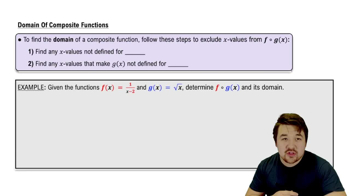
Domain Restrictions of Composed Functions
Square Root Function
A square root function, denoted as √(x), is defined only for non-negative values of x. This means that the expression inside the square root must be greater than or equal to zero. In the context of the given function g(x), the condition x - 2 ≥ 0 must be satisfied, which directly influences the domain of the function.
추천 영상:
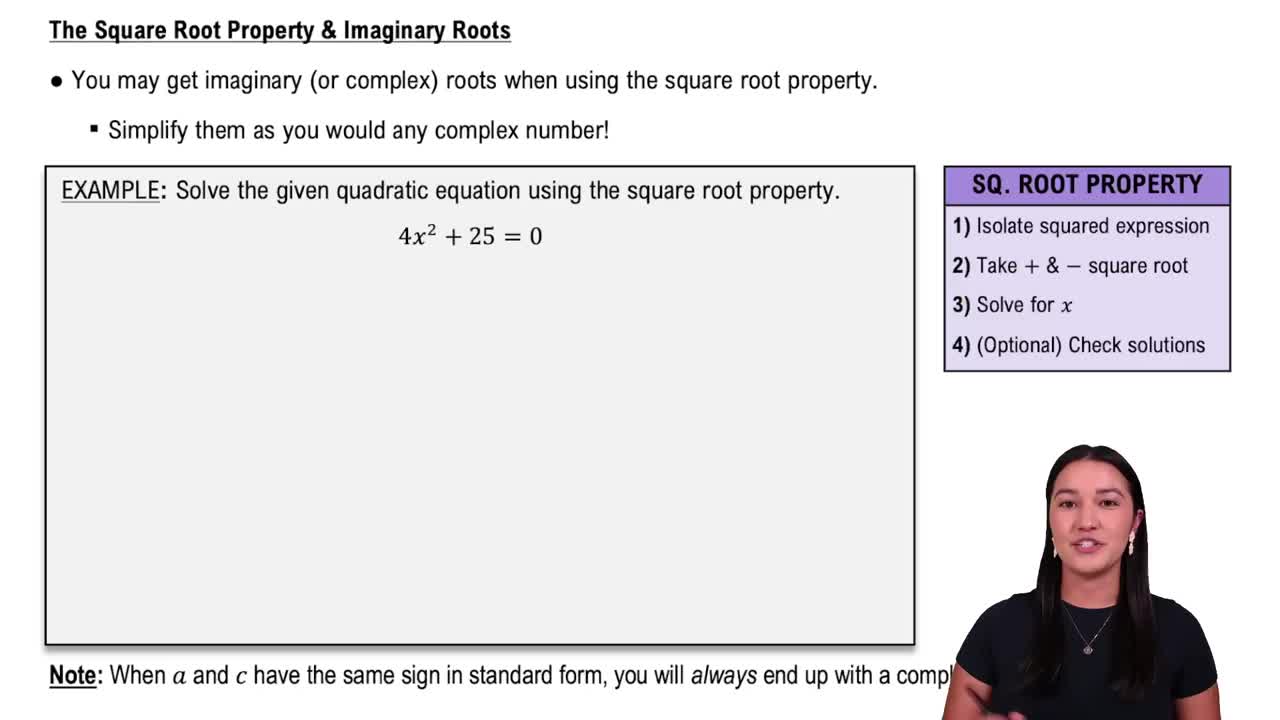
Imaginary Roots with the Square Root Property
Rational Function
A rational function is a function that can be expressed as the ratio of two polynomials. In the case of g(x), the denominator (x - 5) cannot be zero, as this would make the function undefined. Therefore, identifying values that make the denominator zero is essential for determining the domain, as these values must be excluded from the set of possible inputs.
추천 영상:
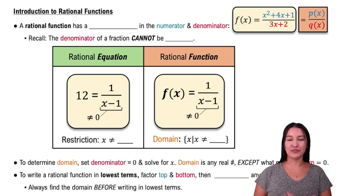
Intro to Rational Functions
관련 실천
교과서 질문
98
views
교과서 질문
In Exercises 27–38, evaluate each function at the given values of the independent variable and simplify.f(x)=4x+5 c. f(-x)
117
views
교과서 질문
Find the midpoint of each line segment with the given endpoints. (8, 3√5) and (−6, 7√5)
808
views
교과서 질문
The functions in Exercises 11-28 are all one-to-one. For each function, a. Find an equation for f-1(x), the inverse function. b. Verify that your equation is correct by showing that f(ƒ-1 (x)) = = x and ƒ-1 (f(x)) = x. f(x) = (2x +1)/(x-3)
599
views
교과서 질문
In Exercises 27–38, evaluate each function at the given values of the independent variable and simplify.f(x)=4x+5 b. f(x + 1)
962
views
교과서 질문
Determine whether each equation defines y as a function of x. |x|- y = 5
1000
views