In Exercises 107–108, write the standard form of the equation of the circle with the given center and radius. Center (-2. 4), r = 6
Ch. 2 - Functions and Graphs

3장, 문제 112
Begin by graphing the cube root function, f(x) = ∛x. Then use transformations of this graph to graph the given function. g(x) = (1/2)∛(x-2)
검증된 단계별 안내1
Start by graphing the parent function f(x) = ∛x. This is the cube root function, which has a characteristic shape. The graph passes through the origin (0, 0), is symmetric about the origin, and increases slowly for positive x and decreases slowly for negative x.
Identify the transformations applied to the parent function to obtain g(x) = (1/2)∛(x-2). The transformations include a horizontal shift, a vertical compression, and a vertical scaling.
The term (x-2) inside the cube root indicates a horizontal shift to the right by 2 units. This means the graph of f(x) = ∛x will be shifted 2 units to the right.
The coefficient (1/2) outside the cube root represents a vertical compression by a factor of 1/2. This means the y-values of the graph will be scaled down by half, making the graph appear 'flatter.'
Combine these transformations: Start with the graph of f(x) = ∛x, shift it 2 units to the right, and then compress it vertically by a factor of 1/2. Plot the resulting graph to visualize g(x) = (1/2)∛(x-2).

비슷한 문제에 대한 검증된 영상 답변:
이 영상 해법은 위 문제에 도움이 된다고 튜터들이 추천한 것입니다.
영상 길이:
6m도움이 되었나요?
주요 개념
질문에 올바르게 답하기 위해 반드시 이해해야 하는 핵심 개념들은 다음과 같습니다.
Cube Root Function
The cube root function, f(x) = ∛x, is a fundamental mathematical function that returns the number whose cube is x. It is defined for all real numbers and has a characteristic S-shaped curve that passes through the origin (0,0). Understanding its basic shape and properties, such as its domain and range, is essential for graphing and transforming the function.
추천 영상:
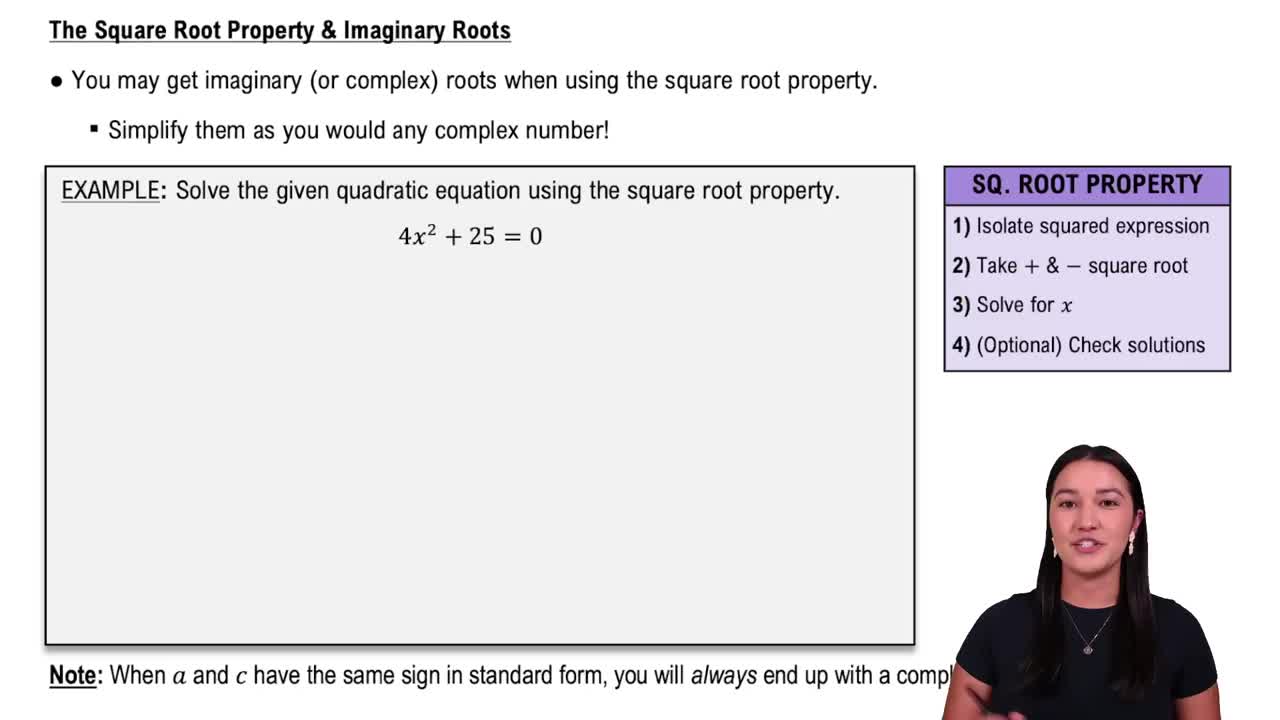
Imaginary Roots with the Square Root Property
Transformations of Functions
Transformations of functions involve shifting, stretching, compressing, or reflecting the graph of a function. For example, the function g(x) = (1/2)∛(x-2) includes a horizontal shift to the right by 2 units and a vertical compression by a factor of 1/2. Mastery of these transformations allows one to manipulate the graph of the original function to create new functions.
추천 영상:
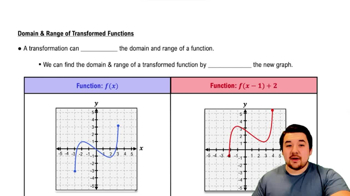
Domain & Range of Transformed Functions
Graphing Techniques
Graphing techniques involve plotting points and understanding the behavior of functions to create accurate representations of their graphs. This includes identifying key features such as intercepts, asymptotes, and end behavior. For the cube root function and its transformations, knowing how to apply these techniques is crucial for visualizing the changes made by the transformations.
추천 영상:
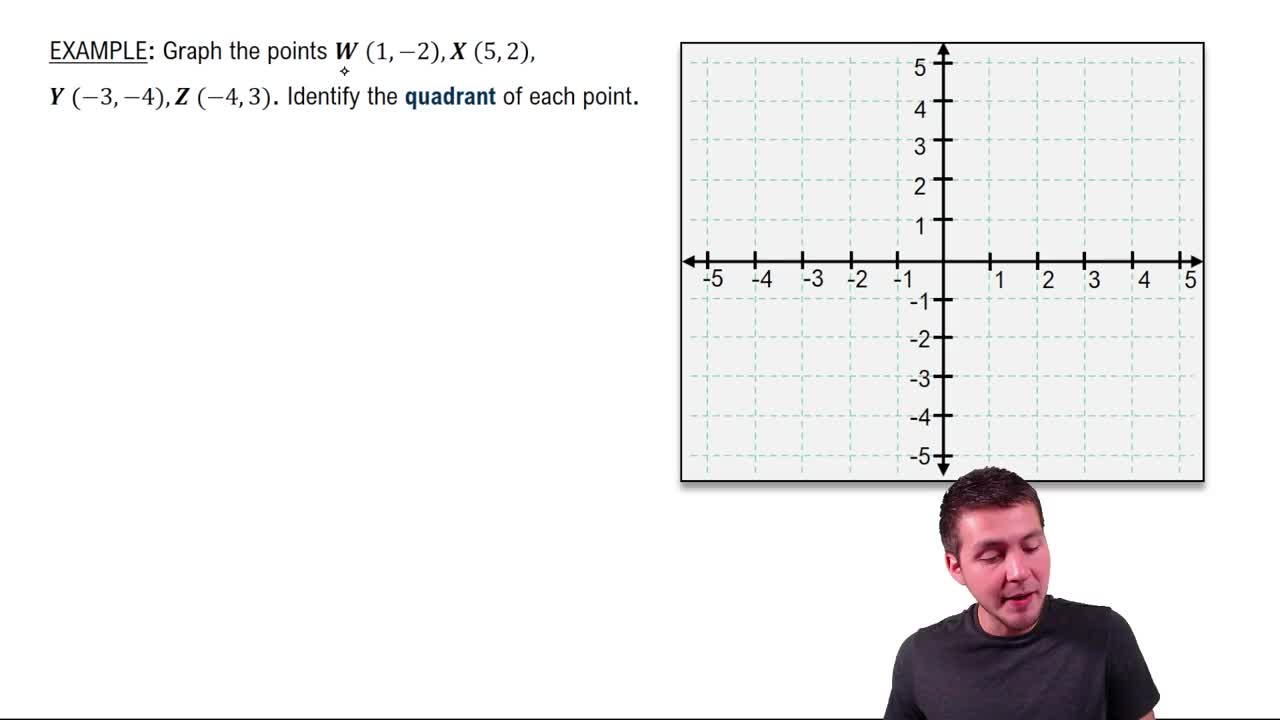
Graphs and Coordinates - Example
관련 실천
교과서 질문
925
views
교과서 질문
Begin by graphing the cube root function, f(x) = ∛x. Then use transformations of this graph to graph the given function. ∛(-x-2)
976
views
교과서 질문
In Exercises 109–111, give the center and radius of each circle. x^2 + y^2 - 4x + 2y - 4 = 0
627
views
교과서 질문
Begin by graphing the cube root function, f(x) = ∛x. Then use transformations of this graph to graph the given function. g(x) = ∛(x-2)
1451
views
교과서 질문
Begin by graphing the cube root function, f(x) = ∛x. Then use transformations of this graph to graph the given function. -∛(x+2)
1315
views
교과서 질문
Begin by graphing the cube root function, f(x) = ∛x. Then use transformations of this graph to graph the given function. g(x) = (1/2)∛(x+2) - 2
846
views