Ch. 2 - Functions and Graphs
Blitzer - College Algebra 8th Edition
Blitzer8th EditionCollege AlgebraISBN: 9780136970514당신이 사용하는 게 아니라요?교과서 변경
3장, 문제 25

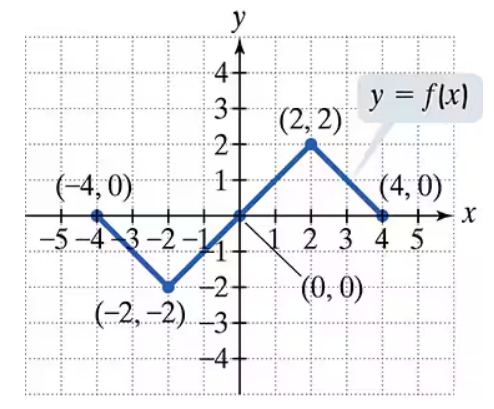
Use the graph of y = f(x) to graph each function g.

g(x) = f(-x)+1

검증된 단계별 안내
1
Step 1: Understand the transformation g(x) = f(-x) + 1. This involves two transformations: (1) Reflect the graph of f(x) across the y-axis (due to f(-x)), and (2) Shift the resulting graph upward by 1 unit (due to +1).
Step 2: Reflect the graph of f(x) across the y-axis. For each point (x, y) on the graph of f(x), replace x with -x to obtain the new coordinates (-x, y). For example, the point (2, 0) becomes (-2, 0), and the point (0, -8) remains unchanged as (-0, -8).
Step 3: Shift the reflected graph upward by 1 unit. For each point (-x, y) on the reflected graph, add 1 to the y-coordinate to obtain the new coordinates (-x, y+1). For example, the point (-2, 0) becomes (-2, 1), and the point (0, -8) becomes (0, -7).
Step 4: Plot the transformed points on the graph. Use the new coordinates obtained from the reflection and upward shift to plot the graph of g(x). Ensure the shape of the graph remains consistent with the original function f(x).
Step 5: Verify the transformation by checking key points and the overall behavior of the graph. Ensure that the graph of g(x) correctly represents the transformations applied to f(x).

비슷한 문제에 대한 검증된 영상 답변:

이 영상 해법은 위 문제에 도움이 된다고 튜터들이 추천한 것입니다.
영상 길이:
3m
도움이 되었나요?

주요 개념

질문에 올바르게 답하기 위해 반드시 이해해야 하는 핵심 개념들은 다음과 같습니다.

Function Transformation

Function transformations involve altering the graph of a function through shifts, stretches, or reflections. In this case, the function g(x) = f(-x) + 1 represents a reflection of f(x) across the y-axis followed by a vertical shift upward by 1 unit. Understanding these transformations is crucial for accurately graphing the new function based on the original.
추천 영상:
4:22
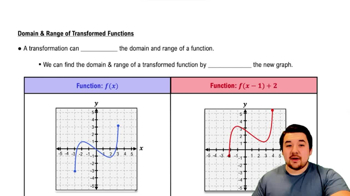
Domain & Range of Transformed Functions

Reflection Across the Y-Axis

Reflecting a function across the y-axis means that for every point (x, y) on the graph of f(x), there is a corresponding point (-x, y) on the graph of f(-x). This transformation changes the sign of the x-coordinates while keeping the y-coordinates the same, which is essential for determining the new positions of points when graphing g(x).
추천 영상:
5:00
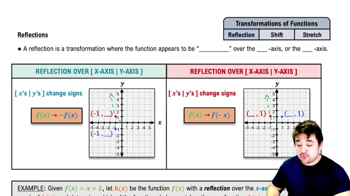
Reflections of Functions

Vertical Shift

A vertical shift involves moving the entire graph of a function up or down without altering its shape. In the function g(x) = f(-x) + 1, the '+1' indicates that every point on the graph of f(-x) is moved up by one unit. This shift affects the y-coordinates of all points, which is important for accurately plotting the final graph of g.
추천 영상:
5:34
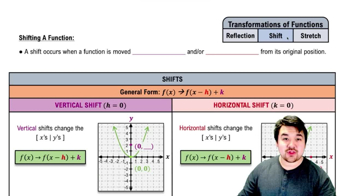
Shifts of Functions