Ch. 2 - Functions and Graphs
Blitzer - College Algebra 8th Edition
Blitzer8th EditionCollege AlgebraISBN: 9780136970514당신이 사용하는 게 아니라요?교과서 변경
3장, 문제 45a

Find ƒ+g and determine the domain for each function. f(x)= = 8x/(x - 2), g(x) = 6/(x+3)

검증된 단계별 안내
1
Step 1: Understand the problem. You are tasked with finding the sum of two functions, f(x) and g(x), which is denoted as (f + g)(x). This means you need to add the two given functions: f(x) = 8x / (x - 2) and g(x) = 6 / (x + 3).
Step 2: Write the expression for (f + g)(x). This is done by adding the two functions: (f + g)(x) = (8x / (x - 2)) + (6 / (x + 3)).
Step 3: Find a common denominator for the two fractions. The denominators are (x - 2) and (x + 3). The least common denominator (LCD) is the product of these two terms: (x - 2)(x + 3).
Step 4: Rewrite each fraction with the common denominator. Multiply the numerator and denominator of the first fraction by (x + 3), and the numerator and denominator of the second fraction by (x - 2). This gives: (f + g)(x) = [(8x)(x + 3) / ((x - 2)(x + 3))] + [(6)(x - 2) / ((x - 2)(x + 3))].
Step 5: Combine the fractions into a single fraction. Add the numerators together while keeping the common denominator: (f + g)(x) = [(8x)(x + 3) + (6)(x - 2)] / ((x - 2)(x + 3)). Simplify the numerator by expanding and combining like terms. Finally, determine the domain by excluding any x-values that make the denominator zero, which are x = 2 and x = -3.

비슷한 문제에 대한 검증된 영상 답변:

이 영상 해법은 위 문제에 도움이 된다고 튜터들이 추천한 것입니다.
영상 길이:
6m
도움이 되었나요?

주요 개념

질문에 올바르게 답하기 위해 반드시 이해해야 하는 핵심 개념들은 다음과 같습니다.

Function Addition

Function addition involves combining two functions, f(x) and g(x), to create a new function, denoted as (f + g)(x). This is done by adding the outputs of the two functions for the same input x, resulting in (f + g)(x) = f(x) + g(x). Understanding this concept is crucial for solving the problem as it requires calculating the sum of the given functions.
추천 영상:
4:46
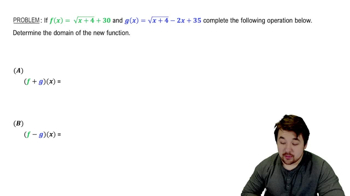
Adding & Subtracting Functions Example 1

Domain of a Function

The domain of a function is the set of all possible input values (x) for which the function is defined. For rational functions like f(x) and g(x), the domain is restricted by values that make the denominator zero. Identifying these restrictions is essential to determine the valid inputs for the combined function (f + g).
추천 영상:
3:51
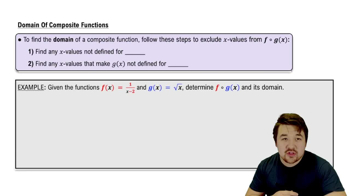
Domain Restrictions of Composed Functions

Rational Functions

Rational functions are expressions formed by the ratio of two polynomials. In this case, f(x) = 8x/(x - 2) and g(x) = 6/(x + 3) are both rational functions. Understanding their behavior, particularly how to handle discontinuities and asymptotes, is important for accurately finding the domain and performing operations like addition.
추천 영상:
6:04
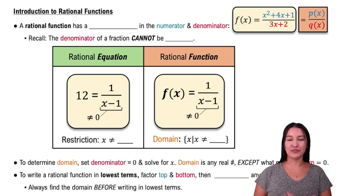
Intro to Rational Functions