Ch. 2 - Functions and Graphs
Blitzer - College Algebra 8th Edition
Blitzer8th EditionCollege AlgebraISBN: 9780136970514당신이 사용하는 게 아니라요?교과서 변경
3장, 문제 63

In Exercises 59-64, let f(x) = 2x - 5 g(x) = 4x - 1 h(x) = x² + x + 2. Evaluate the indicated function without finding an equation for the function. g (f[h (1)])

검증된 단계별 안내
1
Step 1: Start by evaluating the innermost function, h(1). Substitute x = 1 into h(x) = x² + x + 2. This means you calculate h(1) = (1)² + (1) + 2.
Step 2: Use the result from h(1) as the input for the next function, f(x). Substitute the value of h(1) into f(x) = 2x - 5. This means you calculate f(h(1)) = 2(h(1)) - 5.
Step 3: Use the result from f(h(1)) as the input for the next function, g(x). Substitute the value of f(h(1)) into g(x) = 4x - 1. This means you calculate g(f(h(1))) = 4(f(h(1))) - 1.
Step 4: Combine all the results step by step, ensuring each function is evaluated correctly before moving to the next.
Step 5: The final result is g(f(h(1))). You now have the steps to evaluate the indicated function without finding an explicit equation for the composite function.

비슷한 문제에 대한 검증된 영상 답변:

이 영상 해법은 위 문제에 도움이 된다고 튜터들이 추천한 것입니다.
영상 길이:
3m

주요 개념

질문에 올바르게 답하기 위해 반드시 이해해야 하는 핵심 개념들은 다음과 같습니다.

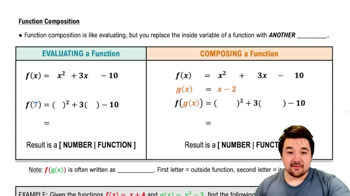
Function Composition

Function composition involves combining two functions where the output of one function becomes the input of another. In this case, we need to evaluate g(f[h(1)]), meaning we first find h(1), then use that result as the input for f, and finally use the output of f as the input for g. Understanding how to properly nest functions is crucial for solving such problems.
추천 영상:
4:56
Function Composition

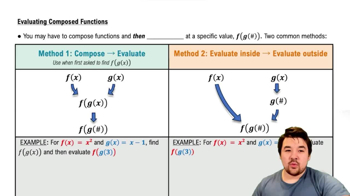
Evaluating Functions

Evaluating a function means substituting a specific value into the function's equation to find the output. For example, to evaluate h(1) for the function h(x) = x² + x + 2, we replace x with 1, resulting in h(1) = 1² + 1 + 2 = 4. This step is essential for determining the values needed for further function evaluations.
추천 영상:
4:26
Evaluating Composed Functions

Linear vs. Quadratic Functions

Linear functions, like f(x) = 2x - 5 and g(x) = 4x - 1, have a constant rate of change and graph as straight lines, while quadratic functions, such as h(x) = x² + x + 2, have a variable rate of change and graph as parabolas. Recognizing the differences between these types of functions helps in understanding their behavior and how to manipulate them during evaluations.
추천 영상:
3:18
Permutations vs. Combinations