
교과서 질문
In Exercises 64–66, begin by graphing the square root function, f(x) = √x. Then use transformations of this graph to graph the given function. r(x) = 2√(x + 2)
1558
views


 검증된 단계별 안내
 4:56
4:56
 05:10 05:10
In Exercises 64–66, begin by graphing the square root function, f(x) = √x. Then use transformations of this graph to graph the given function. r(x) = 2√(x + 2)
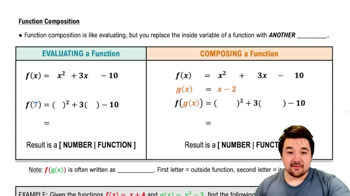
Find a. (fog) (x) b. (go f) (x) c. (fog) (2) d. (go f) (2).
f(x) = 1/x, g(x)= 1/x
Begin by graphing the standard quadratic function, f(x) = x². Then use transformations of this graph to graph the given function. h(x) = (1/2) (x − 1)² – 1
A line segment through the center of each circle intersects the circle at the points shown. a. Find the coordinates of the circle's center. b. Find the radius of the circle. c. Use your answers from parts (a) and (b) to write the standard form of the circle's equation.
Let f(x) = 2x - 5 g(x) = 4x - 1 h(x) = x² + x + 2. Evaluate the indicated function without finding an equation for the function. f(g[h (1)])
In Exercises 64–66, begin by graphing the square root function, f(x) = √x. Then use transformations of this graph to graph the given function. g(x) = √(x + 3)