Ch. 2 - Functions and Graphs
Blitzer - College Algebra 8th Edition
Blitzer8th EditionCollege AlgebraISBN: 9780136970514당신이 사용하는 게 아니라요?교과서 변경
3장, 문제 97

Begin by graphing the standard cubic function, f(x) = x3. Then use transformations of this graph to graph the given function. g(x) = (x − 3)3

검증된 단계별 안내
1
Start by recalling the standard cubic function f(x) = x³. This function has a characteristic S-shaped curve, passing through the origin (0, 0), with symmetry about the origin. The graph increases to the right and decreases to the left.
Understand the transformation applied to f(x) = x³ to obtain g(x) = (x − 3)³. The term (x − 3) indicates a horizontal shift. Specifically, the graph of f(x) = x³ is shifted 3 units to the right.
To graph g(x) = (x − 3)³, take each key point on the graph of f(x) = x³ (e.g., (-1, -1), (0, 0), (1, 1), etc.) and shift it 3 units to the right. For example, the point (0, 0) on f(x) becomes (3, 0) on g(x).
Sketch the new graph by connecting the shifted points smoothly, maintaining the same S-shaped curve as the original cubic function. Ensure the graph still increases to the right and decreases to the left, with the inflection point now at (3, 0).
Label the graph of g(x) = (x − 3)³ clearly, and verify that the transformation has been applied correctly by checking a few additional points. For example, if x = 4, g(4) = (4 − 3)³ = 1³ = 1, so the point (4, 1) should be on the graph.

비슷한 문제에 대한 검증된 영상 답변:

이 영상 해법은 위 문제에 도움이 된다고 튜터들이 추천한 것입니다.
영상 길이:
4m
도움이 되었나요?

주요 개념

질문에 올바르게 답하기 위해 반드시 이해해야 하는 핵심 개념들은 다음과 같습니다.

Cubic Functions

A cubic function is a polynomial function of degree three, typically expressed in the form f(x) = ax³ + bx² + cx + d. The graph of a cubic function can exhibit various shapes, including inflection points and changes in direction. Understanding the basic shape of the standard cubic function, f(x) = x³, is essential for recognizing how transformations affect its graph.
추천 영상:
4:56
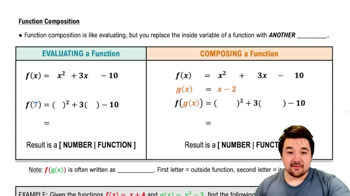
Function Composition

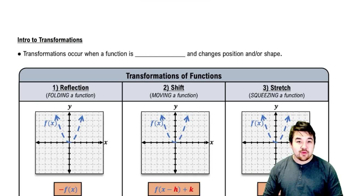
Graph Transformations

Graph transformations involve shifting, reflecting, stretching, or compressing the graph of a function. For example, the transformation g(x) = (x - 3)³ represents a horizontal shift of the standard cubic function f(x) = x³ to the right by 3 units. Mastery of these transformations allows students to manipulate and graph functions based on their parent functions.
추천 영상:
5:25
Intro to Transformations

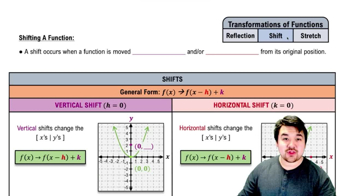
Horizontal Shifts

A horizontal shift occurs when the graph of a function is moved left or right along the x-axis. In the function g(x) = (x - 3)³, the '-3' indicates a shift to the right by 3 units. Understanding horizontal shifts is crucial for accurately graphing transformed functions and predicting their behavior based on the original function.
추천 영상:
5:34
Shifts of Functions