
교과서 질문
Find a. (fog) (x) b. the domain of f o g.
f(x) = x² + 4, g(x) = √(1 − x)
883
views

 검증된 단계별 안내
 06:08
06:08
 5:26
5:26 02:16
02:16Find a. (fog) (x) b. the domain of f o g.
f(x) = x² + 4, g(x) = √(1 − x)
Begin by graphing the square root function, f(x) = √x. Then use transformations of this graph to graph the given function. g(x) = 2√(x+1)
Begin by graphing the square root function, f(x) = √x. Then use transformations of this graph to graph the given function. h(x)=√(-x+1)
Express the given function h as a composition of two functions ƒ and g so that h(x) = (fog) (x).
h(x) = (3x − 1)4
Find the slope of the line passing through each pair of points or state that the slope is undefined. Assume that all variables represent positive real numbers. Then indicate whether the line through the points rises, falls, is horizontal, or is vertical. (-a, 0) and (0, -b)
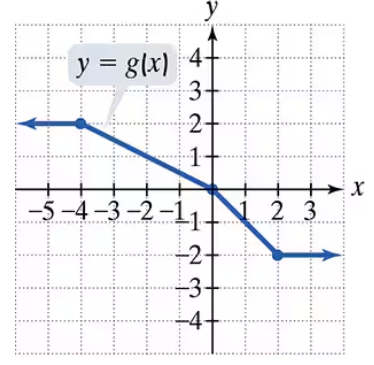
Use the graph of g to solve Exercises 71–76.
For what value of x is g(x) = -1?