Solve each rational inequality in Exercises 43–60 and graph the solution set on a real number line. Express each solution set in interval notation. x/(x + 2) ≥ 2
Ch. 3 - Polynomial and Rational Functions

4장, 문제 60
Find the inverse of f(x) = x3 + 2
검증된 단계별 안내1
Start with the function given: \(f(x) = x^3 + 2\). To find the inverse, replace \(f(x)\) with \(y\), so we have \(y = x^3 + 2\).
Swap the variables \(x\) and \(y\) to begin finding the inverse function. This gives the equation \(x = y^3 + 2\).
Solve the equation \(x = y^3 + 2\) for \(y\). Begin by isolating the cubic term: subtract 2 from both sides to get \(x - 2 = y^3\).
Next, take the cube root of both sides to solve for \(y\): \(y = \sqrt[3]{x - 2}\).
Finally, express the inverse function using function notation: \(f^{-1}(x) = \sqrt[3]{x - 2}\).

비슷한 문제에 대한 검증된 영상 답변:
이 영상 해법은 위 문제에 도움이 된다고 튜터들이 추천한 것입니다.
영상 길이:
2m도움이 되었나요?
주요 개념
질문에 올바르게 답하기 위해 반드시 이해해야 하는 핵심 개념들은 다음과 같습니다.
Inverse Functions
An inverse function reverses the effect of the original function, meaning if f maps x to y, then its inverse maps y back to x. To find the inverse, you swap the roles of x and y and solve for y. The inverse exists only if the function is one-to-one.
추천 영상:
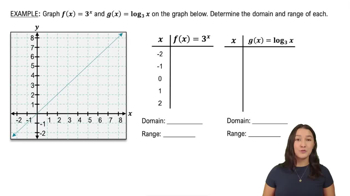
Graphing Logarithmic Functions
One-to-One Functions
A function is one-to-one if each output corresponds to exactly one input, ensuring the function passes the horizontal line test. This property is essential for the existence of an inverse function, as it guarantees that the inverse will also be a function.
추천 영상:
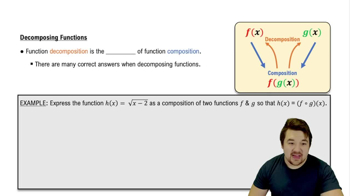
Decomposition of Functions
Solving Equations Involving Cubes
To find the inverse of f(x) = x^3 + 2, you need to solve for x in terms of y by isolating the cubic term and then taking the cube root. Understanding how to manipulate and solve cubic equations is crucial for expressing the inverse function explicitly.
추천 영상:
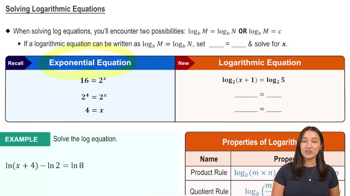
Solving Logarithmic Equations
관련 실천
교과서 질문
579
views
교과서 질문
Find the domain of each function.
589
views
교과서 질문
In Exercises 57–64, find the vertical asymptotes, if any, the horizontal asymptote, if one exists, and the slant asymptote, if there is one, of the graph of each rational function. Then graph the rational function. r(x) = (x^2 + 4x + 3)/(x + 2)^2
693
views
교과서 질문
Among all pairs of numbers whose sum is 16, find a pair whose product is as large as possible. What is the maximum product?
1351
views
교과서 질문
Solve each rational inequality in Exercises 43–60 and graph the solution set on a real number line. Express each solution set in interval notation. (x - 2)/(x + 2) ≤ 2
460
views
교과서 질문
Follow the seven steps to graph each rational function. f(x)=2x2/(x2−1)
32
views