Ch. 3 - Polynomial and Rational Functions
Blitzer - College Algebra 8th Edition
Blitzer8th EditionCollege AlgebraISBN: 9780136970514당신이 사용하는 게 아니라요?교과서 변경
4장, 문제 21

In Exercises 17–24, a) List all possible rational roots. b) List all possible rational roots. c) Use the quotient from part (b) to find the remaining roots and solve the equation. 6x3+25x2−24x+5=0

검증된 단계별 안내
1
Identify the polynomial given: \(6x^{3} + 25x^{2} - 24x + 5 = 0\).
For part (a), list all possible rational roots using the Rational Root Theorem. The possible roots are of the form \(\pm \frac{p}{q}\), where \(p\) divides the constant term (5) and \(q\) divides the leading coefficient (6). So, list all factors of 5 and 6, then form all possible fractions.
For part (b), test each possible rational root from part (a) by substituting into the polynomial or using synthetic division to find which one is an actual root. Once a root is found, perform synthetic division to divide the polynomial by \((x - r)\), where \(r\) is the root found, to get the quotient polynomial.
For part (c), use the quotient polynomial from part (b), which will be a quadratic, and solve it using factoring, completing the square, or the quadratic formula to find the remaining roots.
Combine all roots found (the rational root from part (b) and the roots from the quadratic in part (c)) to write the complete solution set for the equation.

비슷한 문제에 대한 검증된 영상 답변:

이 영상 해법은 위 문제에 도움이 된다고 튜터들이 추천한 것입니다.
영상 길이:
6m
도움이 되었나요?

주요 개념

질문에 올바르게 답하기 위해 반드시 이해해야 하는 핵심 개념들은 다음과 같습니다.

Rational Root Theorem

The Rational Root Theorem helps identify all possible rational roots of a polynomial equation by considering factors of the constant term and the leading coefficient. These possible roots are expressed as ±(factors of constant term) / (factors of leading coefficient). This theorem narrows down candidates for testing actual roots.
추천 영상:
가이드 코스
04:06
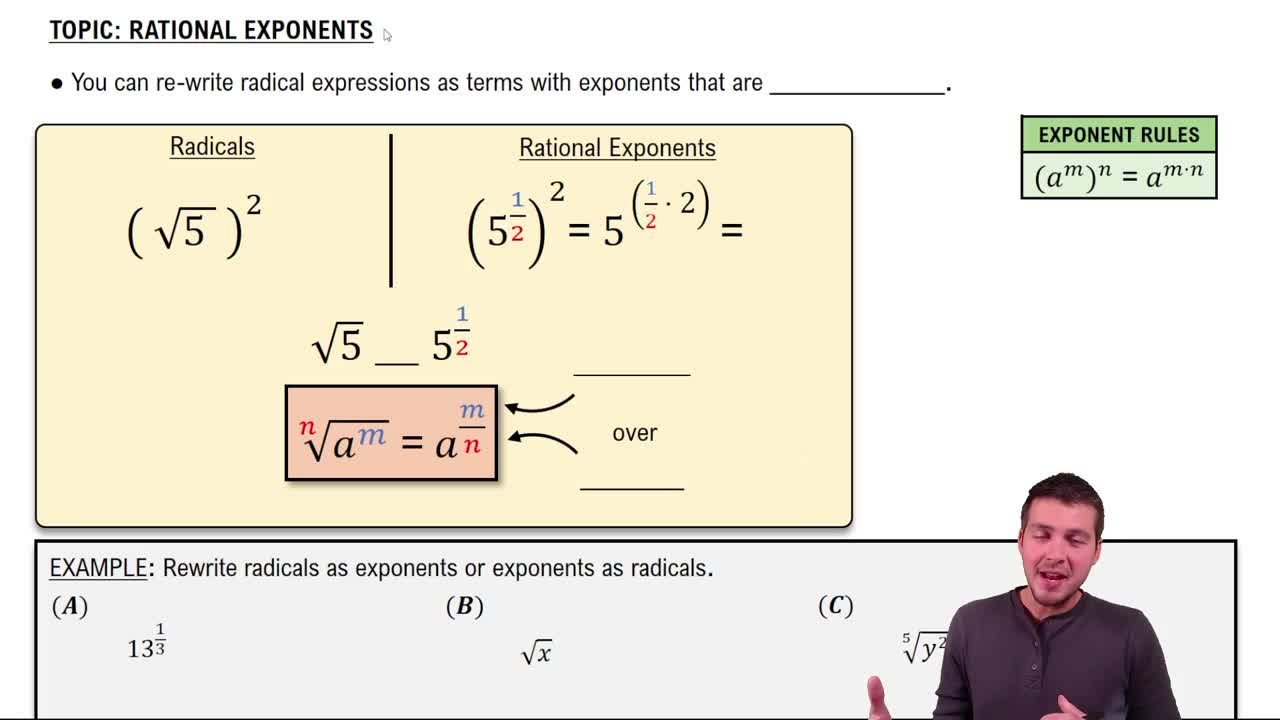
Rational Exponents

Polynomial Division (Synthetic or Long Division)

Polynomial division is used to divide a polynomial by a binomial of the form (x - r), where r is a root. This process simplifies the polynomial to a lower degree, making it easier to find remaining roots. Synthetic division is a shortcut method often used for this purpose.
추천 영상:
가이드 코스
07:30
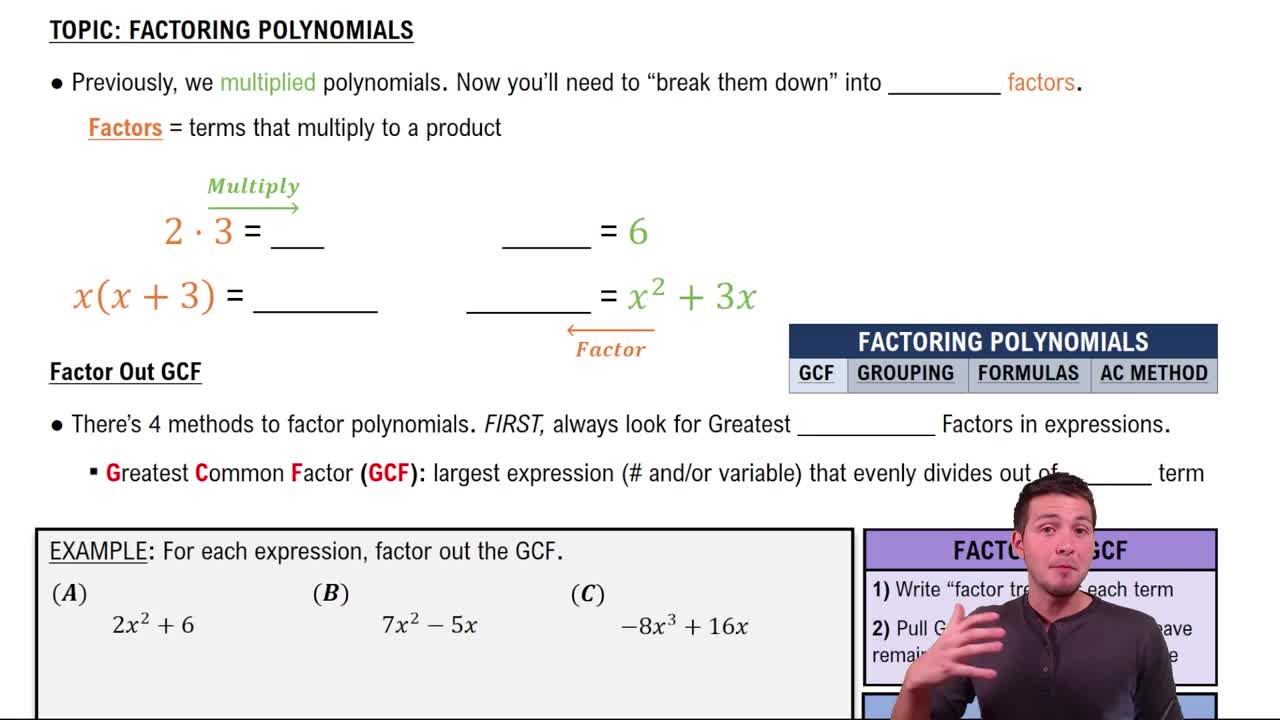
Introduction to Factoring Polynomials

Solving Polynomial Equations

After factoring or dividing the polynomial, solving the resulting lower-degree polynomial or quadratic equation involves finding roots using factoring, quadratic formula, or other algebraic methods. These roots, combined with previously found roots, give the complete solution set.
추천 영상:
5:02
Solving Logarithmic Equations